Low-temperature carbonization
Unpack the process, pilot plants and historical economics.
Start here / 7 minute read
The 1933 Utah Cannel Coal Thesis and the Larsen–Stutz Plant Design
These two studies concern the low-temperature carbonization method associated with Lewis Cass Karrick, but they were written by other authors. The evidence reviewed here shows that the first capture is not a Karrick-authored dossier but a 1933 University of Utah thesis by S. C. Jacobsen and G. W. Carter, and that the second is a plant-design study by Larsen and Stutz. Karrick appears in both as the originator of the low-temperature carbonization (LTC) method being tested, not as the author of the documents.
The source text supplies the verified author identities, the thesis table of contents, the cannel-coal definition the thesis quotes, and the historical coal-oil industry context. It also records what the reviewed excerpts do not contain: the test results, heat calculations and yield figures that the thesis places in its later sections.
The two native sources
| Identity | URL | What it is |
|---|---|---|
| [source note 4] | [source note 5] | Jacobsen & Carter, Engineering Factors Relating to the Utilization of the Cannel Coals of Southern Utah, thesis submitted to the Faculty of the University of Utah, 15 May 1933 |
| [source note 6] | [source note 7] | Larsen & Stutz, Design of Plant for Low Temperature Carbonization Treatment of Utah Coal by Karrick Process |
Both are hosted in the Karrick subdirectory of the source archive, which is why the archive's framing had been read as a single-inventor record. The evidence scope for this source text is Jev-reviewed retrieved passages, not complete source coverage; the full originals remain in the native raw source library.
The 1933 thesis: scope and structure
The thesis is titled Engineering Factors Relating to the Utilization of the Cannel Coals of Southern Utah. Its frontispiece is described as "The Great White Throne (showing members contiguous to the cannel coal measures)" and is not included in the capture. The table of contents is preserved verbatim below; it is the only structured content in the reviewed excerpts.
1. Acknowledgement
2. Introduction
3. Cannel Coal
4. Utah's Cannel Coal Deposit
5. Object of Plant Tests
6. Description of Apparatus
7. General Test Procedure
8. Description of Individual Tests
9. Heat Calculation for Test Run # 6
10. Discussion of Results
11. Summary
12. Bibliography
Sections 1, 2 and 4 are marked "[Not included here]" in the capture. The reviewed excerpts cover sections 3, 5 and the opening of section 6. Sections 8, 9 and 10 — the individual test descriptions, the heat calculation for test run #6, and the discussion of results — are not present in the excerpt set. Any yield figure, operating temperature or residence time would live in those sections, and none is asserted here.
What the thesis says about cannel coal
Section 3 defines the feedstock by quoting two authorities rather than reporting the authors' own measurements.
Ashley (reference 11) is quoted describing cannel coal as:
"a massive, non-caking, tough, clean block coal of fine, even, compact grain, dull luster, commonly conchoidal cross fracture, having a low fuel ration, a high percentage of hydrogen, easy ignition, long yellow flame, black to brown greasy streak, and moderate ash, which is pulvurent in burning. It is essentially a rock derived by solidification and partial distillation or oxidation of water-laid deposits consisting of or containing large quantities of plant spores and pollen grains and more or less comminuted remains of low orders of water plants and animals".
David White (reference 12), writing on his microscopical study of the Utah cannel coal, is quoted as finding "very little if any vestiges of the cell structures of higher plants", the fuel being made up largely of "lemon-yellow, more or less lenticular, or globular, translucent bodies embedded in a brownish black groundmass".
The thesis then states the generally accepted origin distinction: bituminous coals resulted from woody materials, whereas cannel coals appear to have formed from decayed spores, pollen, leaves and cuticle material. Those waxy ingredients are given as the reason for the high oil yield possible from most cannel coals — "usually two to three times the yield from bituminous coals" — and the same organic constituents are said to be largely responsible for the oil obtainable from oil shales. This is a reported claim citing Ashley and White, not an original measurement by Jacobsen and Carter.
The thesis also records the fuel's practical character: cannel coal is adapted to the common uses of bituminous coal except coke manufacture, is described as an ideal and long-accepted "deluxe" fireplace fuel, burns without disintegration and therefore smokes less than high-volatile bituminous coal, and was used extensively in the eastern USA for coal gas enrichment because of its high volatile content and the high candle power of those volatiles.
Historical coal-oil context
Section 3 carries a historical passage on the pre-petroleum coal-oil industry. As early as 1846 oil was manufactured from coals; by 1860, the year the thesis gives for the first real discovery of petroleum, there were 55 coal-oil plants operating in the US, the largest with a distilling capacity of 6000 barrels of oil per day. Kerosene (coal oil), light lubricants, greases and wax are named as the principal refined products, with gasoline having no market value at that time. Most plants were in Pennsylvania, Kentucky and West Virginia, with one large plant in Boston. The principal cannel coal deposits are listed as Pennsylvania, Kentucky, West Virginia, Indiana, Ohio, Tennessee, Missouri, Iowa, Arkansas, Texas and Utah. These are historical assertions, not test results.
Object of the plant tests and the Karrick method
Section 5 states that a 1932 visit to the cannel coal deposit established that it was extensive and accessible enough to large markets by truck and rail to justify early development, and that the coal's superiority for domestic fuel and as a source of road oil and motor fuel motivated a study of processing the slack coal. The study was planned to examine both the heat requirements of treating the coal and the products formed.
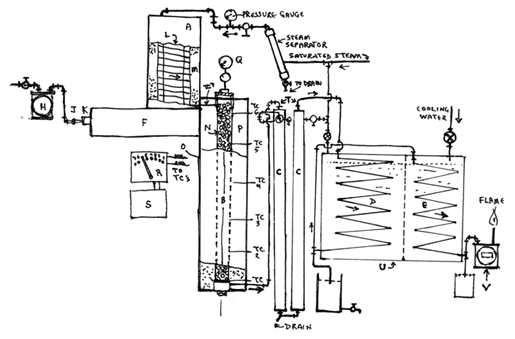
The thesis states that advantage was taken of 1920 studies of this coal by the State of Utah and the Federal Government, in which laboratory processing data were obtained (reference 9) and by which "excellent yields and quality of oil were obtained". The destructive distillation method used steam as the heat-transferring fluid: exhaust steam from power plant engines or turbines was superheated and then passed directly through bodies of sized, dust-free coal. The thesis identifies this method as the Karrick LTC Process (reference 13), notes it had subsequently been developed for commercial uses (reference 5) and appeared to have many advantages, and states that it was adapted for the thesis study of the cannel coal.
The design objectives for the test apparatus are given as minimizing radiated heat losses under all processing conditions, and taking temperature and heat-flow data throughout the coal charges and the apparatus so that products obtained could be correlated with the most economical use of heat.
The thesis closes section 5 by noting that the coal-treating method used "is one of a group being offered to the Utah Research Foundation [by Lewis C. Karrick]". This is the point at which Karrick enters the document: as the originator of the offered method, not as its author.
Apparatus and the figure
Section 6 states that a small distilling plant was constructed for the investigation, and that Figures 2 and 3 are respectively a schematic plant layout and a photograph of the test setup. Only Figure 2 is reproduced in the capture, as jacarfig.gif.
The second source: Larsen and Stutz
The second capture, [source note 6], is titled Design of Plant for Low Temperature Carbonization Treatment of Utah Coal by Karrick Process and is attributed to Larsen and Stutz. Only the title and source URL are present in the reviewed evidence; no body text, figures or design data from this document were retrieved. It is recorded here as a related primary document on the same process and feedstock, and its content should not be inferred from the title alone.
Evidence status and limits
The reviewed excerpts establish the scope, method and framing of the 1933 thesis. They do not establish its results. Specifically:
- No yield figures, product analyses, operating temperatures or residence times appear in the excerpts; those belong to sections 8–10, which are not included.
- The "two to three times the yield from bituminous coals" figure is a reported claim attributed to Ashley and White, not a measurement by the thesis authors.
- The 55 plants and 6000 barrels per day figures are historical assertions about the 1860 US coal-oil industry.
- The Karrick process is described in the thesis as having been developed for commercial uses, citing references 5 and 13; those references are not reproduced here.
- The Larsen and Stutz document is present only as a title.
The archive's broader framing of LTC as a suppressed competitor to petroleum-derived liquid fuel is not supported or refuted by these excerpts; it is recorded as framing. See Karrick Claims vs. Evidence: The Dossier's Assertions and the Absence of Test Data for the standing comparison of Karrick dossier claims against available evidence.
Related work
- Low-Temperature Carbonization (LTC) — the process class the thesis tests.
- karrick-process — the named variant, using superheated steam as heat-transfer fluid.
- cannel-coal — the feedstock and its spore/pollen origin.
- Coal Carbonization vs. Coal Liquefaction — route comparison.
- Lewis Cass Karrick — originator of the offered method.
- s-c-jacobsen, g-w-carter — thesis authors.
- larsen-and-stutz — authors of the plant-design study.
- university-of-utah — host institution of the thesis.
Source notes & attribution
- S. C. Jacobsen and G. W. Carter, Engineering Factors Relating to the Utilization of the Cannel Coals of Southern Utah , thesis submitted to the Faculty of the University of Utah, 15 May 1933. Native source: rexresearch/5a6e8e4a6f35263c.md ; https://rexresearch.com/karrick/1jacar.htm
- Larsen and Stutz, Design of Plant for Low Temperature Carbonization Treatment of Utah Coal by Karrick Process . Native source: rexresearch/d7457570dbc786b7.md ; https://rexresearch.com/karrick/1larstz.htm
- Figure 2, jacarfig.gif , reproduced from the Jacobsen & Carter capture.
- rexresearch/5a6e8e4a6f35263c.md
- https://rexresearch.com/karrick/1jacar.htm
- rexresearch/d7457570dbc786b7.md
- https://rexresearch.com/karrick/1larstz.htm
- https://rexresearch.com/karrick/karric.htm
- https://rexresearch.com/karrick3/karrick3.htm
- https://rexresearch1.com/CoalMiningLibrary/karrick/1jacar.htm
- https://rexresearch1.com/CoalMiningLibrary/karrick/1larstz.htm
- https://rexresearch.com/karrick/1ketch.htm
- https://rexresearch.com/karrick2/kltcusp.htm
- https://rexresearch.com/ketchum/1ltcre.htm
Go deeper.
30 further articles5 min
Karrick / KLTCUSP Capture: A Patent-and-Figure Dossier for Low-Temperature Carbonization
This is a source capture of the page karrick2/kltcusp.htm , filed in the archive's low-temperature-carbonization (LTC) folder. Unlike the earlier Karrick dossiers in the corpus, which carried explanatory prose about the process, this page is primarily a figure-and-patent dossier : it presents a set of GIF images, most of which a
4 min
Karrick Process Dossier (Third Capture): Low-Temperature Carbonization at the source archive
This is a source dossier on low-temperature carbonization (LTC) of coal, organized around the Karrick process and its namesake, Lewis Cass Karrick . The source identity ( karrick3/karrick3.htm , folder context "dossier 10 — Low-temperature carbonization") places it as the third Karrick page in the source archive collection.
4 min
Karrick Page 1jacar.htm: A Third source Capture in the Coal Mining Library
This is a source capture of a page filed as 1jacar.htm , held under the site's Coal Mining Library path in a karrick/ sub-folder. It is the third Karrick-related item ingested into Bench, following Karrick Process and Low-Temperature Carbonization: A source Dossier (Provisional Record) (Karrick Process and Low-Temperature Carbon
4 min
Karrick Process and Low-Temperature Carbonization
This page records a source dossier on low-temperature carbonization (LTC) of coal and oil shale, organized around the Karrick process and its namesake, Lewis Cass Karrick , an engineer associated with the United States Bureau of Mines in the early twentieth century. The dossier sits in the archive's "dossier 10 — Low-temperature
4 min
Karrick Process Dossier (Fourth Capture): Low-Temperature Carbonization at the source archive
This page records a fourth capture of the source dossier on the karrick-process and Low-Temperature Carbonization (LTC) (LTC). It is a variant-provenance record, not a new body of evidence. The underlying subject — Lewis Cass Karrick's low-temperature carbonization work at the US Bureau of Mines , as described in a 1932 Universi
4 min
Karrick Process Dossier (Second Ingestion): Low-Temperature Carbonization at the source archive
This page records a second source file covering the same subject matter as the earlier Karrick dossier: the low-temperature carbonization (LTC) of coal associated with Lewis Cass Karrick and the US Bureau of Mines . The file is a compilation of article text, patent references and three images ( karrick1.gif , karrick2.gif , karr
3 min
Ketchum 1ltcre.htm
This record covers a source page captured from the URL [source note 3]. The page is a full-text reproduction of R. Ketchum, et al., Low Temperature Carbonization of Utah Coals , a report of the Utah Conservation & Research Foundation to the Governor & State Legislature (May 1939). It is a Ketchum-authored treatment of Low-Temper
3 min
Karrick Page 1ketch.htm: An Empty source Capture in the Coal Mining Library
This record documents a source capture of a substantial 1932 report. The imported file [source note 5] contains the full text of Richard Ketchum's "Feasibility of a Pilot Plant for Treating Coal by the Karrick Process," a report to the Joint Smoke Abatement Committee dated October 28, 1932. The source URL is [source note 6].
8 min
Karrick's Coal Retort US2165143A: Sloping Supports, Steam Circuits and Size-Dependent Deformation
US2165143A describes a vertical retort for the continuous low-temperature carbonization of intermediate-sized coal — the pea, nut and egg grades that sit awkwardly between dust and large lumps. Lewis C. Karrick's argument is that these sizes can be devolatilized in a tall column without the charge either fusing into an unworkabl
7 min
Karrick's Gasification Patent US1901170: Continuous Water Gas, the Heated Tube and the Reported Yields
US1901170, "Gasification of Carbonaceous Material," was granted to Lewis Cass Karrick of Salt Lake City, Utah, on 14 March 1933. It is a divisional of an earlier application, Serial No. 144,947, filed 29 October 1926; the divisional itself was filed 20 December 1927 as Serial No. 241,287. The patent describes a continuous proces
6 min
Karrick’s 1933 Utah test plant: reading the process schematic
This source text resolves the identity of jacarfig.gif , an image referenced by the source capture of the Karrick dossier page 1jacar.htm . The image is not an isolated or decorative graphic. It is Figure 2 of a thesis-style report on processing Utah cannel coal, and it is explicitly captioned in the surrounding text as "a schem
5 min
Low-Temperature Carbonization (LTC)
Low-temperature carbonization is the thermal treatment (destructive distillation / pyrolysis) of coal or oil shale at temperatures below those used in conventional coking — broadly in the 450–700 °C range — to drive off volatile matter and leave a solid char or semi-coke, together with a condensable tar/oil fraction and a combus
4 min
Karrick Process
The Karrick process is a named low-temperature carbonization (LTC) route for coal, associated with Lewis Cass Karrick and documented in a source dossier. It heats coal below conventional coking temperatures to drive off volatiles, leaving a solid char together with condensable tar/oil and a combustible gas stream.
3 min
Karrick Dossier Figures: Captioned Schematics and Uncaptioned Images
The source archive Karrick dossier carries several images, and they are not documented to the same degree. Three of them — karrick1.gif , karrick2.gif and karrick3.gif — appear in the karric.htm capture as bare image references with no captions and no accompanying quantitative content. A fourth, jacarfig.gif , belongs to the Jac
2 min
Lewis Cass Karrick
Lewis Cass Karrick is an American fuel technologist and twentieth-century engineer for whom the karrick-process is named. The process is a low-temperature carbonization route for converting coal into char, tar/oil and gas. He is the central subject of a source dossier in the archive's low-temperature carbonization grouping.
2 min
Coal Carbonization vs. Coal Liquefaction
Coal conversion routes differ in what they optimize. Carbonization heats coal to drive off volatiles and leave a solid residue; liquefaction and hydrogenation aim primarily at liquid products.
2 min
Karrick Claims vs. Evidence: The Dossier's Assertions and the Absence of Test Data
This page separates what the source dossier on the karrick-process asserts from what the ingested material actually supports. It follows the pattern established for other archive dossiers in this wiki, such as Bedini Claims vs. Evidence: The Patents, the Inventor's Disclaimers and the Absence of an Energy Balance and E-Cat Claim
2 min
Karrick Patent Set (Seven US Patent Drawings in the KLTCUSP Capture)
The karrick2/kltcusp.htm capture reproduces eight GIF images, seven of which are named with bare seven-digit numbers. In this archive's convention, such filenames denote US patent numbers, and the images are the corresponding patent drawings. This page consolidates those seven references into a single record rather than creating
1 min
NTU Retort (Rifle-Coal Retort Design in the Karrick Dossier)
The NTU retort is the Nevada-Texas-Utah retort design referenced by the diagram filenames in the third the source archive Karrick capture: nturifleco.jpg and nturetortrifleco.jpg . The source caption identifies these as the NTU retorts at the US Bureau of Mines Oil-Shale Demonstration Plant, Rifle, Colorado, with an aerial view
1 min
US Bureau of Mines
The US Bureau of Mines (also referred to as the United States Bureau of Mines ) was a federal agency that conducted research on mineral resources, mining safety, and fuel technology.
1 min
Karrick Process
The Karrick process is a named variant of Low-Temperature Carbonization (LTC) attributed to the engineer Lewis Cass Karrick . It is the central subject of the source dossier ingested as [source note 1].
1 min
KLTCC (Abbreviation in the Karrick Dossier Image Set)
KLTCC is an abbreviation that appears in two image filenames attached to the third the source archive Karrick capture: kltccogen.jpg and kltc-rtrt.jpg . It is recorded here as a named identifier only.
1 min
Byproduct Recovery in Carbonization
Byproduct recovery is the economic claim structure that carbonization advocates rely on: a single coal feed yields several saleable streams, so viability rests on the combined value of the products rather than on any one of them.
1 min
1ketch.htm — Karrick Subdirectory Page on the source archive
1ketch.htm is the filename of a page in the Karrick subdirectory of the source archive, at the URL [source note 1]. The page carries Richard Ketchum's 1932 report to the Joint Smoke Abatement Committee, "Feasibility of a Pilot Plant for Treating Coal by the Karrick Process."
1 min
Ketchum
Ketchum is the surname attached to the source archive author directory, ketchum/ , which hosts R. Ketchum, et al., Low Temperature Carbonization of Utah Coals , a report of the Utah Conservation & Research Foundation to the Governor & State Legislature (May 1939), at [source note 2]. The page is recorded in this wiki as 1ltcre.h
1 min
1ltcre.htm — Ketchum Low-Temperature Carbonization Page on the source archive
1ltcre.htm is a page on the source archive site, located at [source note 6] inside the ketchum/ author directory. It reproduces R. Ketchum, et al., Low Temperature Carbonization of Utah Coals , a report of the Utah Conservation & Research Foundation to the Governor & State Legislature (May 1939).
1 min
Coal Liquefaction
Coal liquefaction is the conversion of solid coal into liquid hydrocarbon products. It is the broader category within which the karrick-process and Low-Temperature Carbonization (LTC) sit.
1 min
Coal Tar
Coal tar is the condensable liquid fraction produced when coal is subjected to Destructive Distillation . In the context of Low-Temperature Carbonization (LTC) and the karrick-process, it is the liquid product stream that the source dossier counts toward its claimed oil yield.
1 min
Semi-Coke
Semi-coke (also called char) is the solid carbon-rich residue left after the volatile fraction of coal or oil shale has been driven off by Destructive Distillation . It is the solid co-product of Low-Temperature Carbonization (LTC) and, by extension, of the karrick-process as described in the source dossier.
1 min
Destructive Distillation
Destructive distillation is the thermal decomposition of a solid organic material — coal, oil shale, wood, or similar — in the absence or near-absence of oxygen. Because combustion is suppressed, the material does not burn; instead it breaks down into volatile and solid fractions.
The visual record.
28 archived figures · open to inspectThe source room.
Everything readable here stays on StrangewellArchived texts preserve what the source said. They may contain historical, speculative, or promotional claims; inclusion is not verification.
Source text38 min
S. Jacobsen & G. Carter: Engineering Factors Relating to Utilization of Cannel Coal of Utah (Karrick Low Temperature Carbonization)
Frontispiece: The Great White Throne (showing members contiguous to the cannel coal measures) [Not included here]
33 min
Larsen & Stutz: Design of Plant for Low Temperature Carbonization Treatment of Utah Coal by Karrick Process
Low Temperature Carbonization (LTC) of coal is not new. A great deal of scientific and technological work has been done on this form of coal processing in Germany, England, and USA. It is closely allied with the principles embodied in the industries which produce oil shale in Scotland and Australia. The subject began to receive
24 min
Lewis Karrick: Low Temperature Carbonization of Coal
America has been called the Saudi Arabia of Coal because it contains 28% of Earth's known reserves, enough to last more than a thousand years. Coal accounts for 90% of our national energy reserves, but only 30% of our energy consumption. Coal is a logical target for a national effort to achieve energy independence. The envi
1 min
Lewis C. Karrick -- Low Temperature Carbonization (LTC) of Coal
Aerial View: Crushing Plant at right; Shale Storage Bins between Crushing Plant and Retorts
39 min
S. Jacobsen & G. Carter: Engineering Factors Relating to Utilization of Cannel Coal of Utah (Karrick Low Temperature Carbonization)
Frontispiece: The Great White Throne (showing members contiguous to the cannel coal measures) [Not included here]
33 min
Larsen & Stutz: Design of Plant for Low Temperature Carbonization Treatment of Utah Coal by Karrick Process
Low Temperature Carbonization (LTC) of coal is not new. A great deal of scientific and technological work has been done on this form of coal processing in Germany, England, and USA. It is closely allied with the principles embodied in the industries which produce oil shale in Scotland and Australia. The subject began to receive
20 min
Richard Ketchum: Karrick Low Temeprature Carbonization Pilot Plant Feasibility Study (1932)
As per your verbal request at your meeting March 30, 1932, we are submitting the following report relative to plans and estimates for a pilot plant to treat coal by the Karrick Process.
1 min
Lewis C.Karrick: US Patents ~ Low Temperature Carbonization of Coal
USP # 1,958,918 Process of Destructively Distilling Solid Carbonaceous Material (May 15, 1934)
218 min
Ketchum: Review of Low Temperature Carbonization Processes [ Karrick, Hayes, Rexco, NFC &c.]
A Report of the Utah Conservation & Research Foundation to the Governor & State Legislature ( May 1939 )
Supporting documents (12)
“Captured” means saved for research; a full reading guide may still be pending.
Keep following.
Thematic connections, not evidence of a shared mechanism36 / Matter & materials
Flash Joule heating
Trace the pulse-heating process from papers to applications.
↗22 / Energy & machines
The steam generator
Separate the machine, test reports and efficiency interpretation.
↗26 / Energy & machines
The superclassical heat engine
A proposed cycle, a patent and the thermodynamic questions.
↗