US1901170, "Gasification of Carbonaceous Material," was granted to Lewis Cass Karrick of Salt Lake City, Utah, on 14 March 1933. It is a divisional of an earlier application, Serial No. 144,947, filed 29 October 1926; the divisional itself was filed 20 December 1927 as Serial No. 241,287. The patent describes a continuous process in which granular or pulverized carbonaceous material is carried through an externally heated tube by a stream of steam, so that the steam acts both as the transport medium and as the reagent that converts the solid carbon into water gas. It sits alongside Karrick's better-known carbonization work in the same patent family, but it addresses gasification rather than the retorting of coal into liquid and solid products.
The core mechanism
The process reduces coal, coke or similar material to a granular or pulverized state fine enough to be conveyed by a flowing steam current. The particles are fed into a heated tube of extended length and restricted cross-section, where they travel with the steam and are heated in contact with it until little or no solid matter remains except ash. Karrick states that all combustible matter in the feed can be converted to gaseous form, leaving only ash and small quantities of low-quality condensible volatiles.
The feedstock determines the product. With coke, the result is blue water gas, separated from excess steam in a cooler or condenser after the ash has been removed. With coal, the coal's volatiles are added, with some decomposition, to the water gas formed from the fixed carbon, giving carburetted water gas. Karrick attributes the degree of carburation to the ratio of hydrocarbon volatile to fixed carbon in the coal, to some extent to the coal's chemical nature, and to how much water gas is formed relative to the volatiles present. He notes that coal may be distilled and its coke separated in one apparatus and the coke then gasified in a second, hotter unit, or that both steps may be carried out in a single apparatus.
Preventing sticking and condensation
Two operating problems are addressed explicitly. The first is the tendency of some coals to become sticky on heating, which would cause particles to agglomerate in the tube. Karrick proposes two remedies: a pretreatment in the presence of oxygen or carbon dioxide, used alone or mixed with steam, or introduction of the coal into steam superheated so strongly that each particle is rapidly coated with a shell of coke before the bulk of the lump softens. He prefers the second route because it avoids diluting the final gas with the pretreatment medium. The second problem is condensation of steam on contact with cold feed; this is handled by preheating the solid material, superheating the steam, or both, so that no condensation occurs at the point of contact.
Pressure staging and heat exchange
A distinctive feature of the design is its use of pressure throughout the system. Because the volatile products form under pressure, the resulting gas can be transmitted long distances without compressors. The hot product gases leaving the gasifier are also used as a heat source: they give up heat to boil water at a lower temperature and pressure, and the steam so raised can supply a second gasifier, or a series of similar units, operating at successively lower pressures. Karrick presents this cascaded heat exchange as a way to recover process heat that would otherwise be lost, and as a reason the volatiles can be condensed in relatively small heat exchangers.
The apparatus as drawn
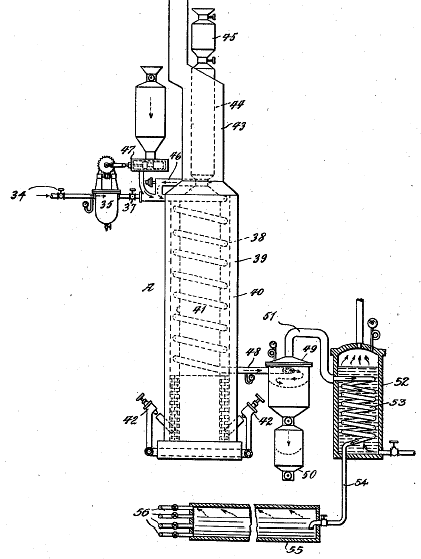
The patent's single figure is a side view, partly in section, of one illustrative arrangement. Steam from a turbine exhaust, an accumulator or another coal-treating unit enters through a valved, heat-insulated main (34), passes a steam separator (35) and a valve (37), and enters the gasifier tube (38). A separate steam supply enters through a valved pipe (87) into a coil (38) occupying the annular space between the heat-insulating outer wall (40) and the core (41) of a furnace setting. Burners (42) at the base heat the coil; combustion gases rise around the coil tubes, heating the lower part most strongly, and leave through a stack (43) that surrounds the feed bin (44), which is supplied by a valved magazine (45). A feeding device (46) controls the rate at which raw fuel enters the tube, and a second device (47) intermittently injects scouring material to remove scale from the inner tube surfaces.
The exit end (48) of the coil leads into a cyclone, heat-insulated dust collector (49) that removes ash from the gas stream, with a double-valved bottom bin (50) for ash removal. An insulated gas outlet (51) carries gases and vapors to a condenser or cooling element (52) that also serves as an evaporator; because the pressure and temperature in the conduit are high, the water in this device yields steam at lower pressure for use in a second coal-treating unit. Condensed vapors, water and uncondensed gases leave through a coil (53) and valved pipe (54) into a separator (55), where material is withdrawn and pressure is reduced. Valved outlet pipes (56) withdraw the uncondensed gases and any condensate, and their valves also regulate pressure throughout the system and allow gas to be delivered at high pressure. Karrick notes that the conduit (51) may instead be connected to a lump-coal carbonizer, so that the hot gases carbonize the coal and are partially cooled before reaching the heat-exchange device (52); that arrangement is described in the parent application, Serial No. 144,947.
In operation, coal, coke or other solid carbonaceous fuel is fed through the magazine (45) into the bin (44), where it is preheated to a chosen temperature, then fed by the device (46) at a controlled rate into the gasifier tube (38) in contact with the steam admitted through valve (37). The suspended or rolling particles move at high velocity through the tube counter to the flow of combustion gases, into zones of increasing temperature.
The claims
The patent's three claims define the process rather than the specific apparatus. The first covers a continuous water-gas process: preheating granular particles in a chamber; periodically delivering material from that chamber into a second, pressurized heating chamber; then continuously discharging the material and passing it at high pressure by means of steam in a generally downward direction through an externally heated tube of extended length and restricted cross-section, at a temperature and for a period sufficient to substantially gasify the carbon constituent. The preheat chamber is held at the working pressure of the second chamber by the medium that maintains pressure there. The second claim specifies a pressure of the order of one hundred pounds per square inch. The third adds the introduction of a scouring material and its passage through the tube.
Reported operating figures
Karrick reports his own operating experience rather than third-party measurements. He states that he used final temperatures from 1350 °F to 1950 °F, and obtained gas with calorific values between 250 and 1050 BTU per cubic foot from Utah coal and between 275 and 525 BTU per cubic foot from its coke. He reports steam velocities carrying the solid material through the tube of 100 to 600 feet per second, and steam pressures from about 100 lb/in² downward, preferably with turbulence. He also states that the gas is generated at pressures high enough for economical long-distance transmission.
These figures are assertions made by the inventor inside the patent. The document supplies no independent replication, no duration for a continuous run, no material balance and no efficiency figures. The drawing by itself does not identify operating conditions or measured yields, and the source page presents it without such annotation. The reported calorific values should therefore be read as the inventor's claims about his own process, not as established performance.
The wider patent listing
The page that carries this patent also lists other Karrick patents in the same low-temperature carbonization family: US1832219 on superheating steam (1931), US1913395 on underground gasification of carbonaceous material (1933), US1919636 on a system of mining oil shales (1933), US1923213 on carbonizing coal (1933), US1938596 on a retort (1933) and US1942650 on coking bituminous liquids (1934). The listing ends with a truncated entry, US1950,5xx, so it is incomplete as a catalogue. That truncation is a limit of the page, not evidence that no further patents exist.
What the source does and does not establish
The patent text is internally consistent: the description and the claims agree, and the apparatus components are described concretely enough to be followed. What the source does not provide is any external check on the process. There is no record here of the Utah coal tests beyond Karrick's own summary, no independent assessment of the pressure-staging efficiency argument, and no comparison with other water-gas processes of the period. The relationship between this gasification patent and Karrick's carbonization retorts is structural rather than demonstrated: the parent application Serial No. 144,947 is referenced as containing the lump-coal carbonizer arrangement, but that parent is not reproduced on this page. Whether it is separately available, and whether any independent record of the reported Utah coal runs survives, remain open questions.
Related material
- entities/lewis-c-karrick — the inventor and assignee.
- concepts/karrick-ltc-process and Low-Temperature Carbonization (LTC) — the carbonization work this patent extends into gasification.
- concepts/cannel-coal — a different Utah feedstock treated elsewhere in the Karrick material.
- entities/utah-research-foundation — the research organization associated with Karrick's coal work.
- Karrick’s 1933 Utah test plant: reading the process schematic — a separate Karrick dossier figure, distinct from the drawing accompanying this patent.
- concepts/fuels and concepts/water — topical guides.
Source notes & attribution
- US1901170, "Gasification of Carbonaceous Material," Lewis Cass Karrick, granted 14 March 1933; original application Serial No. 144,947 filed 29 October 1926; divisional application Serial No. 241,287 filed 20 December 1927.
- Source page: https://rexresearch.com/karrick2/kltcusp.htm
- https://rexresearch.com/karrick2/kltcusp.htm