The superclassical heat engine
A proposed cycle, a patent and the thermodynamic questions.
Start here / 5 minute read
Rauen Superclassical Heat Engine
Introduction
This source is a source dossier devoted to a device called the Rauen Superclassical Heat Engine, attributed to an inventor identified only as Rauen. The page is hosted at [source note 2] and belongs to the same family of inventor dossiers that the source archive maintains across its energy, propulsion and materials sections.
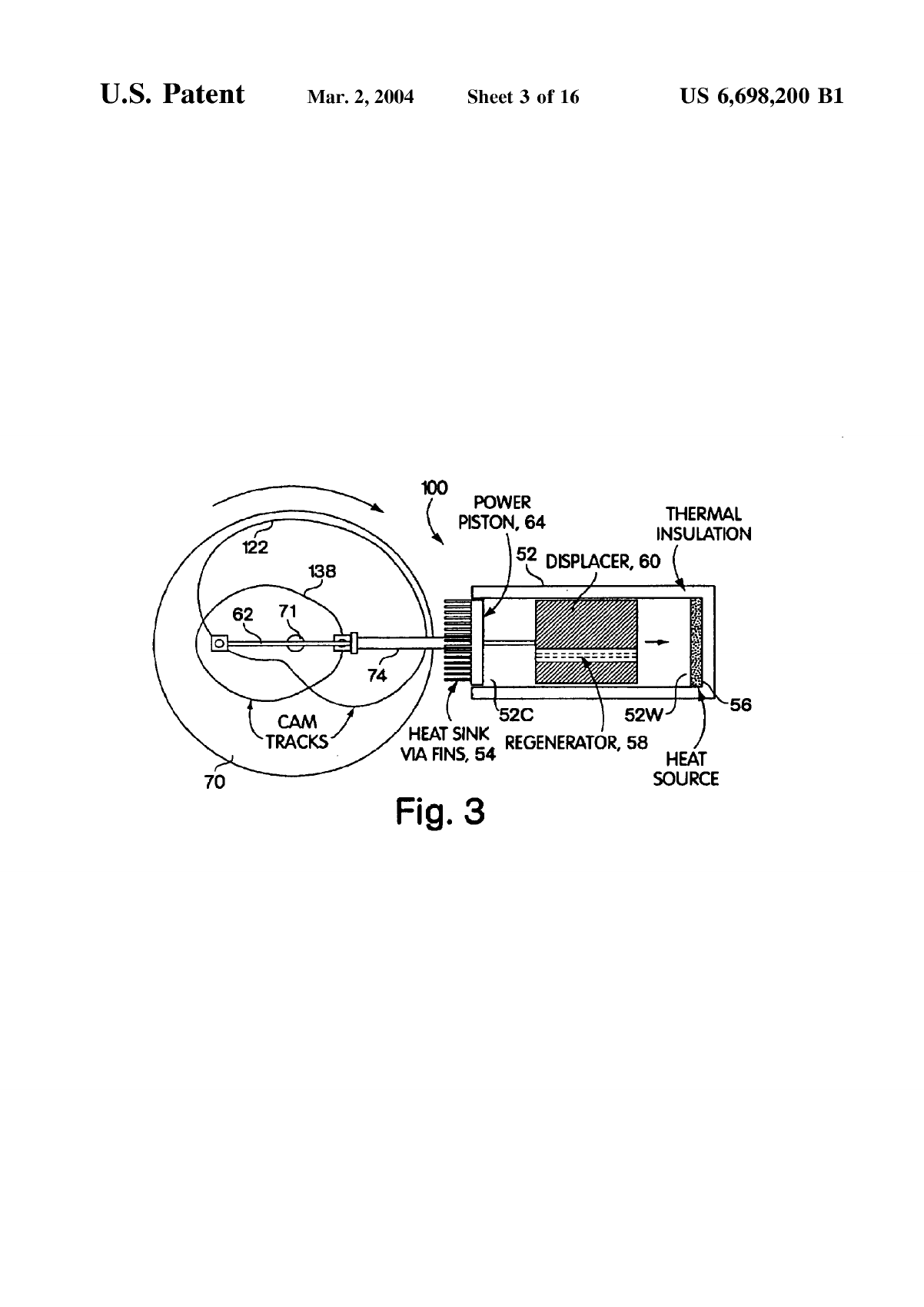
US patent publication; document page 4. Preserved page.
The dossier is short. It presents a named device and a framing term — "superclassical" — rather than a technical paper, a test report or a patent specification. The material available for this article therefore supports a description of what is claimed and how the claim is framed, but not an assessment of whether the device works. That distinction is the central point of this page.
What the device is claimed to be
The subject is a heat engine: a device that converts thermal energy into mechanical work. Heat engines are a well-established category of machine, and their performance is conventionally bounded by the thermodynamic limits worked out in the nineteenth century — most famously the Carnot efficiency, which sets an upper bound on the fraction of heat that can be converted to work between two reservoirs at different temperatures.
The Rauen device is presented under the label "superclassical." The term is the dossier's distinguishing hook. It signals that the inventor frames the engine's operation as lying outside, or beyond, the classical thermodynamic description — that is, as not being governed by the usual efficiency ceiling. The dossier does supply a stated mechanism: the "Proell effect," described as quasi-spontaneous thermal separation achieved by perturbing a heterogeneous constant-volume system with displacement and regeneration, in which a working fluid displaced across a temperature gradient through a regenerative heat exchanger undergoes complementary pressure-volume compression and expansion work. Rauen argues this transfers energy between the regenerator and the bulk gas volumes in a way classical analysis of the constant-volume process does not recognize, and that heat capacity at constant pressure (rather than at constant volume) applies, allowing the Carnot limit to be exceeded in certain cycles.
The "superclassical" framing
"Superclassical" is a self-applied label rather than a term with an established technical definition in thermodynamics. Nothing in the supplied material defines it operationally, states the physical principle it is meant to invoke, or specifies the measurement that would distinguish a superclassical engine from a classical one.
This matters for how the page should be read. A label of this kind is a claim about a category, not a demonstrated result. Without a stated mechanism and a stated measurement protocol, the term cannot be checked against the classical framework it implicitly rejects. It functions as a framing device — it tells the reader that the inventor regards the device as special — but it does not by itself carry evidentiary weight.
What the source actually reports
The dossier, as available, reports:
- the existence of a device named the Rauen Superclassical Heat Engine;
- its attribution to an inventor named Rauen;
- the "superclassical" characterization of its operation.
The dossier does not, on the evidence available, report:
- measured energy input and output figures;
- a stated efficiency, coefficient of performance, or power rating;
- a named test facility, laboratory or independent replicator;
- a peer-reviewed publication or conference paper (the source does cite an AIP Conference Proceedings paper, "The Proell Effect: A Macroscopic Maxwell's Demon," AIP Conf. Proc. 1411, 167 (2011));
- a patent number or filing reference (the source does cite US Patent No. 6,698,200, "Efficiency thermodynamic engine");
- a parts list, bill of materials or dimensional specification.
No structured data — no tables, schematics with labelled values, or code — are present in the supplied material. If the live page contains a diagram, a patent number or a named publication, that detail is not captured here and would need to be transcribed verbatim from the original page.
Observations and evidence
There is no experimental evidence in the supplied material. The only artifact is the archive page itself.
This is a recurring pattern in the source archive corpus: an inventor's own description is preserved as a dossier, sometimes with the archivist's commentary, and the page functions as a pointer to a claim rather than as a record of validation. An archive listing is not proof of effectiveness. Nothing in this source should be read as confirming that the Rauen engine operates as described, and no efficiency figure or replication should be inferred from the page's existence.
The claim, if it implies operation beyond the Carnot bound, stands in tension with the second law of thermodynamics as currently understood. That tension should be noted as a tension — the source does not resolve it, and this article does not assert that the claim is false. It asserts only that the supplied material does not support it.
Limitations and unresolved questions
- Thin provenance. The dossier is the sole artifact. There is no corroborating document in the supplied material.
- Mechanism asserted, not independently verified. The source states a physical principle (the Proell effect) and cites a patent and a conference paper, but supplies no independent measurement or replication.
- No measurement. Without input/output figures or a test protocol, the claim is not falsifiable as presented.
- Attribution boundary. All claims belong to Rauen and to the source dossier. They must not be transferred to other inventors or devices in this wiki — for example Schaeffer (steam generator inventor), Jerome Meyers or Antonio d'Angelo — merely because those are also energy-claim dossiers. Shared dossier format is not shared evidence.
- Open items. The source cites US Patent No. 6,698,200 and an AIP Conference Proceedings paper, but the supplied material does not include the patent specification text or the full paper, so their detailed contents remain unresolved.
Related work
The Rauen dossier sits alongside several structurally similar pages already in this wiki:
- Schaeffer Steam Generator: The source archive Energy Dossier (Provisional Record) — the Schaeffer steam generator dossier, the closest structural analogue: a named device, an inventor's claim, and no independent test data.
- Steam Generator Claim — the claim class associated with Schaeffer.
- Inter-Atomic Ion Energy Claim — d'Angelo's non-classical energy mechanism claim.
- concepts/hho-oxyhydrogen-gas — the Boyce efficiency/excess-energy claim family.
- concepts/energy — the top-level topic guide under which this dossier sits.
- concepts/research-method — how to read an unverified device claim.
The Rauen page extends the wiki's existing pattern of the source archive energy dossiers. It does not strengthen any existing claim, because it supplies no new evidence.
Source notes & attribution
- source dossier: https://rexresearch.com/RauenHeatEngine/RauenSuperclassicalHeat%20Engine.html (native source: rexresearch/4ea4fe9d4a3c5db7.md ).
- https://rexresearch.com/RauenHeatEngine/RauenSuperclassicalHeat%20Engine.html
Go deeper.
4 further articles2 min
Rauen Claims vs. Evidence: An Archive Dossier Without Test Data
This page sets the claims made in the source dossier for the Rauen Superclassical Heat Engine against the evidence the dossier actually supplies. It follows the same structure used for other the source archive energy dossiers in this wiki, so that the evidentiary gap can be compared across cases.
1 min
Superclassical Heat Engine Claim
The superclassical heat engine claim is the assertion, made in the source dossier for Rauen Superclassical Heat Engine , that a heat engine can operate in a manner described as "superclassical" — outside or beyond the classical thermodynamic framework.
1 min
Rauen Superclassical Heat Engine
The Rauen Superclassical Heat Engine is a device described in a source dossier and attributed to the inventor Rauen . It is presented as a heat engine whose operation is characterized as "superclassical" — that is, framed as lying outside the classical thermodynamic description.
1 min
Rauen
Kenneth Rauen (also given as Kenneth M. Rauen) is the inventor named in the source dossier for the Rauen Superclassical Heat Engine . The supplied material gives no dates, nationality or institutional affiliation.
The visual record.
1 archived figures · open to inspectThe source room.
Everything readable here stays on StrangewellArchived texts preserve what the source said. They may contain historical, speculative, or promotional claims; inclusion is not verification.
Source text5 min
Kenneth RAUEN Superclassical Cycle Heat Engine -- Explois the Proell Effect to extract energy from the environment; articles & patent
https://www.youtube.com/watch?v=7lBDve65dAo SSE Talks - Proell Effect, Energy Devices, Maxwell's Demon - Kenneth Rauen // Society for Scientific Exploration
Supporting documents (1)
“Captured” means saved for research; a full reading guide may still be pending.