US2165143A describes a vertical retort for the continuous low-temperature carbonization of intermediate-sized coal — the pea, nut and egg grades that sit awkwardly between dust and large lumps. Lewis C. Karrick's argument is that these sizes can be devolatilized in a tall column without the charge either fusing into an unworkable mass or crumbling into fines, provided two conditions are met: the weight pressing on any individual lump is capped by a series of staggered internal supports, and heat is applied gradually enough that a lump becomes uniformly plastic before it sets. The patent is a design disclosure built around the inventor's own experimental observations on Utah coal, not a report of independently replicated testing.
The problem the design addresses
Karrick frames the difficulty in terms of lump size. Dust and very fine particles behave almost as surface reactions: mass and thickness stop mattering, heat can be applied violently, and the material can be distilled or gasified by steam in a fraction of a second — work he assigns to suspension methods in externally heated tubes, cross-referencing his earlier US1950558 and US1901170. Large lumps sit at the opposite extreme, where the mass factor dominates and the temperature difference between the outside and the interior of a lump governs how the material changes state.
Intermediate sizes inherit neither advantage. They are too coarse for suspension treatment and too small to tolerate the slow, self-limiting heating that a big lump can absorb. Karrick's stated aim is to make this middle band continuously processable.
Gradual heating versus sudden heating
The patent's central physical claim concerns how a lump fails. If a fusing coal is heated slowly, the whole lump reaches a similar temperature at roughly the same time, so it passes through plasticity uniformly and sets as a coherent, dense coke. If the same lump meets a sudden high temperature, the outer shell distils and converts to coke far ahead of the interior; the surface layers change volume while the core is still unaltered, and the lump flakes or falls apart. Karrick reports that 4-inch Utah coal confined under the pressure of contacting lumps and surrounded by 1200 °F steam flaked badly at the surface, while a similar charge brought up gradually stayed substantially intact — though it was deformed somewhat by the expansion of neighbouring lumps.
This is the internal tension of the document: gradual heating preserves the lump, but gradual heating under continuous pressure also lets the mass deform and cohere. The sloping supports are the proposed resolution, capping the load so that deformation stays below the point of agglomeration.
Reported size-dependent deformation thresholds
The most concrete and testable content in the source is a set of column heights at which Utah coal of a given size begins to deform or cohere. Karrick presents these as his own findings for coal from the Mesa Verde formation — a high-oxygen bituminous coal of roughly forty percent volatiles.
| Coal size | Behaviour in 1200 °F steam | Deformation threshold (moving column) |
|---|---|---|
| 4-inch | Surface flaked badly | Not excessively deformed below 20 ft |
| 2-inch | Did not flake badly | Not deformed below 15 ft |
| 1-inch | Less affected by steam contact | Not materially deformed below 10 ft |
| ½-inch | Very little flaking | Deforms and coheres considerably at 6 ft |
| ¼-inch | No disintegration if confined | Coheres at 4 ft moving / barely 2 ft stationary |
| ⅛-inch | No disintegration if confined | Coheres at 1 ft moving / barely 4 in stationary |
The pattern is that smaller particles fuse more readily, because heat penetrates them more evenly and the whole particle reaches a comparable degree of plasticity. Confinement matters as well: the same ¼-inch and ⅛-inch coal coheres at much shorter column heights when the column is stationary rather than moving.
These figures carry no sample sizes, error bounds or replication. They are the inventor's experimental observations on one coal type, and the patent does not claim they generalize to other ranks or formations.
Sloping supports and the clearance rule
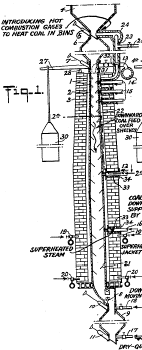
The mechanical core of the retort is a set of substantially flat supports projecting from the side walls partway across the chamber, mounted in staggered relation and angled steeply enough that coal slides off their upper surfaces. They do two jobs: they carry part of the descending column's weight so no lump is crushed or fused by the mass above it, and they repeatedly deflect the distilling lumps as they descend.
Two design rules are stated. The clearance between the lower edge of any support and the opposite wall should be no less than five times the maximum diameter of the largest lumps in the charge; below that, the largest pieces can bridge into a rigid arch and halt the column. The vertical spacing of the supports should be the greatest the coal can bear without disintegrating or agglomerating, since maximum permissible compression yields the densest coke. Where the chamber walls are vertical or only slightly outward-sloping, the spacing should increase from top to bottom, so the channel cross-section grows continuously down the retort.
Steam circuits and internal heating
Steam enters the retort at several levels with distinct purposes. Superheated steam admitted near the bottom of the reaction chamber reacts with the coke already formed in the upper zone to produce water gas; when this line is used, the superheated steam fed higher up may be reduced or shut off entirely. Saturated steam introduced at the bottom of the receiving bin rises counterflow to the hot coke, absorbing its heat, becoming superheated in the process, and dry-quenching the coke while imparting reactive properties. When the bin valve closes briefly for emptying, the saturated steam is routed through an alternate supply pipe.
Near the top of the chamber, coils carrying superheated steam sit beneath the sloping supports. They supply internal radiated or conducted heat to the upper contents and are intended to prevent heavy tar-oils from condensing out of the rising vapour stream. The coils can be connected in series or parallel to govern the temperature gradient and the heat delivered to the upper distilling zone. Spent steam is preferably returned to a second superheater and reintroduced through the upper pipes to react with the coal by direct contact.
External heating, preheating and surface oxidation
The reaction chamber is heated externally by burning gas in flues surrounding it. Multiple burners at different levels along the chamber walls let the operator regulate heat independently at different heights, controlling the temperature profile of the flues.
Combustion gases rising through the flues are routed through insulated pipes and driven by a blower into the bottom of the coal bunker, where they preheat and dry the incoming coal. Karrick reports that preheating the coal to about 400 °F with stack gases leaves very little heavy tar-oil condensing on the coal as it descends through the distilling region. For fusing coals, the hot gases supplemented by air through a branch pipe oxidize the outer surface of the lumps, reducing their tendency to cake or fuse.
Managing thermal expansion
Because the chamber operates hot and gas-tight, the patent devotes attention to letting the metal move without leaking. The lower portion of the chamber, in the hottest zone, is built from chromium–iron alloys or calorized steel; the upper part may be cast steel or calorized steel plate, and the whole chamber is welded or otherwise sealed for pressure operation.
The brickwork is built with clearance so the chamber walls can move laterally as they expand and contract. Vertical movement is handled by a counterweighted beam system: beams resting on fulcrums supported by the brick walls engage lugs fastened near the top of the chamber walls on opposite sides, and a weight at the opposite end of each beam maintains a slight upward tension in the metal of the hottest zone, countering any tendency to warp or sag under the weight of the structure above. The magazine feeding the chamber connects to it through a gas-tight slip-joint that permits vertical expansion without leakage, and a similar slip-joint is provided in the insulated gas pipe. Supply pipes passing through the brickwork are given ample clearance, with the openings sealed by yielding asbestos-yarn bushings held by close-fitting metal discs.
The chain variant
A modified arrangement replaces the fixed sloping supports with one or more continuous flexible members — chains — running from top to bottom of the retort, each carrying laterally projecting portions spaced according to the size and character of the coal being treated. This provides a continuous support for the weight of the descending column rather than a series of discrete ledges.
Evidence and limits
The document is a patent specification. Its quantitative content — the deformation thresholds, the five-times-diameter clearance rule, the 400 °F preheat target, the 1200 °F steam temperature — comes from the inventor's internal testing and is presented without statistical treatment or third-party verification. The thresholds are explicitly tied to Utah Mesa Verde coal, and the patent does not assert that they hold for other ranks or formations. The text refers to Figures 1, 3, 4, 6 and 8. Figure 1 is reproduced here from the archived patent illustration; the other referenced drawings are not reproduced in this article. The absence of additional experimental detail here is not evidence that none exists elsewhere in the record.
Related work
The retort design extends the Karrick process and the broader practice of Low-Temperature Carbonization (LTC) with mechanical and thermal specifics — support geometry, steam routing, expansion management — that sit below the level of a process overview. It adds another patent to the portfolio of Lewis Cass Karrick and cross-references his suspension-distillation patents US1950558 and US1901170. The material context is Utah bituminous coal rather than the cannel coal treated in other Karrick work, and the institutional setting connects to the Utah Research Foundation. Figure references may correspond to the Karrick Dossier Figures: Captioned Schematics and Uncaptioned Images set.
Source notes & attribution
- https://patents.google.com/patent/US2165143A/en