What this capture is
This is a source capture of a page filed as 1jacar.htm, held under the site's Coal Mining Library path in a karrick/ sub-folder. It is the third Karrick-related item ingested into Bench, following Karrick Process and Low-Temperature Carbonization: A source Dossier (Provisional Record) (Karrick Process and Low-Temperature Carbonization) and Karrick Process Dossier (Second Ingestion): Low-Temperature Carbonization at the source archive (Karrick Process Dossier, second ingestion). The numbered filename and the folder placement indicate it belongs to a small series of Karrick pages rather than being a standalone document.
The capture carries two image assets: jacarfig.gif, which appears to be a figure accompanying the text, and 0logo.gif, which is a site logo and is decorative rather than substantive. The advisory audit attached to this capture flags a moderate probability (0.38) that the capture has a problem — thin body text, image-heavy layout, or partial truncation — and registers only a small number of energy-topic signals. That profile is consistent with an archive page whose value lies in its images and its position in a series rather than in a long prose argument.
What can and cannot be stated about the contents
The capture's body text is a transcription of a 1933 University of Utah thesis by S.C. Jacobsen and G.W. Carter, "Engineering Factors Relating to the Utilization of the Cannel Coals of Southern Utah," submitted 15 May 1933. It reports destructive-distillation tests of southern Utah cannel coal using superheated steam as the heat-transfer fluid, following the method associated with Lewis C. Karrick. The article therefore separates what the thesis itself reports from what remains unverified.
Established by the capture's own structure:
- The page is hosted by the source archive under a Coal Mining Library path with a
karrick/sub-folder. - It is one of a numbered series (
1jacar.htm), implying sibling pages. - It includes at least one figure image (
jacarfig.gif) and one site logo (0logo.gif).
Not established by the available material, and therefore not asserted here:
- The thesis reports eight test runs with final superheated-steam temperatures of 535 °C, 650 °C, and 760 °C, saturated steam at 20 psi, and a 50 lb charge per run.
- Reported yields for Test #1 include 1.6 gal crude oil (64 gal/ton), 170 cu ft gas (6800 cu ft/ton), and 23.5 lb residue from 50 lb coal.
- The authors are S.C. Jacobsen and G.W. Carter; the work is a thesis, not a Karrick-authored document, though it cites Karrick's LTC process and patents.
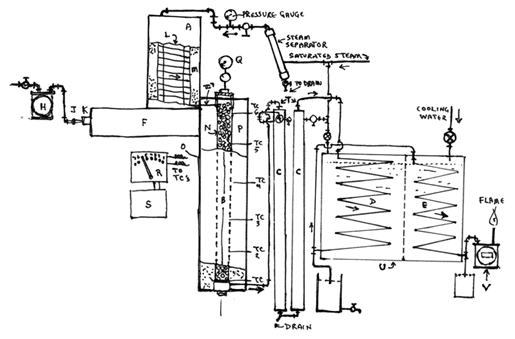
jacarfig.gifis identified in the source as Figure 2, a schematic plant layout showing superheater, retort, and condensers.
Readers should treat this page as a record of an archive item and its placement, not as a source of process data. Any quantitative claim about the karrick-process must come from a capture whose text has been read and preserved.
Where it sits in the Karrick cluster
The subject matter is the karrick-process, Lewis Cass Karrick's variant of Low-Temperature Carbonization (LTC) (LTC). LTC heats coal at roughly 450–700 °C — below normal coking temperatures — to drive off volatiles, leaving Semi-Coke as the solid residue and yielding Coal Tar and gas as the condensable and gaseous fractions. The underlying mechanism is Destructive Distillation: thermal decomposition of organic material in the absence of oxygen. The broader framing, in which the process is presented as a route to liquid fuel from coal, is Coal Liquefaction.
None of those concepts are new to Bench; all are already documented from the two prior Karrick captures. This third capture is significant mainly as a repetition of the same subject across another source page.
Figures
The capture's substantive image is jacarfig.gif, identified in the source text as Figure 2, a schematic plant layout of the test apparatus (gas-fired superheater, coal retort, and condensers):
The second image, 0logo.gif, is the source archive site logo. It is excluded from this article as decorative, consistent with the wiki's guidance against repeated site branding.
Limitations and unresolved questions
Archive-page status. This is a capture record. It documents that a page exists at a given location with given assets; it does not certify the page's contents, and it does not constitute evidence for any performance claim about the Karrick process.
Repetition is not replication. Three Karrick captures now exist in Bench. If they restate the same claims without introducing new primary data, the correct reading is that the archive repeats a subject, not that the subject has been independently corroborated. The existing Karrick Claims vs. Evidence: The Dossier's Assertions and the Absence of Test Data page documents the gap between the dossier's assertions and the absence of test data; this third capture does not close that gap on the available evidence.
Capture quality. The capture is a full transcription of the thesis text, though several sections (Acknowledgement, Introduction, Utah's Cannel Coal Deposit, and the detailed data sheets for Tests #2–#8) are marked "[Not included here]" in the source. The logo image is decorative.
Open questions. Whether the body text names patents, yields, or collaborators not yet in the wiki; whether jacarfig.gif is a diagram, photograph, or chart; and whether the three Karrick captures should be consolidated into a single source article with variant notes or kept as separate records. The current pattern of separate provisional records is internally consistent but may eventually warrant a synthesis page.
Related work
- Karrick Process and Low-Temperature Carbonization: A source Dossier (Provisional Record) — Karrick Process and Low-Temperature Carbonization (first Karrick capture).
- Karrick Process Dossier (Second Ingestion): Low-Temperature Carbonization at the source archive — Karrick Process Dossier (second ingestion).
- Karrick Dossier Figures: Captioned Schematics and Uncaptioned Images — image-entity page for the Karrick dossier figures.
- Karrick Claims vs. Evidence: The Dossier's Assertions and the Absence of Test Data — the cluster's claims-versus-evidence comparison.
- Patent as Evidence — the epistemic status of patents as claims rather than proof, relevant if this capture includes patent text.
Source notes & attribution
- Rex Research, Coal Mining Library, karrick/1jacar.htm (capture: rexresearch/1a8a218d1b326d85.md ). Images: jacarfig.gif , 0logo.gif .
- https://rexresearch1.com/CoalMiningLibrary/karrick/1jacar.htm