Tetrasilver tetroxide
Read the antimicrobial claims alongside their patent record.
Start here / 14 minute read
Marvin Antelman: TetraSilver TetrOxide (TSTO) — Molecular Crystal Devices, Antimicrobial Patents and the AIDS Cure Claim
This source dossier collects material on tetrasilver tetroxide (Ag₄O₄), a mixed-valence silver oxide that the chemist and inventor Marvin Antelman patented as a "molecular crystal device" capable of electrocuting pathogens. The page is a composite: patent abstracts, an independently documented preparation chemistry, a 1995 U.S. EPA efficacy review, a 2010 FDA warning letter, and a commercial advertisement offering the material for sale by the gram. It is a useful case study in how a real, well-characterized inorganic compound can carry a very large and very weakly supported therapeutic claim.
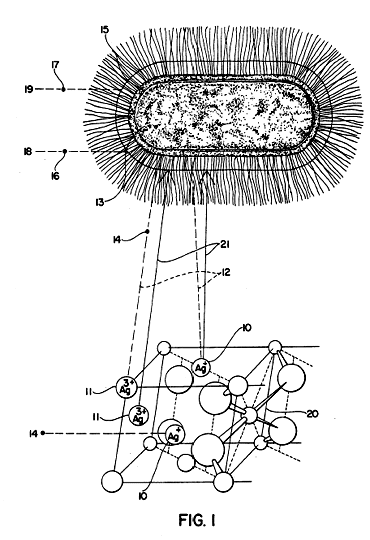
The compound itself is not in dispute. Ag₄O₄ is a dark brown-to-grey-black diamagnetic solid, a component of silver–zinc batteries, and a strong oxidizer. What is in dispute is whether it does what the patents say it does in the human body.
What the compound is
Tetrasilver tetroxide has the empirical formula AgO but is properly formulated as Ag(I)Ag(III)O₂, equivalently Ag₂O·Ag₂O₃. Each formula unit contains two monovalent silver ions and two trivalent silver ions. It is not a peroxide: it contains no O₂²⁻ ion, which is why the older names "silver peroxide" and "silver(II) oxide" are considered incorrect. Silver(III) Chemistry covers the brown Ag³⁺ ion and its hydrolysis to this oxide.
The dossier reproduces structural and physical data from Wikipedia and PubChem:
| Property | Value |
|---|---|
| Chemical formula | Ag₄O₄ / Ag₂O·Ag₂O₃ |
| Molar mass | 123.87 g/mol (as AgO); 495.469 g/mol (as Ag₄O₄⁴⁻, PubChem) |
| Appearance | grey-black powder, diamagnetic |
| Density | 7.48 g/cm³ |
| Melting point | >100 °C, with decomposition |
| Solubility in water | ~0.0027 g/100 mL |
| Solubility | soluble in alkalis |
| CAS numbers | 1301-96-8; 155645-89-9 |
| EPA PC Code | 129097 |
| EPA Registration Number | 3432-64 |
| PubChem CID | 44150047 |
The source explicitly warns that Ag₄O₄ is not to be confused with Ag₂O (silver(I) oxide, CAS 20667-12-3, molar mass 231.74, density 7.14, melting point 280 °C, photosensitive). Both are strong oxidants; both ignite on contact with sulfur, red phosphorus, and antimony or arsenic sulfides. Ag₄O₄ reacts explosively with ammonia and hydrogen peroxide.
The dossier lists the many names under which the material has circulated: silver(II) oxide, silver(I,III) oxide, argentic oxide, Tetrasil, Sildate, Divasil, silver peroxide, silver suboxide, divalent silver oxide, mono-trivalent silver oxide, and tetrasilver tetroxide.
The "molecular crystal device" claim
Antelman's framing is that each Ag₄O₄ crystal is a molecular battery: two Ag(I) and two Ag(III) ions in a diamagnetic semiconducting lattice that, when activated by an oxidizing agent, "fires" electrons at pathogens. The dossier's own summary states the compound "works against pathogens by electrocuting, oxygenating, and chelating the target."
The mechanism is described in three parts, which Antelman groups under the term Electron Jumping Compounds (EJC):
- covalent bonding with the target;
- release of electrical energy ("nano-electrocution") through a reduction/oxidation process;
- release of highly active singlet oxygen.
See Molecular Crystal Device (Electron Jumping Compound) for the full framing, including the claimed oligodynamic ordering that the source calls the "Horsfal series" (conventionally the Horsfall series): Ag₄O₄ > Ag(III) > Ag(II) >> Ag(I).
The power-flux arithmetic
The dossier reproduces Antelman's quantitative argument, and it is worth quoting the numbers because they do not reconcile with each other.
Per molecule, two electrons are released, each with a charge of 4.8 × 10⁻¹⁰ e.s.u., approximately 1.6 × 10⁻¹⁹ coulombs. The EMF for the oxidation of Ag(I) to Ag(II) is given as 1.98 V (≈2.0 V), citing Antelman's own Encyclopedia of Chemical Electrode Potentials (Plenum, 1982), page 88. The power per electron is then:
P = E × I
2.0 × 1.6 × 10^-19 = 3.2 × 10^-19 watts per electron
The patent text (US5336499 / US5571520) instead states the crystals "release electrons equivalent to 6.4 × 10⁻¹⁹ watts per molecule." Antelman then proposes an arbitrary "power flux" metric:
Power Flux = EMF generated per molecule × Concentration × 5
             (EMF = 4.0 volts per molecular device; concentration in PPM)
Note the shift: 2.0 V in the per-electron calculation, 4.0 V in the formula. The dossier presents both without reconciling them. The resulting "power flux to effectuate 100% kills" table is reproduced below as given:
| Organism | Power Flux |
|---|---|
| Escherichia coli | 50.0 |
| Staphylococcus aureus | 50.0 |
| Streptococcus faecalis | 50.0 |
| Streptococcus pyogenes | 50.0 |
| Candida albicans | 50.0 |
| Pseudomonas aeruginosa | 25.0 |
| Micrococcus luteus | 25.0 |
| Staphylococcus epidermidis | 12.5 |
Persulfate activation
A load-bearing part of the claim is that the crystals are inert against pathogens unless activated by an oxidizing agent. Antelman compares this to the surface "etching" required to activate a photovoltaic semiconductor such as copper indium selenide. The activators named are persulfates — from DuPont's Oxone (potassium monopersulfate) to alkali peroxydisulfates — or hydrogen peroxide. See Persulfate Activation.
The dossier reports that persulfates tested alone as a control "failed to exhibit any unilateral antipathogenic activity at the optimum level selected of 10 PPM." Technical-grade TSTO is said to contain trace Oxone as activator and potassium/sodium sulfate as stabilizer.
This activation requirement sits awkwardly beside the dossier's own application instructions, which tell the user to stir TSTO in water, add a few drops of 3% hydrogen peroxide, and administer orally, nasally, dermally or rectally — while also warning "NOT FOR INJECTION" and "NOT FOR USE IN AQUARIUMS: TSTO can be toxic to fish."
Preparation chemistry
The most technically reliable material in the dossier is the preparation chemistry, which is independent of Antelman's therapeutic claims.
Hammer & Kleinberg, Inorganic Syntheses IV:12
The classical procedure oxidizes silver(I) nitrate with potassium peroxydisulfate in alkaline medium:
72 g NaOH (1.8 mol), pellets, added portionwise with stirring to 1 L water at ~85 °C
+ 75 g potassium peroxydisulfate (0.28 mol) as an aqueous slurry
+ 51 g AgNO3 (0.30 mol) dissolved in minimum water
Raise temperature to 90 °C; stir ~15 minutes
Filter the black precipitate on a large Buchner funnel
Wash with water made slightly alkaline with NaOH to remove sulfate
Air-dry
Yield: 35 g (94%)
Analysis: calculated for AgO, Ag 87.08%; found 86.93%, 86.90%
          (gravimetric chloride method, after dissolution in 3N nitric acid)
The Hammer & Kleinberg text notes that AgO does not give free hydrogen peroxide when acidified, behaves as a strongly oxidized metal ion stabilized by coordination, evolves oxygen immediately in dilute acid, and forms intensely colored solutions in concentrated acid (brown in nitric acid, olive green in sulfuric acid). The solid is stable to 100 °C, decomposes above that, is a semiconductor, and is diamagnetic.
Antelman's modified procedure (Precious Metals 16:141–149, 1992)
Stock solution: 24.0 g potassium peroxydisulfate in distilled water
              + 24.0 g sodium hydroxide
              diluted to 500 mL final volume
Vials: aliquots of silver nitrate containing 1.0 g of silver
50 mL stock heated in a 100 mL beaker to 85 °C
Add contents of one vial
Hold at 90 °C for 15 minutes
Wash and decant 4× with distilled water
Commercial comparison material: Johnson Matthey / Aesar Group,
  product code 11607, 99.9% purity, listed as silver peroxide
  and silver suboxide
The informal preparation write-up
A second, hobbyist-style account (hosted at an old university chemistry page) describes the same chemistry from the bench:
Ag+ + S2O8^2-  →  Ag3+ + 2 SO4^2-
4 Ag3+ + 6 H2O  →  2 Ag(I)Ag(III)O2 + 12 H+ + O2
4 Ag3+ + 12 OH-  →  2 Ag(I)Ag(III)O2 + 6 H2O + O2
2 Ag(I)Ag(III)O2  →  2 Ag(I)2O + O2
The write-up notes that in acidic media persulfate oxidizes Ag(I) to the brown Ag(III) ion; that Ag(III) is unstable and slowly oxidizes water, precipitating the mixed-valence oxide; that adding the brown liquid to NaOH makes the precipitation almost immediate; and that the black solid evolves oxygen in a visible "dance," rising to the surface on trapped bubbles and sinking again. It also notes that at neutral pH no brown color forms at all — the mixed oxide precipitates directly. Chloride must be avoided, since it clouds the solution as AgCl and is itself oxidized to chlorine.
The same page draws an analogy to nickel: persulfate oxidizes Ni(OH)₂ to a non-stoichiometric NiO₂·nH₂O, and silver nitrate acts as a catalyst for persulfate oxidations in acidic media via an Ag³⁺ intermediate. Both silver(III) and NiO₂ are strong enough oxidizers to take Mn(II)/Mn(IV) to permanganate and Cr(III) to dichromate.
The patent family
The dossier lists a large family of patents, all naming Antelman. They fall into rough groups.
Water treatment and bactericides (divalent/trivalent silver):
- US5017295 — Divalent Silver Bactericide for Water Treatment. Claims odorless, non-volatile control of bacteria in pool and industrial water, superior to monovalent silver because it does not decompose in light and resists halide precipitation.
- US5073382 — Divalent Silver Alkaline Bactericide Compositions. Solid alkaline compositions for food and dairy cleaners and surgical scrubbing soaps; claims 100% kills of anaerobic colonies at 100K/cc within 5 minutes.
- US5089275 — Stabilized Divalent Silver Bactericides. Ag(II) complexes entrapped in hydrated calcium sulfate; Ag(II) phosphate in phosphoric acid at a 5:2 solid:liquid ratio; claims 100% kills of E. coli within 10 minutes per EPA protocols.
- US5098582 — Divalent Silver Oxide Bactericides. Divalent silver ions in the presence of persulfate; claims no halide curdy precipitate and no skin staining.
- US5211855 — Method of Treating Water Employing Tetrasilver Tetroxide Crystals. Claims 100% kills of 100K/cc Streptococcus faecalis and E. coli in three minutes at 0.3 PPM, meeting the ten-minute EPA criterion.
- US5223149 — Trivalent Silver Water Treatment Compositions. Claims the trivalent complexes "far exceeded" EPA bacteria requirements at 1 PPM or less, and were effective without persulfates as bactericides — a notable tension with the activation requirement stated elsewhere.
The "molecular crystal device" patents:
- US5336499 / US5571520 — Molecular Crystal Device for Pharmaceuticals. The core statement of the mechanism: diamagnetic semiconducting Ag₄O₄ crystals containing two monovalent and two trivalent silver ions; activated by an oxidizing agent they release electrons equivalent to 6.4 × 10⁻¹⁹ watts per molecule (per the patent's own arithmetic), "which in effect electrocute pathogens." Claims efficacy at concentrations as low as 0.3 PPM as preservatives in cosmetics and pharmaceuticals; complete destruction of S. epidermidis at 0.6 PPM in a nutrient broth of about 1 million organisms; Candida albicans at 2.5 PPM; and the AIDS virus at 18 PPM.
The AIDS patents:
- US5676977 — Method of Curing AIDS with Tetrasilver Tetroxide Molecular Crystal Devices. Claims a single intravenous injection at about 40 PPM of human blood is sufficient; that device electrons are "triggered" by pathogens, a proliferating virus and immunity suppressing moieties (ISM); that a redox chelation mechanism produces divalent silver moieties that chelate and bind active sites; and that "a single intravenous injection will completely obliterate acquired immune deficiency syndrome (AIDS) in humans." The patent states the devices are "completely non-toxic" while conceding they "put stress on the liver causing hepatomegaly, but there is no loss of liver function." It also claims 100% destruction of the AIDS virus in vitro at 20 PPM.
- WO9745133 — the PCT counterpart, "Use of Tetrasilver Tetroxide Molecular Crystals in the Preparation of a Medicament for Treatment of AIDS."
- WO03043537 — Improvement in Curing AIDS with Tetrasilver Tetroxide Molecular Crystal Devices. Claims an improvement over US5676977: 15 PPM for non-terminal patients, and slow injections at 40 PPM for terminal patients "so as to reduce side effects such as benign hepatomegaly." Only a single injection is required.
Dermatology and skin:
- US6258385 — Tetrasilver Tetroxide Treatment for Skin Conditions. Claims treatment and cure of dermatitis, acne, psoriasis, herpes and skin ulcers.
- US2006105057 / US2004022868 — Compositions using tetrasilver tetroxide and methods for management of skin conditions. In one embodiment the compositions are "substantially free of added persulfates." The listed conditions include eczema, psoriasis, dermatitis, disease-induced skin ulcers, undefined tropical diseases, shingles, rashes, bedsores, cold sores, blisters, boils, herpes simplex, acne, pimples, chafing, cracking, itchiness, peeling and warts.
- US6669966 — Compositions for facilitating skin growth. Claims electron-active compounds with at least two polyvalent cations in different valence states, including Bi(III,V), Co(II,III), Cu(I,III), Fe(II,III), Mn(II,III), Pr(III,IV) and Ag(I,III) oxides, for wound dressings, burns and skin grafts.
Cancer and broader multivalent oxides:
- US6485755 — Methods of using electron active compounds for managing cancer. Also published as WO200149303 / WO200149302 / WO200149301. Claims Ag(I,III), Cu(I,III), Pr(III,IV) and Bi(III,V) oxides for systemic and external cancers, adaptable to subcutaneous, intramuscular, intravenous, infusion, transdermal or topical application.
- US6645531 / WO0149303 — Multivalent electron active compositions and methods of making and using same. The broadest statement of the Mixed-Valence Metal Oxides family.
- WO03003809 — Methods of using electron active compounds for managing conditions afflicting mammals.
Materials and textiles:
- US6436420 — High performance silver (I,III) oxide antimicrobial textile articles. Deposition or interstitial precipitation of Ag₄O₄ crystals within fibers, yarns and fabrics.
- WO0149115 — High Performance Silver (I,III) Oxide & Cobalt (II,III) Antimicrobial Textile Articles. Adds Co₃O₄.
- US20080233161 — Deposition products, composite materials and processes for the production thereof. A medical-device substrate with a deposition product consisting essentially of at least one oxidized silver species of formula Ag₇O₈X, where X is an anion.
- WO01077030 — Ozonated solutions of tetrasilver tetroxide. Claims a water disinfection method and a method for increasing the half-life of ozone in water by providing TSTO alongside the ozone.
- CN101336640 — Tetrasilver tetroxide bactericide, preparation method and use thereof. A formulation of 800–1200 parts weakly alkaline solution (pH 7.0–7.5), 0.1–0.5 parts tetrasilver tetroxide, and 8–20 parts polyvinyl alcohol as carrier, for use as a disinfection additive.
Regulatory record
EPA registration (real, and the strongest independent evidence in the dossier)
The dossier reproduces an EPA Antimicrobial Program Branch efficacy review for SILDATE, submitted by N. Jonas & Co., EPA Reg. No. 3432-AU, received 06/16/95, in 06/30/95, out 10/05/95. Key details:
- Product type: swimming pool water disinfectant.
- Active ingredient: Silver Oxide II (AgO), 2.05%; 2.73 oz silver oxide II per gallon, equivalent to 2.38 oz elemental silver per gallon.
- Activator: "Energize" (potassium persulfate), 1 pound per 10,000 gallons.
- Application rate: 1 ppm (1 oz per 10,000 gallons).
- MRID numbers: 431365-01, 434656-01, 434583-02.
- Product Manager: PM 32 (Douglas).
A separate Scorecard product profile lists SILDATE under EPA Registration Number 00343200064, used as a disinfectant, registered for unrestricted use, toxicity code 3 (Caution), with 2% silver oxide (Ag₄O₄) by mass.
The dossier also reproduces the toxicology summary for the 2% active-ingredient product:
- Acute Oral Toxicity: LD₅₀ greater than 5,000 mg/kg
- Acute Dermal Toxicity: LD₅₀ greater than 2,000 mg/kg
- Primary Eye Irritation: mildly irritating
- Primary Skin Irritation: no irritation
- Skin Sensitization: non-sensitizing
- Toxicity Category III (Caution) for the 2% product; Category IV for supporting studies
- Practically non-toxic to avian species; highly toxic to aquatic species
- Does not hydrolyze
The dossier states a 3% concentrate was evaluated by a certified laboratory under Good Laboratory Practice per the Code of Federal Regulations.
FDA warning (2010)
The dossier notes that in 2010 the FDA issued a warning letter to Aidance Skincare and Topical Solutions, LLC concerning the firm's marketing of Tetrasil and Genisil ointments of tetrasilver tetroxide for herpes and similar conditions. This is a direct regulatory contradiction of the therapeutic claims made in the patents and in the dossier's own advertisement.
The "14 labs" claim
The dossier asserts that TSTO "was tested by 14 independent research labs against gram-negative bacteria, gram-positive bacteria, fungi, yeast, and viruses," naming Quintiles, Parexel, MDS/Pharma "and other renowned research organizations." No report, protocol, or result from any of these organizations is reproduced anywhere in the document. The claim should be treated as an assertion, not as evidence.
Nomenclature and the Tudela correction
The dossier includes David Tudela's 2008 Journal of Chemical Education paper, "Silver(II) Oxide or Silver(I,III) Oxide?" (J. Chem. Educ. 2008, 85(6), 863, doi:10.1021/ed085p863). Tudela argues via a thermochemical cycle with volume-based lattice energies that the mixed-valence silver(I,III) oxide is more stable than a hypothetical silver(II) oxide, and relates the coordination geometries of silver and copper in their oxides to their electron configurations. The dossier cites this precisely to resolve the naming confusion — yet continues to use "silver(II) oxide" in places, including in the EPA review's own active-ingredient line.
The dossier also reproduces a set of older silver oxide references: Johnston, Cuta & Garrett, "The Solubility of Silver Oxide in Water, in Alkali and in Alkaline Salt Solutions," JACS 55(6), 2311–2325 (1933); a 1926 J. Phys. Chem. note on silver oxide solubility; a 1944 J. Chem. Educ. piece on the oxidation states of silver; Herley & Prout, "The Thermal Decomposition of Silver Oxide," JACS 82(7), 1540–1543 (1960); and Sproul on electronegativity scales, J. Phys. Chem. 98(27), 6699–6703 (1994).
Oxone and potassium peroxymonosulfate
The activator chemistry is documented in the dossier via the Wikipedia entry on potassium peroxymonosulfate. Oxone (DuPont) and Caroat (Evonik, formerly Degussa) are trade names for the potassium salt of peroxymonosulfuric acid, supplied as a triple salt 2KHSO₅·KHSO₄·K₂SO₄ (CAS 37222-66-5, molecular weight 614.76, water solubility 250 g/L at 20 °C). The standard electrode potential is +1.44 V:
HSO5- + 2 H+ + 2 e- → HSO4- + H2O
Oxone oxidizes aldehydes to carboxylic acids (and to esters in alcoholic solvents), cleaves internal alkenes, epoxidizes terminal alkenes, converts thioethers to sulfones, tertiary amines to amine oxides, and phosphines to phosphine oxides. It is used in swimming pools to keep water clear so that chlorine can sanitize rather than clarify.
Limitations and unresolved tensions
The dossier contains several internal contradictions that it does not adjudicate:
- Arithmetic. EMF is given as 1.98 V (≈2.0 V) in one passage and 4.0 V in the power-flux formula. Power output is given as 3.2 × 10⁻¹⁹ W per electron and 6.4 × 10⁻¹⁹ W per molecule. These are not reconciled.
- "Completely non-toxic" vs. hepatomegaly. The AIDS patent claims the devices are "completely non-toxic" while conceding they cause hepatomegaly.
- "No interactions with other medications" vs. strong oxidizer. The dossier claims no drug interactions, yet also states TSTO reacts explosively with ammonia and hydrogen peroxide.
- Patent claims vs. FDA warning. The patents claim cures for herpes and AIDS; the FDA warned a marketer against exactly those claims.
- "14 independent labs" vs. no reports. The claim is asserted; no report is reproduced.
- Activation requirement vs. no-persulfate claims. US5223149 claims trivalent silver complexes were effective without persulfates, while the core mechanism claim requires an oxidizing activator. US2006105057 describes dermatological compositions "substantially free of added persulfates."
- Nomenclature. The dossier warns against confusing Ag₄O₄ with Ag₂O, and cites Tudela to correct the "silver(II) oxide" name, but still uses the incorrect name in places.
- Informal preparation account. The second preparation write-up is a hobbyist web page with a YouTube link and a self-experiment anecdote about athlete's foot, not a peer-reviewed procedure.
Related work and cross-references
- Marvin Antelman — the inventor and sole named patentee.
- Tetrasilver Tetroxide (Ag₄O₄) — the compound itself.
- Molecular Crystal Device (Electron Jumping Compound) — the "electron jumping compound" / "molecular battery" framing.
- Persulfate Activation — the oxidizing-agent activation requirement.
- Mixed-Valence Metal Oxides — the broader Ag/Cu/Pr/Bi/Co/Fe/Mn family.
- Silver(III) Chemistry — the brown Ag³⁺ ion and its hydrolysis.
- Tetrasilver Tetroxide: The Electron-Jumping Claim, the Patent Set and the Bounded Evidence — patent claims vs. EPA registration vs. FDA warning vs. absence of clinical data.
- concepts-chemistry and concepts-health — topic guides this source extends.
Source notes & attribution
- Rex Research dossier: https://rexresearch.com/AntelmanTSTO/AntelmanTSTO.html
- Hammer, R. & Kleinberg, J., Inorganic Syntheses IV:12, "Silver (II) Oxide."
- Antelman, M., "Anti-Pathogenic Silver Molecular Semiconductors," Precious Metals 16:141–149 (1992).
- Antelman, M., Encyclopedia of Chemical Electrode Potentials , Plenum, 1982, p. 88.
- Tudela, D., "Silver(II) Oxide or Silver(I,III) Oxide?" J. Chem. Educ. 85(6), 863 (2008), doi:10.1021/ed085p863.
- Johnston, Cuta & Garrett, "The Solubility of Silver Oxide in Water, in Alkali and in Alkaline Salt Solutions," JACS 55(6), 2311–2325 (1933).
- Herley & Prout, "The Thermal Decomposition of Silver Oxide," JACS 82(7), 1540–1543 (1960).
- EPA Antimicrobial Program Branch efficacy review, EPA Reg. No. 3432-AU, 1995.
- FDA warning letter to Aidance Skincare and Topical Solutions, LLC, 19 July 2010.
- PubChem CID 44150047.
- https://rexresearch.com/AntelmanTSTO/AntelmanTSTO.html
Go deeper.
30 further articles7 min
Tetrasilver Tetroxide (TSTO)
This source is a short promotional page from the source archive advertising tetrasilver tetroxide (TSTO) — a silver–oxygen compound with the formula Ag₄O₄, also written Ag₂O·Ag₂O₃ and known as silver(I,III) oxide. The page markets the material as an "electron jumping compound" and "molecular battery," pairs a product listing wit
5 min
Tetrasilver Tetroxide: The Electron-Jumping Claim, the Patent Set and the Negative Kinshasa Result
Tetrasilver tetroxide, written Ag₄O₄, is an inorganic silver oxide that Marvin S. Antelman describes as a "molecular-scale device" rather than a conventional disinfectant. The material is presented as a diamagnetic semiconducting crystal whose unit contains two monovalent and two trivalent silver ions. Antelman attributes its cl
5 min
Tetrasilver Tetroxide Product Page: A Fourth the source archive TSTO Capture (Sales-Page Variant)
This capture is the fourth Tetrasilver Tetroxide (TSTO) item ingested from the source archive, and it differs in kind from the three that precede it. Where the earlier captures were patent-and-sales dossiers built around Antelman's patent text and product literature, this one is a product/sales page — a commercial listing of TST
4 min
Tetrasilver Tetroxide: A Sixth source Capture (AntelmanTSTO Variant)
This capture is the sixth TSTO-related record ingested into Bench from the source archive corpus. It reproduces the AntelmanTSTO page — a combined sales page and patent reference dossier for tetrasilver tetroxide (TSTO, Ag₄O₄) attributed to the chemist and inventor Marvin S. Antelman . The page sits in the archive's tetrasilver-
4 min
TSTO Reports: A Variant source Capture of the Tetrasilver Tetroxide Dossier
This page records a source dossier capture identified by the native source filename [source note 3]. The underlying page belongs to the TSTOReports.html family — the source archive aggregation of reports and patent material concerning tetrasilver tetroxide (Ag₄O₄, also written TSTO), the mixed-valence silver oxide associated wit
4 min
TSTO Preparation Page
This record documents an ingested source capture of the TSTO Preparation page. The capture contains substantial body text: a reproduction of the Hammer & Kleiberg Inorganic Syntheses procedure for silver(II) oxide, an excerpt from Marvin Antelman's Precious Metals paper on tetrasilver tetroxide, Wikipedia material on potassium p
4 min
Tetrasilver Tetroxide Index Page
This capture is the index (hub) page of the source archive tetrasilver tetroxide dossier, recorded under the native source identity [source note 3]. It is a navigational entry point into the TSTO material rather than a data-bearing document: it carries no experimental results, no synthesis procedure, and no independent measureme
3 min
TSTOAd.html: A Variant source Capture of the Tetrasilver Tetroxide Sales-and-Patent Dossier
This page records a source capture of the TSTOAd.html page, held in the archive's AntelmanTSTO directory. It is a variant of the same tetrasilver tetroxide (TSTO) sales-and-patent material that Bench has already ingested several times, and it belongs to the cluster of captures catalogued under Tetrasilver Tetroxide (Ag₄O₄) and M
3 min
Tetrasilver Tetroxide: A Third source Capture (Variant Record)
This page records a third capture of the source archive tetrasilver tetroxide (TSTO) dossier. It is a variant capture , not a new subject: the underlying material is the same sales-and-patent page already represented in the wiki by Tetrasilver Tetroxide: The Electron-Jumping Claim, the Patent Set and the Negative Kinshasa Result
7 min
Tetrasilver Tetroxide (Ag₄O₄)
Tetrasilver tetroxide is the inorganic compound with the formula Ag₄O₄, also written Ag(I)Ag(III)O₂ or Ag₂O·Ag₂O₃. It is a mixed-valence silver oxide: each formula unit contains two monovalent silver ions and two trivalent silver ions. It is a dark brown-to-grey-black diamagnetic solid, a component of silver–zinc batteries, and
5 min
Antelman's Microorganism-and-Lattice Schematic: Power Flux, the Activation Control and the Ag₄O₄ Structure
Marvin S. Antelman's account of tetrasilver tetroxide treats the compound not as a conventional disinfectant but as a molecular electronic device: a small crystalline unit that releases electrons when suitably triggered, and whose killing action against microbes is therefore an electrical effect rather than a purely chemical one
5 min
Tetrasilver Tetroxide: The Electron-Jumping Claim, the Patent Set and the Bounded Evidence
Tetrasilver tetroxide, written Ag₄O₄, is an inorganic silver–oxygen compound that Marvin S. Antelman describes as a molecular-scale antimicrobial device. The material is characterized in the source as a diamagnetic semiconducting crystal whose molecular unit holds two monovalent silver ions, Ag(I), and two trivalent silver ions,
4 min
TetraSilver TetrOxide Information: The Lattice Diagram and the Two-Part Mechanism Claim
TetraSilver TetrOxide (TSTO) is presented on this page as a new class of chemical, described by the phrase "Molecular Battery." The material is identified by the formula Ag₄O₄ and characterized as a diamagnetic semiconducting crystal. The page is short and promotional in character: it states a composition, a mechanism, a downstr
3 min
Tetrasilver Tetroxide Preparation (Unresolved in This Capture)
This page summarizes what the source captures establish about how Tetrasilver Tetroxide (Ag₄O₄) (Ag₄O₄) is prepared. The capture [source note 5] contains a full preparation procedure reproduced from Inorganic Syntheses IV:12 (Hammer & Kleiberg) and a modification described by Antelman in Precious Metals 16:141–149 (1992).
3 min
Silver(III) Chemistry
Silver(III) chemistry concerns the trivalent oxidation state of silver, Ag³⁺, which appears as a brown ion in acidic solution and is the key intermediate in the preparation of Tetrasilver Tetroxide (Ag₄O₄) (Ag₄O₄).
2 min
Marvin S. Antelman
Marvin S. Antelman is the chemist and inventor named in the source dossiers as the developer and patent holder for applications of Tetrasilver Tetroxide (Ag₄O₄) (Ag₄O₄). He is the central figure of the dossier: the page's technical claims, its per-molecule power calculation, and its medical assertions all trace back to patents a
2 min
Molecular Crystal Device (Electron Jumping Compound)
"Molecular crystal device" is Marvin Antelman 's term for a diamagnetic semiconducting crystal of Tetrasilver Tetroxide (Ag₄O₄) (Ag₄O₄) that he claims functions as a "molecular battery" against pathogens. He also uses the broader term Electron Jumping Compounds (EJC) for the class.
2 min
Marvin Antelman
Marvin Antelman is a chemist and inventor, and the sole named inventor across the entire tetrasilver tetroxide patent family collected in the source archive TSTO dossier. He is the author of Encyclopedia of Chemical Electrode Potentials (Plenum, 1982) and of the 1992 Precious Metals paper "Anti-Pathogenic Silver Molecular Semico
2 min
Persulfate Activation
Persulfate activation is the requirement, central to Marvin Antelman 's claims about Tetrasilver Tetroxide (Ag₄O₄) , that the Ag₄O₄ crystals are inert against pathogens unless activated by an oxidizing agent. The activators named in the dossier are persulfates — from DuPont's Oxone (potassium monopersulfate) to alkali peroxydisu
2 min
TSTO Product Line (Tetrasilver Tetroxide Formulations)
The TSTO product line is the set of commercial formulations built around Tetrasilver Tetroxide (Ag₄O₄) (Ag₄O₄) and marketed by its originator, Marvin S. Antelman . The product/sales page captured in [source note 1] is the wiki's clearest record of the line as a commercial offering rather than as a patent disclosure.
2 min
Electron Jumping Compound / Molecular Battery Claim
The "electron jumping compound" (EJC) or "molecular battery" claim is the distinctive technical assertion of the source archive TSTO dossier: that tetrasilver tetroxide crystals release electrons through a reduction/oxidation (redox) process, and that this electron release "electrocutes pathogens." The claim is presented as the
2 min
Antimicrobial Silver and the Oligodynamic Effect
The oligodynamic effect is the observation that very low concentrations of certain metal ions, silver among them, are toxic to microorganisms. Silver ions (Ag⁺) interfere with microbial function through several routes: binding to thiol groups in enzymes, disrupting the cell membrane, and interfering with DNA replication. This is
1 min
Mixed-Valence Metal Oxides
Mixed-valence metal oxides are inorganic compounds in which a single crystal lattice contains metal cations in two different oxidation states. Tetrasilver Tetroxide (Ag₄O₄) (Ag₄O₄, or Ag(I)Ag(III)O₂) is the archetype in the source archive TSTO dossier, but Marvin Antelman 's later patents generalize the concept to a broader fami
1 min
TSTOReports.html
TSTOReports.html is the source page that aggregates reports and patent material on Tetrasilver Tetroxide (Ag₄O₄) (Ag₄O₄). It is the underlying document behind the capture recorded at TSTO Reports: A Variant source Capture of the Tetrasilver Tetroxide Dossier (8458b23075a0c581) and behind several sibling captures of the same page
1 min
TSTOPreparation.html
TSTOPreparation.html is a page on the source archive site, located under the tetrasilver/ directory. It was ingested into Bench as the capture [source note 3], which contains substantial body text: a reproduction of the Hammer & Kleiberg Inorganic Syntheses IV:12 procedure for silver(II) oxide, an excerpt from Antelman's Preciou
1 min
Water Disinfection by Silver
Silver has a long history as a water-treatment agent, from stored-water vessels to modern silver-ion electrolysis systems and silver-impregnated filters. The active species is the silver ion (Ag⁺), which acts on microorganisms through the Antimicrobial Silver and the Oligodynamic Effect .
1 min
Mixed-Valence Silver Oxide
A mixed-valence compound contains the same element in more than one oxidation state within a single structure. In the silver oxides, the relevant pair is Ag(I) and Ag(III). Tetrasilver Tetroxide (Ag₄O₄) (Ag₄O₄), also written as silver(I,III) oxide, is the mixed-valence silver oxide at the center of the source dossier.
1 min
AntelmanTSTO Page
The AntelmanTSTO page is the source archive web page that combines a product presentation for Tetrasilver Tetroxide (Ag₄O₄) (TSTO, Ag₄O₄) with references to the patents of Marvin S. Antelman . It is the page reproduced by this capture.
1 min
tetrasilverindex.html
tetrasilverindex.html is the landing page of the source archive tetrasilver tetroxide dossier, captured here under the native source identity [source note 2]. It is a navigational hub: it points readers to the TSTO sub-pages rather than presenting data of its own.
1 min
Silver(I,III) Oxide
Silver(I,III) oxide is the systematic name for the mixed-valence silver oxide with the formula Ag₄O₄ (equivalently Ag₂O·Ag₂O₃), also called tetrasilver tetroxide. The source archive TSTO page links to the Wikipedia article on this compound as the general reference for the material it sells.
The visual record.
5 archived figures · open to inspectThe source room.
Everything readable here stays on StrangewellArchived texts preserve what the source said. They may contain historical, speculative, or promotional claims; inclusion is not verification.
Source text39 min
Marvin ANTELMAN: TetraSilver TetrOxide Database -- Articles & Patents
TetraSilver TetrOxide ( TSTO ) is a new class of chemical called "Molecular Battery". It works against pathogens by electrocuting, oxygenating, and chelating the target. It has no interactions with other medications.
5 min
TSTO Ad
*Includes the TSTO Database * plus * * * *some on a USB Flash Drive * [ BUY* \ * \ **NOW via PAYPAL ] PostPaid USPS Priority Mail NOTE: AVAILABLE IN THE USA ONLY *
13 min
TetraSilver TetrOxide Information
) is a new class of chemical called "Molecular Battery". It works against pathogens by electrocuting, oxygenating, and chelating the target. It has no interactions with other medications.
78 min
TSTO Patents
The germicidal properties of silver, even not known as such, have been utilized since the early Mediterranean cultures. It has been known since 1000 BC and possibly before that water kept in silver vessels and then exposed to light and filtered could be rendered potable. Other forms of silver have been used throughout centur
27 min
TSTO Preparation
Silver (II) oxide has been made by the hydrolytic action of boiling water on a substance of the approximate formula Ag7O8NO3, a material which obtained by the electrolytic oxidation of silver (I) nitrate solutions (Ref. 1-4). A more rapid and convenient process for the preparation of this oxide involves the oxidation of sil
15 min
TSTO Products
SILVERQUINE Animal Wound Dressing is a water-base hydro gel wound dressing for use in moist wound care management. The gel contains silver that may help inhibit the growth of microorganisms within the dressing. SILVERQUINE Animal Wound Dressing Gel has been evaluated in standard tests that show it can reduce the level of co
24 min
Tetrasilver Tetroxide Reports
Belcaro G1, Cesarone MR, Errichi BM, Ricci A, Antelman P, Dugall M, Pellegrini L, Ledda A, Viscardi G.
39 min
Marvin ANTELMAN: TetraSilver TetrOxide Database -- Articles & Patents
TetraSilver TetrOxide ( TSTO ) is a new class of chemical called "Molecular Battery". It works against pathogens by electrocuting, oxygenating, and chelating the target. It has no interactions with other medications.
5 min
TSTO Ad
*Includes the TSTO Database * on a * * * *USB Flash Drive * [ BUY* \ * \ **NOW via PAYPAL ] PostPaid USPS Priority Mail NOTE: AVAILABLE IN THE USA ONLY *
1 min
Tetrasilver Tetroxide Index : Reports, Patents, Preparation, Properties, & Products
Molecular Weight Calculator -- Enter the chemical formula of a compound to calculate its molar mass and elemental composition
Supporting documents (39)
“Captured” means saved for research; a full reading guide may still be pending.