Marvin S. Antelman's account of tetrasilver tetroxide treats the compound not as a conventional disinfectant but as a molecular electronic device: a small crystalline unit that releases electrons when suitably triggered, and whose killing action against microbes is therefore an electrical effect rather than a purely chemical one. The material in this source presents that framework in its most compact form — a numbered line drawing pairing a rod-shaped microorganism with a cube-like silver–oxygen lattice, a table assigning each target organism a numerical "power flux," a short derivation of the energy available per device, and a statement of the condition under which the device is said to work at all. It also reproduces a reference description of the compound's mixed-valence structure and a Chinese patent formulation for a tetrasilver tetroxide bactericide.
The compound and its structure
Tetrasilver tetroxide, also written silver(I,III) oxide, has the formula Ag₄O₄. The reference material reproduced here describes it as a dark brown solid that decomposes in water with release of oxygen, dissolves in concentrated nitric acid to give brown solutions containing the Ag²⁺ ion, and is used as a component of silver–zinc batteries. It is prepared by adding silver nitrate to a sodium persulfate solution.
The structural point matters for the rest of the argument. Although the empirical formula AgO would suggest silver in the +2 oxidation state throughout, the compound is in fact a mixed-valence species: each formula unit contains two monovalent silver atoms each bonded to a single oxygen, and two trivalent silver atoms each bonded to three oxygens. X-ray diffraction shows the silver atoms occupying two distinct coordination environments, one with two collinear oxide neighbours. The compound is diamagnetic. This coexistence of two silver valences within one crystal is the feature Antelman's framework builds on — the source notes that such compounds may exist in a crystalline state carrying metallic cations of two different valences, or electronic states, within the inorganic crystal.
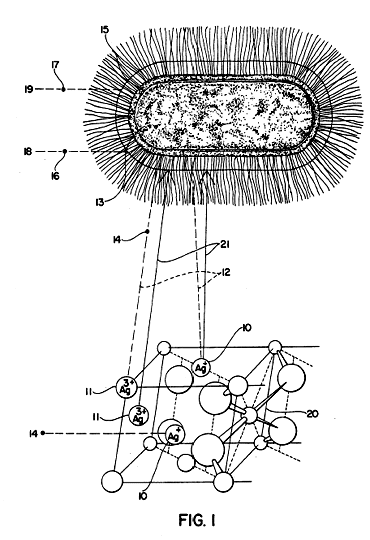
The microorganism-and-lattice schematic
The accompanying figure is a patent-style line drawing labelled FIG. 1. It places a rod-shaped microorganism schematic above a cube-like silver/oxygen lattice, with numbered callouts and connecting lines linking the two halves of the image. It is an explanatory diagram rather than a micrograph or a plot of measured results: it illustrates the claimed relationship between the crystal lattice and the organism, and does not itself supply data about how either behaves.
Power flux per organism
The distinctive quantitative element of this source is a table assigning a "power flux" value to each of eight organisms. The values fall into three tiers:
| Organism Name | Power Flux |
|---|---|
| Escherichia coli | 50.0 |
| Staphylococcus aureus | 50.0 |
| Streptococcus faecalis | 50.0 |
| Streptococcus pyogenes | 50.0 |
| Candida albicans | 50.0 |
| Pseudomonas aeruginosa | 25.0 |
| Micrococcus luteus | 25.0 |
| Staphylococcus epidermidis | 12.5 |
The table is presented as a finished result. No measurement protocol, instrument, culture condition, exposure time or dose–response series accompanies it, and the units of "power flux" are not defined in the excerpt. The values are therefore assertions within Antelman's framework rather than reported experimental determinations, and the reader should treat the ranking of organisms as a claim about relative susceptibility rather than a measured quantity. Whether the numbers derive from any described experimental procedure elsewhere in the corpus remains an open question.
The power-per-device calculation
The source sketches how the total power output of a single device is obtained. The elementary charge is given as approximately 1.6 × 10⁻¹⁹ coulombs. The electromotive force for the oxidation of Ag(I) to Ag(II) is cited as 1.98 volts — rounded to about 2.0 V — from Antelman's own Encyclopedia of Chemical Electrode Potentials (Plenum, 1982), page 88. Multiplying the power output for each electron by 2 gives the total power output per device in watts. The factor of two reflects the two trivalent silver centres available per formula unit. This is the same electron-jumping arithmetic that appears elsewhere in the tetrasilver tetroxide cluster; here it is stated in its briefest form, with the electrode-potential value drawn from the author's own reference compilation rather than from an independent measurement of the compound.
The activation requirement
Antelman states that when the tetroxide crystals are used to destroy pathogens, they will not do so unless activated by an oxidizing agent. The comparison offered is with single semiconducting photovoltaic molecular devices such as copper indium selenide, whose surfaces must be etched before photovoltaic activity appears — that is, before light can facilitate the release of electrons from the molecule. On this analogy, the tetroxide crystal is inert until its surface is prepared, and the oxidizing agent plays the role of the etch.
For water supplies, the source names OXONE, a Du Pont trademarked oxidizing agent, or hydrogen peroxide as suitable activators. The claim is stated absolutely, but the excerpt does not document a controlled comparison between activated and unactivated crystals, so the necessity of activation is asserted rather than demonstrated here. The photovoltaic comparison is illustrative: it is offered as a way of picturing the mechanism, not as evidence that the two systems behave identically.
The CN101336640 formulation
The source reproduces a Chinese patent, CN101336640, titled as a tetrasilver tetroxide bactericide together with its preparation method and use. The disclosed formulation is given by weight part as follows:
- weak alkaline solution: 800–1200 parts
- tetrasilver tetroxide: 0.1–0.5 parts
- polyvinyl alcohol: 8–20 parts
The preparation uses the weak alkaline solution at pH 7.0–7.5 as the solvent; the tetrasilver tetroxide is added and sufficiently diluted and mixed, and the polyvinyl alcohol serves as carrier. The patent also discloses use of the preparation as a disinfection additive, and describes the method as simple and suited to large-scale production. The formulation is notable for how little tetroxide it contains relative to the carrier and solvent, and for the near-neutral pH range specified.
Evidence and limitations
The quantitative content of this source rests on two things: a table of assigned values and a short arithmetic derivation. Neither is accompanied by a described measurement. The figure is an explanatory drawing, not microscopy or a dose–response plot. The activation requirement is stated as a rule with an analogy attached, not as the conclusion of a controlled experiment. The structural description of Ag₄O₄, by contrast, is standard reference material and is the most securely grounded part of the page. Read together, the source is best understood as a statement of Antelman's device framework — its structural premise, its energy arithmetic, its organism ranking and its activation condition — rather than as a body of experimental evidence for antimicrobial efficacy.
Related work
This material extends the existing tetrasilver tetroxide cluster in the wiki. The compound itself is described at Tetrasilver Tetroxide (Ag₄O₄), and the author at Marvin S. Antelman. The electron-release argument appears as electron-jumping-claim, the arithmetic as power-per-molecule-calculation, and the activation condition as oxidizing-agent-activation-requirement. The trivalent silver chemistry underlying water-treatment claims is covered at trivalent-silver-complexes, and the patent family at us5211855, us5223149, us5676977 and us6258385. The organism-specific power-flux table and the CN101336640 formulation are details this source adds to that cluster.
References
- Antelman, M. S. Encyclopedia of Chemical Electrode Potentials. Plenum, 1982, p. 88 (Ag(I)→Ag(II) potential, 1.98 V).
- CN101336640 — Tetrasilver tetroxide bactericide, preparation method and use thereof.
- Silver(I,III) oxide reference description, including structure and preparation.
- PubChem CID 44150047 — Tetrasilver tetraoxide.
Source notes & attribution
- https://rexresearch.com/AntelmanTSTO/AntelmanTSTO.html
- https://rexresearch.com/AntelmanTSTO/TSTOAd.html
- https://rexresearch.com/tetrasilver/TSTOInfo.html
- https://rexresearch.com/tetrasilver/TSTOPatents.html
- https://rexresearch.com/tetrasilver/TSTOPreparation.html
- https://rexresearch.com/tetrasilver/TSTOProducts.html
- https://rexresearch.com/tetrasilver/TSTOReports.html
- https://rexresearch1.com/AntelmanTSTO/AntelmanTSTO.html
- https://rexresearch1.com/AntelmanTSTO/TSTOAd.html
- https://rexresearch.com/tetrasilver/tetrasilverindex.html