TetraSilver TetrOxide (TSTO) is presented on this page as a new class of chemical, described by the phrase "Molecular Battery." The material is identified by the formula Ag₄O₄ and characterized as a diamagnetic semiconducting crystal. The page is short and promotional in character: it states a composition, a mechanism, a downstream chemical consequence, and a comparative boast, and it supplies one structural diagram. It reports no experiments, no methods, no measurements and no clinical outcomes. Its claims belong to the material's promoters and are best read within that attributed framework.
The "molecular battery" framing
The central metaphor of the page is that the substance behaves less like a conventional chemical disinfectant and more like a device that stores and discharges electrons. Under this framing, the crystal is not consumed in a one-off reaction but acts as a reservoir whose stored charge can be released on demand. The page contrasts the tetroxide with other silver preparations, asserting that they compare poorly against it and that colloidal silver does so as well. That comparison is asserted rather than demonstrated; the page supplies no side-by-side measurements, no minimum inhibitory concentrations, and no test conditions that would allow a reader to check the ranking.
The proposed two-part mechanism
The anti-pathogenic properties of the material are attributed to electron activity said to be indigenous to the crystals. The page lays out a sequence in which the crystals are first activated with an oxidizing agent, after which they release electrons. The released electrons are said to be equivalent to 6.4 × 10⁻¹⁹ watts per molecule, and this release is said in effect to electrocute pathogens. A second, separate consequence is then described: the process is said to yield divalent silver moieties that chelate and bind active sites of the target entities, destroying them.
Two distinct mechanisms are therefore bundled together on the page. One is electrical, resting on the idea that liberated electrons deliver a lethal current to a pathogen. The other is a coordination-chemistry mechanism, resting on the idea that silver in the divalent state coordinates to and blocks functionally important sites on the target. The page does not explain how the two are related, whether they operate simultaneously or in sequence, or whether one is offered as an alternative account of the same observation. Neither mechanism is supported on the page by data.
The lattice diagram
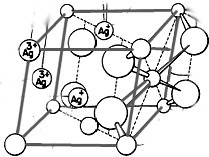
The single figure accompanying the page is a ball-and-line, cube-like lattice diagram, with circles labelled Ag and valence indications, set alone on a white background. It depicts a structural model — a visualization of the proposed crystal arrangement — and nothing more. The image contains no clinical outcomes, no antimicrobial measurements, and no annotation tying particular lattice positions to the claimed electron release. It should be read as an illustration of the proposed structure rather than as evidence for the mechanism, and it does not by itself establish that the depicted arrangement corresponds to the real solid.
Evidence and its limits
The page offers no experimental evidence for any of its claims. There are no measurements of electron release, no pathogen-kill data, no activation protocols, and no references to independent work. The figure is a schematic, not a result. The figure of 6.4 × 10⁻¹⁹ watts per molecule is stated as a bare assertion; the page does not show how it was derived or measured. The unit itself is worth noting: watts per molecule is a power-per-molecule quantity rather than an energy, so the number describes a rate of energy transfer attributed to a single molecule rather than a quantity of charge or a total energy released. The comparative claim against colloidal silver is likewise unsupported on the page.
The page is therefore best understood as a statement of a proposed mechanism together with a structural model, not as a report of verified results. It does not describe which oxidizing agents are used for activation, the conditions under which activation occurs, or how the electrical and chelation accounts are meant to fit together. It makes no reference to independent replication or to any controlled study.
Place in the wider tetrasilver tetroxide corpus
This page is one of several tetrasilver tetroxide items in the same collection. It overlaps with the antelman-tsto-patent-set (US5211855, US5223149, US5676977, US6258385) and with the other TSTO reports and advertisements, which repeat the electron-jumping-claim, the power-per-molecule-calculation and the oxidizing-agent-activation-requirement. The distinctive contribution of this particular page is the lattice diagram and the compact statement of the two-part mechanism, combining electron release with divalent-silver chelation. It adds no new evidence beyond what the other TSTO items contain, and it does not report the negative kinshasa-result that appears elsewhere in the corpus.
Related work
- Tetrasilver Tetroxide (Ag₄O₄) — the material itself, its formula and its reported properties
- Marvin S. Antelman — the inventor associated with the tetrasilver tetroxide patents and reports
- electron-jumping-claim — the broader claim that electrons move between silver valence states
- power-per-molecule-calculation — the power-per-molecule figure and how it is used
- oxidizing-agent-activation-requirement — the requirement that the crystals be activated before use
- trivalent-silver-complexes — related silver water-treatment chemistry
- kinshasa-result — the negative result reported elsewhere in the corpus
Source notes & attribution
- TetraSilver TetrOxide Information, Rex Research. Source: https://rexresearch.com/tetrasilver/TSTOInfo.html
- Related corpus items: Antelman tetrasilver tetroxide patent set (US5211855, US5223149, US5676977, US6258385); other TSTO reports and advertisements in the same collection.
- https://rexresearch.com/AntelmanTSTO/AntelmanTSTO.html
- https://rexresearch.com/AntelmanTSTO/TSTOAd.html
- https://rexresearch.com/tetrasilver/TSTOInfo.html
- https://rexresearch.com/tetrasilver/TSTOPatents.html
- https://rexresearch.com/tetrasilver/TSTOPreparation.html
- https://rexresearch.com/tetrasilver/TSTOProducts.html
- https://rexresearch.com/tetrasilver/TSTOReports.html
- https://rexresearch1.com/AntelmanTSTO/AntelmanTSTO.html
- https://rexresearch1.com/AntelmanTSTO/TSTOAd.html
- https://rexresearch.com/tetrasilver/tetrasilverindex.html