Biological transmutation
Microorganisms, radionuclides and the question of measurement.
Start here / 8 minute read
Vysotskii & Kornilova: Biological Transmutation of Radionuclides — Articles and Four Patents
This source dossier collects the work of Vladimir I. Vysotskii (a physicist working in Kiev, Ukraine) and Alla A. Kornilova (a biologist/microbiologist), who together claim that growing microbiological cultures can accelerate nuclear transmutation — transforming stable isotopes into other elements and, more consequentially, driving radioactive isotopes such as Cs-137 toward stable decay products far faster than natural radioactive decay would allow. The dossier gathers journal articles, conference reports, a monograph listing, four patents, a podcast interview transcript, and two third-party commentary pieces.
US patent publication; document page 2. Preserved page.
The central applied claim is that "microbiological deactivation" could be used to clean up radioactive contamination, including at Chernobyl and Fukushima. The dossier is a self-collected archive of the claimants' own publications and patents plus commentary; it reports no independent replication of the effect.
What the claim is
The source asserts that during the growth and metabolism of microbiological cultures, low-energy nuclear reactions occur that transmute one isotope into another. Two categories of transformation are named:
- Transmutation of stable isotopes — for example, the reactions the 2022 report lists as Mn55 + d = Fe57, Na23 + p31 = Fe54, and Cs133 + p = Ba134.
- Accelerated deactivation of radioactive isotopes — chiefly the reaction Cs137 + p = Ba138, in which the radioactive Cs-137 is said to convert to stable Ba-138.
The claimed effect is framed as an acceleration relative to natural decay. In a control flask containing "active water" but no microbiological associations, the source states that "the usual law of nuclear decay applies," with a Cs-137 lifetime of about 30 years. In flasks containing an optimal microbiological association, the reported lifetime drops dramatically.
Reported numbers and how they are attributed
The dossier reports several acceleration factors across different publications and periods. These are the claimants' own figures, presented here as attributed claims rather than verified results:
| Source item | Reported result | Attributed acceleration |
|---|---|---|
| ScienceDirect abstract (S0306454913000844) | Transmutation in microbiological associations is 20× more effective than in "one-line" (pure) cultures | 20× (associations vs. pure cultures) |
| ScienceDirect abstract | Most rapid decay rate observed with lifetime τ* ≈ 310 days, in a closed flask with Cs-137 solution, Ca salt and optimal microbiological association | 35× relative to natural decay |
| 2022 Vid. Proc. Adv. Mater. report | Transmutation of reactor Cs-137 to stable Ba-138 in microbe syntrophic associations (MSA) | 35× relative to natural decay (30-year baseline) |
| 2022 Vid. Proc. Adv. Mater. report | Decrease in Cs-137 concentration over 15 days reached 70% at most optimal conditions | 103× relative to natural decay |
| 2017 rensit.ru report | Rate of activity decrease in aqueous radionuclide solutions | "accelerated by 35 to 200 times in relation to the natural decay" |
The 2022 report describes these as progressive improvements across three periods: initial experiments (1992–2000) on light, middle-mass and heavy stable isotopes; later experiments (2000–2015) on long-lived reactor isotopes in MSA; and recent work (2016–2021) with further biotechnology improvements.
The proposed mechanism
The 2022 report offers a physical mechanism for the claimed reactions. It states that the mechanism "is connected with formation of coherent correlated states of interacting nuclear isotopes," accompanied by "giant energy fluctuations (up to 10-50 keV and more)" of those nuclei that can persist long enough to produce nuclear reactions. The generation of these fluctuations is said to happen "automatically in non-stationary potential biological nano-wells," which the report locates in processes such as cell division, DNA replication, and the entrance to ion channels in cellular plasma membranes.
The 2017 rensit.ru report frames the same idea in terms of "the catalytic influence of non-stationary spatial inhomogeneities in the volume of growing living objects." The mechanism is presented in the source as established ("It was shown that the physical mechanism... is connected with..."), but it is a theoretical justification rather than an experimentally isolated mechanism.
The four patents
The dossier reproduces claim language from four patent documents. These are legal documents describing methods; a granted patent is not evidence that the described effect occurs.
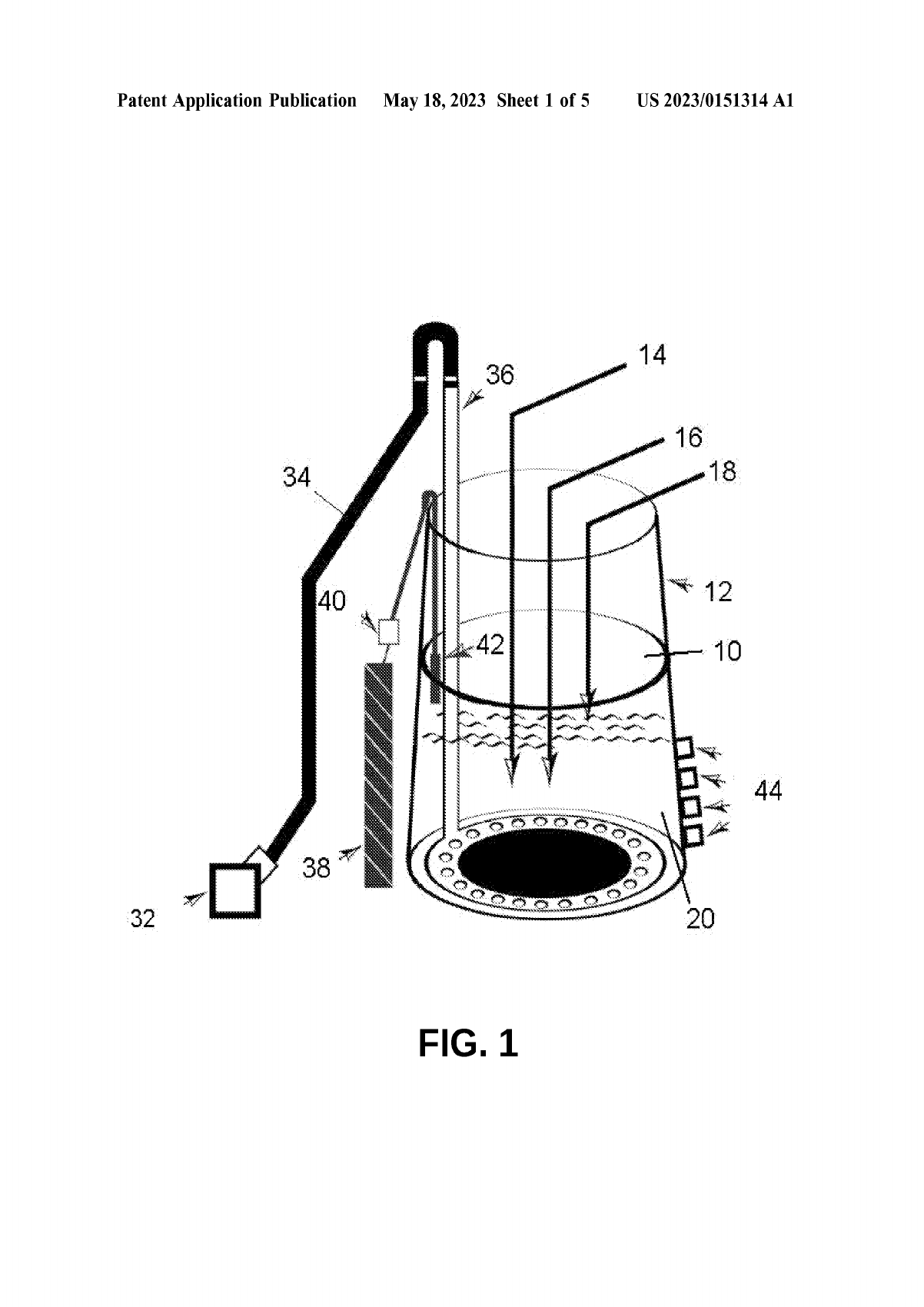
US2023151314A1 — Aerobic and anaerobic cultivation of microorganisms
The source quotes the anaerobic cultivation claim:
A method for the anaerobic cultivation of microorganisms includes providing an aqueous solution having a pH value of 4.5 to 7.5 in a container, adding a substrate in a first substrate dosage to the aqueous solution, adding further elements to the aqueous solution, adding an inoculant with microorganisms to the aqueous solution, hermetically sealing the container, varying a temperature of the initial product or the intermediate products in a range from 40 to 80 degrees Celsius, taking a sample and determining a first concentration of organic substance in the sample, taking another sample and determining another concentration of organic substance in the further sample after the expiration of the first waiting time, if the concentration of organic substance is smaller than 10 percent of the first concentration of organic substance, adding substrate in another substrate dosage, repeating the above until a sufficient amount of biomass is present in the container
US2023143790A1 — Cleaning radioactive liquids and radioactively charged surfaces
The source summarizes this as relating to a method for aerobic and anaerobic cultivation of microorganisms, a method for producing a preparation for cleaning radioactive liquids and radioactively charged surfaces, and a method for cleaning radioactive liquids and radioactively charged surfaces.
WO2015156698A1 — Method for purifying water of radionuclides
The source quotes the method:
The present method for purifying water of radionuclides by nuclear transmutation involves preparing a culture medium for the growth of microbiological cultures, adding a biomass of microorganisms to said medium, holding the biomass of microorganisms in an aqueous solution undergoing purification for from 10 hours for aerobic microorganisms to 24 hours for anaerobic microorganisms, and adding key trace elements and/or combinations thereof to different parts of the resultant aqueous solution. The aqueous solution undergoing purification is held for the purpose of selecting the trace elements and/or combinations thereof necessary to speed up the process of transmutation, and the selected trace elements and/or combinations thereof are added to the aqueous solution undergoing purification. The aqueous solution undergoing purification is held for the time necessary to achieve the required residual radioactivity value, and the biomass of microorganisms is removed from the aqueous solution undergoing purification.
RU2052223C1 — Producing stable isotopes by nuclear transmutation
Titled "Method for producing stable isotopes due to nuclear transmutation, such as low-temperature nuclear fusion of elements in microbiological cultures." The dossier links a translation PDF but does not reproduce claim text.
The Cs/Sr joint-transmutation paper
The most methodologically candid item in the dossier is the paper "Joint transmutation of stable Cs and Sr isotopes in microbiological systems and prospects for accelerated deactivation of liquid radioactive waste" by Kornilova, Vysotskii, Gaidamaka and Gladchenko. Its abstract records both a positive result and a significant internal caveat.
Reported findings:
- In both experimental and control bioreactors that initially contained only cesium and strontium, yttrium and barium were found by the end of the experiments. The authors attribute these to low-energy nuclear reactions involving protons.
- Experimental bioreactors with an optimal composition showed a two- to threefold increase in yttrium concentration compared with the control non-optimal experiments.
- Strontium and cesium accumulated in biomass, which the authors explain as biosorption. The source states that "biosorption is the first step towards nuclear transformation (biotransmutation)," and that a main condition for nuclear transformation of biomass elements is its maximum efficient growth.
- A decrease in cesium and strontium content in the liquid of 20% and 55% respectively was recorded, stated to go beyond the statistical error.
The control-contamination caveat: The paper reports that yttrium and barium were also found in the control bioreactor, where no biomass was added before the experiment — only deionized water, glucose, and the initial stable cesium and strontium salts. The authors note that these elements were not detected in the analysis of the initial salts, substrates, or deionized water. Their own explanation: "Most likely, the presence of yttrium and barium is due to inoculation of the control fluid of the bioreactor (where no biomass pellets were added) with microorganisms from the experimental bioreactors during their periodic opening for taking current pH samples and adding glucose."
This is a candid admission that the control was not clean, and it complicates the attribution of the observed yttrium and barium to the experimental cultures.
Third-party commentary in the dossier
Two items are not authored by Vysotskii and Kornilova:
- Ernest Schapiro, "Are Nuclear Processes in Biology Unique?" — 21st Century Science & Technology, Spring–Summer 2012.
- Jean-Paul Biberian, "Biological Transmutations" — Current Science, vol. 108, no. 4, 25 February 2015, in a special section on low-energy nuclear reactions.
The dossier also includes a transcript of Cold Fusion Now! Podcast episode 11, an interview with Vysotskii conducted by Ruby Carat, and a 2017 report hosted at rensit.ru.
Related work and lineage
The dossier's "Related" links point to other the source archive pages on transmutation, cold fusion and nuclear waste, and to the archive's Louis Kervran page. Kervran's mid-20th-century claims of biological transmutation (for example, that hens convert potassium to calcium) are the conceptual ancestor of this line of work, though the source does not develop the connection in detail.
Within the wiki, this source extends the existing low-energy nuclear reaction material — see concepts/low-energy-nuclear-reactions and concepts/low-energy-transmutation-of-elements — by adding a microbiological branch and a specific radwaste-deactivation application. It offers a useful contrast with concepts/eltons (Vachaev's plasma-water-metal transmutation claim), which proposes a very different physical setting for low-energy transmutation.
Limitations and unresolved questions
- No independent replication is reported in the source. The dossier is the claimants' own publications, patents and interviews, plus two commentary pieces.
- The acceleration factors are internally inconsistent. 35× (2000–2015), 103× (2016–2021), and "35 to 200 times" (2017 report) are not reconciled. The source presents them as progressive improvement, but the numbers come from different experiments and conditions and are not directly comparable.
- The control-contamination finding in the Cs/Sr paper undercuts clean attribution of the effect to the experimental cultures. Whether the earlier Cs-137 results used cleaner controls is not addressed in the source.
- Mechanism vs. evidence gap. The coherent-correlated-states / nano-well mechanism is a theoretical proposal, not an experimentally isolated mechanism.
- Patent vs. proof. The four patents describe methods; the source reports no independent replication or regulatory validation.
- Application claims. The Chernobyl/Fukushima use is stated as a possibility ("may be used"), not as a demonstrated remediation.
Source notes & attribution
- Vysotskii, V. & Kornilova, A. "Transmutation of stable isotopes and deactivation of radioactive waste in growing biological systems." ScienceDirect, S0306454913000844.
- Vysotskii, V. & Kornilova, A. "'Biological Transmutation' of Stable and Radioactive Isotopes in Growing Biological Systems." J. Condensed Matter Nucl. Sci. 28 (2019) 7–20.
- Vysotskii, V., Kornilova, A. & Gaydamak, S. "Growing Microbiological Substance as Effective System for Accelerated Deactivation of Radioactive Waste and Transmutation of Stable Isotopes." Vid. Proc. Adv. Mater. , vol. 3, Article ID 2208324 (2022). DOI: 10.5185/vpoam.2022.08324.
- Kornilova, A. A., Vysotskii, V. I., Gaidamaka, S. N. & Gladchenko, M. A. "Joint transmutation of stable Cs and Sr isotopes in microbiological systems and prospects for accelerated deactivation of liquid radioactive waste." istina.ficp.ac.ru.
- "Synthesis and Transmutation of Stable and Radioactive Isotopes in Biological Systems." rensit.ru report (2017).
- Vysotskii, V. & Kornilova, A. Nuclear Transmutation of Stable and Radioactive Isotopes in Biological Systems (monograph).
- Schapiro, E. "Are Nuclear Processes in Biology Unique?" 21st Century Science & Technology , Spring–Summer 2012.
- Biberian, J.-P. "Biological Transmutations." Current Science , vol. 108, no. 4, 25 February 2015.
- Cold Fusion Now! Podcast episode 11, interview with Vladimir Vysotskii, transcript.
- Patents: US2023151314A1; US2023143790A1; WO2015156698A1; RU2052223C1.
- Source archive: https://rexresearch.com/VysotskiiTransmutation/VysotskiiBiolTransmutation.html
- https://rexresearch.com/VysotskiiTransmutation/VysotskiiBiolTransmutation.html
Go deeper.
11 further articles2 min
Biological Transmutation Claims vs. Evidence: Acceleration Factors, Control Contamination and the Absence of Replication
This page compares the claims made in the Vysotskii–Kornilova dossier with the evidence the dossier itself presents. It follows the wiki's existing pattern for contested transmutation and energy claims (see comparison-lost-elements-vs-adept-alchemy).
2 min
Accelerated Radionuclide Deactivation
Accelerated radionuclide deactivation is the applied claim of the Vysotskii–Kornilova dossier: that growing microbiological cultures can reduce the radioactivity of radionuclide solutions — chiefly Cs-137 — faster than natural radioactive decay, by transmuting the radioactive isotope to a stable one. The named reaction is Cs137
2 min
Biological Transmutation (Biotransmutation)
Biological transmutation, or biotransmutation, is the claim that living systems — in this dossier, growing microbiological cultures — can transform one chemical element or isotope into another through low-energy nuclear reactions. The claim is a branch of low-energy-nuclear-reactions and is conceptually related to the historical
1 min
US2023151314A1 — Aerobic and Anaerobic Cultivation of Microorganisms
US2023151314A1 is one of four patent documents in the Vysotskii–Kornilova dossier on biological transmutation. Its full title is "Method for the aerobic and anaerobic cultivation of microorganisms, method for the production of a preparation for cleaning contaminated liquids and surfaces."
1 min
Vladimir I. Vysotskii
Vladimir I. Vysotskii is a physicist based in Kiev, Ukraine, and the organizing figure of the source dossier on biological transmutation of radionuclides. He is a co-author of essentially every item in that dossier and a co-patentee on the associated patent family.
1 min
Coherent Correlated States of Interacting Nuclei
Coherent correlated states of interacting nuclei are the proposed physical mechanism by which the Vysotskii–Kornilova dossier claims nuclear reactions occur in growing biological systems. The mechanism is a theoretical justification offered in the 2022 Vid. Proc. Adv. Mater. report; it is not an experimentally isolated mechanism
1 min
WO2015156698A1 — Method for Purifying Water of Radionuclides
WO2015156698A1 is one of four patent documents in the Vysotskii–Kornilova dossier. Its title is "Method for purifying water of radionuclides." The dossier links both the patent and a translation PDF.
1 min
Microbe Syntrophic Associations (MSA)
Microbe syntrophic associations (MSA) are cooperative microbial consortia — mixtures of microorganisms living together — as defined in the Vysotskii–Kornilova dossier. The term is central to the claimants' mechanism and to their reported results.
1 min
Alla A. Kornilova
Alla A. Kornilova is a biologist/microbiologist and the co-author, with Vladimir I. Vysotskii , of the body of work claiming biological transmutation of stable and radioactive isotopes. She is a co-patentee on the associated patent family and a co-author on the monograph Nuclear Transmutation of Stable and Radioactive Isotopes i
1 min
US2023143790A1 — Cleaning Radioactive Liquids and Radioactively Charged Surfaces
US2023143790A1 is one of four patent documents in the Vysotskii–Kornilova dossier. Its full title is "Method for the aerobic and anaerobic cultivation of microorganisms, method for the production of a preparation for cleaning radioactive liquids and radioactively charged surfaces."
1 min
RU2052223C1 — Producing Stable Isotopes by Nuclear Transmutation in Microbiological Cultures
RU2052223C1 is one of four patent documents in the Vysotskii–Kornilova dossier. Its title, as given in the source, is "Method for producing stable isotopes due to nuclear transmutation, such as low-temperature nuclear fusion of elements in microbiological cultures."
The visual record.
1 archived figures · open to inspectThe source room.
Everything readable here stays on StrangewellArchived texts preserve what the source said. They may contain historical, speculative, or promotional claims; inclusion is not verification.
Source text8 min
Vladimir VYSOTSKII & Alla KORNILOVA : Biological Transmutation of Radionuclides -- Articles & 4 patents
http://www.padrak.com/vesperman/Nucwaste%20&%20Biotransmutation%20-%20Vladimir%20Vysotskii,%20Alla%20Kornilova%20-%20Sofia%202017.pdf Accelerated deactivation of water solutions of reactor radionuclides by transmutation to stable isotopes in growing microcultures Vladimir Vysotskii, Alla Kornilova
Supporting documents (20)
“Captured” means saved for research; a full reading guide may still be pending.