The alchemy reading room
Davidson, Kranich, Pelikan, Kollerstrom, Schwenk and Wachsmuth.
Start here / 9 minute read
Sensitive Chaos: The Creation of Flowing Forms in Water and Air
Sensitive Chaos: The Creation of Flowing Forms in Water and Air is Theodor Schwenk's attempt to describe water not as an inert substance but as an active, form-seeking element whose movements carry a kind of organic logic. Schwenk is identified in the source as the director of an institute at Herrischried, in Germany's Black Forest, devoted to the study of the movement of water and air. The book was published by Schocken Books in New York, with drawings and layout executed by Walther Roggenkamp and writing assistance acknowledged to Helga Brasch.
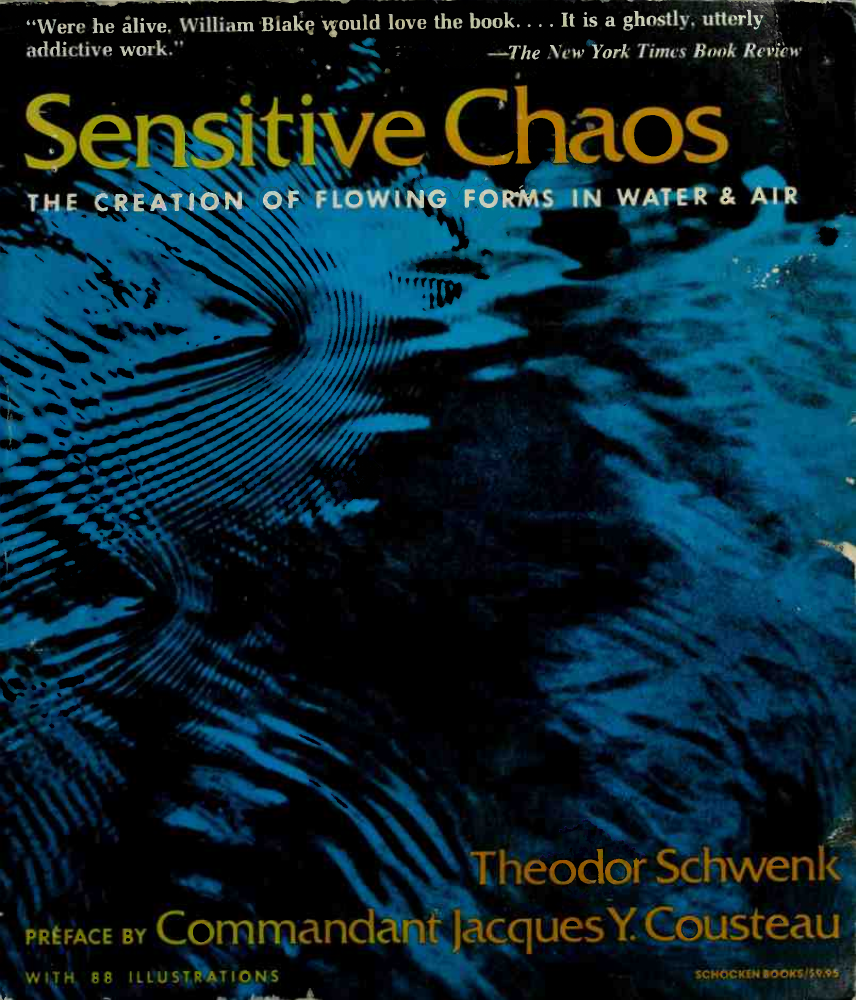
The material available here is partial: front matter, the opening chapters on archetypal water movements and on three characteristic features of water, and the list of plates. It is enough to reconstruct the central argument and the observational method, but not enough to judge the full book's evidential weight. That limitation matters, because the excerpt is overwhelmingly conceptual and illustrative rather than quantitative.
The organizing thesis: sphere, circulation, wholeness
Schwenk's starting observation is that water everywhere tends toward spherical form. It wraps the earth in a thin film, encloses objects dipped into it, and a falling drop oscillates around the sphere rather than settling into some other shape. Dew on a clear night, in his image, turns an inconspicuous field into a "starry heaven" of droplets.
Against this tendency stands gravity. Moving water seeks a lower level and is drawn away from the sphere into a more or less linear, determined course. Schwenk's claim is that water never simply surrenders to that pull: it continually strives to return to spherical form, finding many ways to hold a rhythmical balance between its own nature and earthly gravity. The book's later chapters are presented as a survey of that "play of movement."
From the sphere Schwenk derives a second idea. A sphere is a totality, a whole; water, he argues, always attempts to form an organic whole by joining what is divided and uniting it in circulation. A circulatory system, on this account, has no true beginning or end — everything in it is inwardly connected and reciprocally related. Hence his formulation that water is essentially the element of circulatory systems. The familiar cycle through solid, liquid and gaseous phases is offered as the best-known instance: water rises from oceans, lakes and rivers, circulates with the air in the great atmospheric currents, and returns.
The thesis has a corollary that is more a philosophical claim than an observation. Schwenk writes that if a living circulation is interrupted, a totality is broken into and the linear chain of cause and effect — "an inorganic law" — is set in motion. This is the pivot of the whole book: circulation is treated as the signature of the organic, and linear causation as what remains when organic wholeness is destroyed. It is an assertion about how to read natural processes, not a result demonstrated by measurement.
Boundary surfaces as the birthplaces of living things
The most distinctive claim in the excerpt concerns boundary surfaces. Schwenk proposes that boundary surfaces, together with their rhythmical processes, are the birthplaces of living things — as though creative, formative impulses needed such surfaces in order to act in the material world at all. He lists examples across scales: cell membranes and the surfaces of contact between cells, where "life forces" are said to be mysteriously present; the great boundary surfaces between ocean current systems flowing past one another in different directions, which he notes are known to be particularly rich in fish; and the extensive surfaces of natural and artificial filter systems, where seeping water is purified and, in his phrasing, given back its vital qualities.
This is the conceptual core that connects the book to the anthroposophical natural-science tradition. The notion of formative impulses requiring a surface to act upon is attributed by Schwenk to his own framework, with a footnote pointing to Rudolf Steiner's Riddles of the Soul for the basic explanations. Readers should treat the boundary-surface claim as Schwenk's assertion within that framework rather than as an independently established finding; the fish-richness of current interfaces is an observation he cites, but the interpretation placed on it is his.
Water as mediator: metabolism, heat and landscape
A second strand of the argument concerns water's role as a neutral mediator. Schwenk observes that organisms consist chiefly of water, and concludes that water is the primary and most essential element for all living processes. It refrains from taking a form of its own, filling out whatever form is offered and enveloping whatever is dipped into it. In human development he notes that the embryo floats entirely in water and in the second month is still almost entirely water, while even an old man is about 60 per cent water.
Chemically, Schwenk describes water as neutral and non-committal, and treats that neutrality as the source of its usefulness: because it does not commit itself, it has a multitude of possibilities for nearly all chemical changes. Metabolism — the breaking down and building up of substances — is, in his account, unthinkable without water as the mediating and dissolving element. He illustrates dissolving power with the everyday example of a lump of sugar, which water disperses effortlessly, and notes that water can also absorb gases such as carbonic acid, thereby increasing its ability to attack solids. Under suitable conditions it can deposit what it has dissolved, producing formations such as the aragonite sinter terraces of Yellowstone National Park.
Water's role extends to heat. Schwenk points out that water absorbs not only large quantities of dissolved substances but also great amounts of heat, and transports that heat wherever it goes. Northern Europe's mild climate is attributed to this: the Gulf Stream carries tropical warmth past those countries, flows into polar regions, cools, densifies, sinks, and continues on, beginning a circulation that reaches the depths of the Atlantic.
The same properties are said to shape landscape and fertility. Water dissolves and bursts apart rock; its buoyancy lightens stones rolling down scree slopes into rivers; and its grinding action — in glacial pot-holes and along stream beds — smooths edges and reduces rock to pebbles, sand and the finest particles that downstream form the basis of arable land. Schwenk cites the culture of Ancient Egypt as inconceivable without this process, noting that religious rites accompanied the Nile floods and the annual washing down of fertile mud.
Self-regulation, beavers and the Mississippi claim
Schwenk extends the argument to water's own flow. Water, he says, regulates its course in its own way: by flowing more slowly it prevents fruitful earth from being washed out to sea and gives it back to the land by depositing it again. The beaver is presented as the embodiment of this wisdom — an animal whose instinctive actions are so bound up with what happens between water and countryside that it forestalls floods by raising its dams. He reports that the renowned fertility of the Mississippi basin is considered to result from beaver activity over thousands of years, which slowed the river and caused fertile mud to be deposited, and he notes contemporary efforts to reintroduce beavers to upper reaches as a counter-measure to river straightening, which he says washes inconceivable amounts of fertile earth into the sea each year.
These are historical and ecological assertions rather than experimental results, and they carry the same attribution caveat as the rest of the book.
Three characteristic features of water
The excerpt closes its argumentative section with a summary. Schwenk proposes three characteristic features of water that together form a complete picture. Two are, in his words, clear for all to see; the third is almost unknown and requires very sensitive methods of observation.
- Metabolic activity — water's activity in all metabolic processes, both in the great organism of the earth and in each separate living creature.
- Connection with rhythm — water's close connection with all rhythmical processes in time and space.
- Boundary-surface sensitivity — the sensitivity of boundary surfaces, which he says comes to light only through careful observation.
The third feature is the one that motivates the book's observational program, and it is the one least amenable to ordinary measurement.
Method and evidence: plates, analogies and their limits
The evidence offered in this excerpt is observational and analogical. The plate list documents the method: vortex rings rising through water and taking star-like forms when they collide with a surface; a drop falling into still water producing a star-shaped figure; an ascending vortex ring shaped like a bell; flames and air or gas streams moulded by notes played on an organ, by spoken vowels, and by the timbres of different instruments at the same pitch; cloud formations — mackerel clouds, approaching storms, descending hail clouds, wave formations where wind crosses mountain ridges — that recur in water as well. Schwenk's recurring move is to show the same forms arising in water and in air, and to treat that recurrence as meaningful.
What is absent from this excerpt is equally important. There are no quantitative measurements, no controlled experiments, and no statistical results. The claims about formative impulses and boundary surfaces are metaphysical in character and belong to Schwenk's anthroposophical framework. The publisher's blurb quotes Water Resources Bulletin to the effect that a gaze fixed only on what is profitable cannot perceive the vital coherence of all things in nature, and quotes the Journal of the Institute of Water Engineers describing the commentary as "filled with poetry and mysticism, certainly not 'science' within the ordinary meaning of the word" — while praising the illustrations as of breath-taking beauty. That second quotation is worth keeping visible: it is a contemporary engineering journal conceding that the book's mode of argument is not the ordinary scientific one, which sits uneasily with the empirical-looking plate documentation.
Unresolved questions
Three things remain open. First, whether the full book contains quantitative or experimental work beyond this excerpt — the absence of such material here should not be read as proof that none exists elsewhere. Second, the precise relationship between Schwenk's "formative impulses" and Steiner's framework, which the footnote gestures toward but does not spell out. Third, an internal tension the text does not resolve: water is described as chemically neutral and non-committal, yet simultaneously as the active mediator of all metabolic and formative processes — passive in nature, agentive in role.
Related work in this wiki
This source sits within the existing Schwenk cluster, alongside theodor-schwenk, formative-forces-claim-schwenk, vortex-as-ur-organ, cochlea-vortex-analogy and breathing-of-the-continents. Its boundary-surface emphasis extends the formative-forces claim, and its anthroposophical vocabulary connects it to rudolf-steiner and the wider treatment of etheric-formative-forces. Claims made here should remain attached to Schwenk and not be transferred to other named authors merely because they share that vocabulary.
References
- Theodor Schwenk, Sensitive Chaos: The Creation of Flowing Forms in Water and Air, Schocken Books, New York. Drawings and layout by Walther Roggenkamp; writing assistance acknowledged to Helga Brasch. Author's institute at Herrischried in the Black Forest.
- Footnote reference in the source to Rudolf Steiner, Riddles of the Soul.
- Publisher blurb quotations attributed to Water Resources Bulletin and the Journal of the Institute of Water Engineers.
- (excerpt: front matter, chapters on archetypal movements of water and the three characteristic features, and the plate list).
Keep reading
- Morphic Resonance: The Nature of Formative Causation — Adds context.
- Etheric Formative Forces in Cosmos, Earth and Man — Adds context.
- Chaos, Creativity, and Cosmic Consciousness — Adds context.
Source notes & attribution
- https://elettronelibero.org/wp-content/uploads/2022/07/sensitive_chaos_the_creation_of_flowing_forms_in_water_and_air_compress.pdf
Go deeper.
3 further articles8 min
Metal Power: The Soul Life of the Planets
Metal Power: The Soul Life of the Planets is a 1991 book by Alison Davidson that treats the metals as carriers of planetary and cosmic qualities rather than as inert chemical elements. Its organizing claim is that each metal belongs to a planet — silver to the Moon, gold to the Sun, quicksilver to Mercury, copper to Venus, iron
7 min
Etheric Formative Forces in Cosmos, Earth and Man
Guenther Wachsmuth's The Etheric Formative Forces in Cosmos, Earth and Man is a programmatic treatise of anthroposophical natural science, written at the Goetheanum in Dornach, Switzerland, in 1923 and translated into English by Olin D. Wannamaker in 1932. Its subtitle, "A Path of Investigation into the World of the Living," sta
5 min
Planetary Influences Upon Plants: A Cosmological Botany
Planetary Influences Upon Plants: A Cosmological Botany is Ernst Michael Kranich's attempt to read plant form as a legible script whose grammar is planetary. The book was translated from the German by Ulla and Austin Chadwick; the original, Die Formensprache der Pflanzen ("the language of forms of plants"), was published by Verl
The visual record.
3 archived figures · open to inspectThe source room.
Everything readable here stays on Strangewell4 of 6 selected works have reviewed reading guides here. The remaining works still need a completed guide.
Archived texts preserve what the source said. They may contain historical, speculative, or promotional claims; inclusion is not verification.
Book guides
The six-book selection
- Alison Davidson — Metal Power
- Ernst Kranich — Planetary Influences Upon Plants
- Wilhelm Pelikan — Secrets of Metals
- Nicholas Kollerstrom — Secrets of the Seven Metals
- Theodor Schwenk — Sensitive Chaos
- Guenther Wachsmuth — The Etheric Formative Forces in Cosmos, Earth and Man
Supporting documents (1)
“Captured” means saved for research; a full reading guide may still be pending.
Keep following.
Thematic connections, not evidence of a shared mechanism16 / Mind & perception
Morphic resonance
Read the hypothesis and the arguments surrounding it.
↗09 / Matter & materials
Biological transmutation
Microorganisms, radionuclides and the question of measurement.
↗07 / Mind & perception
The Pleiades embassy
An archive of contact narratives, off-world visas and belief.
↗50 / Mind & perception
Psychotronic generators
Steel devices, biological-energy claims, and the gap between a measurement and an explanation.
↗