The activator
One apparatus, many claims. Examine the source trail.
Start here / 14 minute read
Jacques Ravatin: Space and Fluid Activators — Form Emissions, CN Cycloid Conduits and the Sprink Lineage
What this source is
This is a source archive compilation page devoted to the French inventor Jacques Ravatin, described in the source as "an associate of Leon Sprink" who "invented smaller and more powerful versions of the Sprink Space Activator." The page reproduces the text of three patent documents plus brief editorial framing:
- EP0016079 / WO8000293 — Apparatus for Amplifying Emissions Due to Shapes
- FR2716123 — Device for Activating Fluids & Solids (dated 1995-08-18)
- FR2488096 — Dispositif d'application des émissions dues aux formes, à la matière en mouvement (dated 1982-02-05)
The page also links out to a separate source page on the Sprink Space Activator, which is not included in this source. The material is a patent compilation, not a peer-reviewed publication: it reports inventor claims and archive editorial notes, with no experimental replication, no third-party measurement and no error analysis. The source itself concedes that the nature of the emissions it builds on "could not be determined."
The text is evidently a machine translation from French. Phrasing such as "with dimensions" for côtés (sides), "extended" for sortie (outlet), "square dummy one" for a diagonal, and "celongated" for allongée (elongated) indicates that some technical details may be garbled in translation. This caveat should be carried with any reading of the specific numbers below.
The shared premise: emissions due to shapes
All three patents rest on the same assertion. Certain geometric forms — pyramids are the example given — are said, "when they present appropriate proportions," to be "the seat of emissions which one could not determine to present the exact nature." These emissions are claimed to have effects "in particular on the living organisms." The source states plainly that until the invention it "was not possible to obtain with the aforementioned emissions due to the forms, of the measurable and exploitable effects in industry."
Ravatin's stated contribution is therefore not the discovery of the emissions but a claimed method of amplification by "localization" — concentrating the supposed emissions to industrially exploitable levels by combining a low-symmetry geometric form with applied electric, magnetic or electromagnetic fields. See Form Emissions (Emissions Due to Shapes) for the premise as a cross-cutting concept.
EP0016079 / WO8000293 — Apparatus for Amplifying Emissions Due to Shapes
Claimed construction
The preferred embodiment is a hollow cylindrical form whose radial cross-section is a regular 16-sided polygonal frame. Four pointed electrodes are mounted on the frame, directed toward its center, with their points coplanar in the plane that bisects the polygonal frame. Two electrodes carry a stable, filtered DC positive potential relative to ground; the other two are connected to ground.
The frame sides are made of "very dry wood" — poplar, oak or an exotic wood — with the plank length taken along the direction of the wood fibres. The applicant noted that natural materials with directed fibres such as wood "gave the good results," while rubber, plywood and synthetic products such as plastic "did not produce any substantial result." Sides are joined by mortise-and-tenon wood assembly.
Some frame sides are constructed as Moebius-strip volumes — the result of twisting one end of a rectangular cuboid strip 180° about its longitudinal axis relative to the other end, the strip being classified as right- or left-handed according to whether it corresponds to a right or left threading. In the preferred 16-sided embodiment, sides 2, 4, 5, 9, 11, 13 and 15 are right Moebius strips and sides 6 and 10 are left Moebius strips; sides 1, 3, 7, 8, 12, 14 and 16 are plain rectangular parallelepipeds. The Moebius volumes are thicker at their middle to allow drilling for insulators and mounting. The source states the total number of Moebius volumes "must be odd" and that they are preferably regular (symmetric about their centres). See Moebius Frame Amplification.
Preferred parameters
| Parameter | Value |
|---|---|
| Positive electrodes | 2 (stable filtered DC, positive vs. ground) |
| Negative electrodes | 2 (connected to ground) |
| Angle between positive electrode points | ~28° |
| Angle between negative electrode points | ~23° |
| Positive potential | ≥45 kV, preferably ≥60 kV |
| Electrode point angle (positive pair) | 28° ± 30′ |
| Electrode point angle (negative pair) | 23° ± 30′ |
| Electrode length | ~60–90 mm |
| Circumscribed circle diameter | ≥250 cm (≥200 cm stated elsewhere for 45 kV; ≥280 cm for 300 kV) |
| Electrode point separation | ≥400 mm at 45 kV; ≥1 m at 300 kV |
| Current delivery | ~100 µA, with protective cutoff above ~100 µA (stated in FR2716123, not EP0016079) |
| Onset of effects | ~1 hour after energizing; radius ~30 m (stated in FR2716123, not EP0016079) |
The source contains an internal inconsistency on the circumscribed-circle diameter: one passage requires "at least 200 centimetres for a potential of approximately 45 Kv," while a later passage states that "industrially to obtain useful results" the diameter "was to have a diameter of at least approximately 250 cm." The source does not reconcile the two figures.
Additional claimed amplification elements
- Ovoidal volumes threaded on the electrode stems, made of the same wood as the frame, with conical facings at each end (openings of 28° + 30′ and 23° ± 30′). Four such volumes are homothetic, with preferred axial lengths L1 = 6 cm, L2 = 15 cm, L3 = 24 cm and L4 ≈ 33 cm; the conical facing depths follow the same homothety ratios.
- Discs of ~32 cm outer diameter and ~1 cm thickness threaded outside the frame around the insulators.
- Rhomboidal volumes as an alternative to the ovoidal volumes, generated by rotating a round rhombus about its long axis, with acute angles of ~57° 20′ and ~51° and axial conical facings of ~23° and ~28°.
- Cylinder-and-cone volumes fixed on the inner faces of certain sides, with cone point angles of ~140°.
- Inorganic additions: carborundum, and optionally proustite, pyragyrite, obsidian, natural graphite or nematic liquids, claimed to increase amplification, change the nature of the emissions, or confer a "fractal character" on the frame.
- Acoustic resonators, lasers for continuous or rhythmic emission, and "many fluids in movement in conduits of appropriate form" — the source's bracketed editorial note here reads "Schauberger…".
- Concentric frames: an alternative embodiment uses an outer octagonal frame F1 and an inner 16-sided frame F2, with circumscribed diameters of 384 cm and ~192 cm respectively, joined by wooden spacers and rotatable about an axis.
- Truncated pyramid enclosure: a truncated pyramid of ~4.5 m height on a ~5 m square base, derived from a pyramid whose oblique side length L equals C·W where C is the base side and W is the real root of X³ − X − 1 = 0 (≈1.325), cut at the quarter length of its oblique edges.
Claimed effects
All of the following are attributed to the inventor's observations ("the applicant noted," "it was noted") and none is independently verified:
- Local action on the terrestrial magnetic field — after ~30 minutes, the magnetic variation moves ~60° west of magnetic north, whatever the applied tension above the ~45 kV threshold, stabilizing at that value for as long as the potential is applied, regardless of frame orientation. A variation of magnetic slope was also noted but its value "was not fixed."
- Local action on gravitation — at ~45 kV, local gravitation "passed to 0,9 times its usual value," decreasing further as applied potential increased.
- Local action on the refractive index of air — it increases slightly, more so at higher positive potential.
- Combustion — no ash formation in reactions that normally produce blast-furnace slag, persisting up to four days after the potential is switched off.
- Fuel reduction — ~30% less coal for the same thermal energy at ~45 kV; ~50% reduced gasoline consumption in explosion engines compared with operation without the apparatus.
- Solubility — the solubility coefficient of dehydrated sodium chloride in twice-distilled water was multiplied by 2.1 to ~2.3 at ~45 kV, measured in 10 °C increments from 10 °C to 100 °C.
- Plant growth — increased speed of growth and size, with an increase factor of at least 2 up to 10 depending on the plant.
- Catalysis — the possibility of partially or completely removing a catalyst from a chemical reaction that normally requires one.
The source notes that without the application of one of the fields, effects are "relatively not very exploitable," and that field application increases their intensity.
FR2716123 — Device for Activating Fluids & Solids
Claimed mechanism
The device circulates a fluid between an inlet tank and an outlet tank through a treatment unit under the action of at least one compressed gas supply. The treatment unit contains fluid circulation conduits shaped as a CN curve, where N ≥ 2, defined recursively:
- C1 is a left-handed cycloid in the orthonormal reference frame;
- for any integer N ≥ 1, CN+1 is a left-handed cycloid in the curved reference frame bound to CN.
A left cycloid is the curve followed by a point on a ray of a circle as the circle rolls on a straight line and simultaneously turns about that line. The cycloid is "stringent" when the point lies on the circle, "lengthened" when the point's distance from the centre exceeds the radius, and "shortened" when it is less. The preferred embodiment uses elongated left cycloids, and the source states that activation is maximum for C3 conduits — an elongated left cycloid C3 rolled around an elongated left cycloid C2 itself rolled around the starting elongated left cycloid C1. See CN Cycloid Conduits.
The source is explicit that this is not a strict fractal construction: the laying out of C2 involves a slight modification of the form of C1, and likewise at each recursion, so "there is not thus a stringent construction like that which one applique in the theory of the said objects fractals but it is to some extent a generalization of the concept of fractal object. One is presented with a new class of objects."
The claimed physical rationale is that each element of fluid at a point P3 of C3 "behaves as if it were at the same time in P1, P2 and P3," where P1 and P2 lie at distances from the respective origins O1 and O2 of C1 and C2 equal to the distance separating O3 from P3 — even though C1 and C2 "do not exist materially in the installation."
Conduit materials and geometry
- Circulation conduits have a hexagonal transverse section, or the section of a third-degree curve with inflection points.
- To stabilize the activation, conduits are made of copper alloyed with ~2% by weight of heavier metals — those with atomic number Z between 38 and 45, or rare earths; indium and molybdenum are named.
- Compressed-gas supply conduits are also formed as C3 curves, since the compressed gas is itself activated and then activates the fluid more strongly; this is stated not to be an absolute requirement, and conventional profiles (helical serpentine, straight circular-section tube) are permitted.
The hemisphere activation system
An intermediate tank between the two circulation conduits contains a system of two nested hollow half-hemispheres, inner and outer, defining four surfaces S1–S4. Each surface corresponds to a surface of constant curvature generated by rotating the tractrix curve about its asymptote yy′:
x = an (t - th t)
y = an / cht ; an > 0
for n = 1 to 4, with a4 < a3 < a2 < a1. The abscissa has a maximum value of, for example, 5an to 6an. The system is adapted to rotate about its asymptotic axis, for example under a power unit. The two half-hemispheres are joined by cross-pieces that leave a passage for fluid to circulate between S2 and S3 as a centripetal helical movement. A spiral throat is provided at the S3 surface level so that rotation can be generated by the incoming pressurized fluid without the power unit; the throat may alternatively or additionally be made on S2. A single hollow half-hemisphere with an internal spiral throat is also described.
Claimed operating parameters and applications
- Fluid is circulated by compressed gas at 1–8 bar; maximum activation is claimed when the pressure is applied sinusoidally or as square waves.
- A "more labile" activation can be conferred by electromagnetic rays applied to portions of the treatment unit for at least 2 hours, preferably 3 hours, at wavelengths in one of the following bands: 3800–3860 Å, 4400–4480 Å, 5500–5600 Å, 8000–8700 Å.
- Water desalination and purification — preferably with a filter downstream of the inlet tank to remove coarse impurities.
- Industrial fume treatment — for fumes with a high pollution rate; the treated fluid (water or smoke) is claimed to be simultaneously purified and activated.
- Glass activation — glass heated to 850–1800 °C (preferably 900–1000 °C) and immersed in activated fluid (preferably oil) is claimed to become activated during hardening and on return to ordinary temperature. Under scanning electron microscopy, microbubbles are said to be present whose diameter and distribution characterize the process. See Activated Glass (Microbubble Glass).
- Alcohol ageing — glass bottles made of such activated glass and containing cognac or Armagnac are claimed to transmit activation to the liquid, which loses a degree of alcohol in some weeks, becomes amber, and loses its ethyl taste "as in the case of aged alcohol after several years."
- Microwave ovens associated with such activated glass are claimed to activate the food they heat. Other claimed applications include greenhouse and building glazing, colourless and coloured glass bezels, car windshields, and bottles for liquid food, fragrances or medical treatment solutions.
- Metal, ceramic, hard plastic and terracotta activation — the material is immersed in pre-activated fluid (preferably oil) and then cooled below −40 °C, preferably −80 °C, for at least 1 hour. Return to ordinary temperature is claimed not to affect the activation, and the treated materials are claimed to propagate their properties to their contents and to electromagnetic waves reflecting from their surfaces. See Low-Temperature Material Activation.
The source notes an internal tension here: activation is said to "persist and be stabilized" only when the conduits are made of the particular alloys, yet activation is also described for applications without specifying the alloy.
FR2488096 — Application of Form Emissions to Matter in Motion
Claimed construction
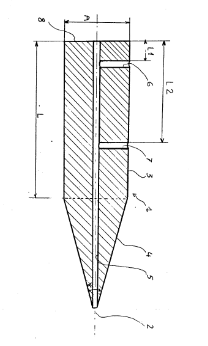
The device is a geometric form of revolution about an axis, through whose axial bore passes the moving fluid or a conductor carrying an electrical current. The tube or conductor is preferably force-fitted into the axial hole to ensure the best possible mechanical contact between form and tube.
The preferred form is a cylinder whose downstream end finishes in a conical prolongation with a point angle of preferably 33°. The form may be made of electrically conductive or insulating material, "this material being densest possible."
| Parameter | Relation |
|---|---|
| Cylindrical portion axial length | ≈2.3 × outer diameter D |
| Axial bore diameter | ≤0.1 × D |
| Radial holes | 2, on the same generator, ~0.1 × axial bore diameter |
| Distance from frontal face to hole edges | 0.3 × D and 1.5 × D |
| Cone point angle | 33° |
| D | ≥10 × tube diameter; ≥1 cm; advantageously 10 cm or more |
The two radial holes are stated to be "mainly intended to stabilize and to increase the level of the emissions due to form 1." Other geometric forms may be placed nearby, and an electric, magnetic or electromagnetic field may be associated with the form.
Claimed applications
- Water for agriculture.
- Fluid entering a chemical reaction.
- The current supplying the electrodes of an electromedical care apparatus.
- The current supplying the ignition of a combustion engine.
In all cases the emissions due to the form are claimed to improve the effects produced by these fluids or currents and/or to bring new and beneficial effects.
Prior art cited
- FR-A-966735 — a process and equipment allowing influence on the modifications of state of the material, especially by the action of suitably directed emissive apparatuses.
- AT-A-113487, AT-A-122144, AT-A-134543 — cited in bracketed editorial notes as Schauberger water-pipeline patents of particular form, allowing the regulation of torrents or rivers. The source's editorial notes also flag "Schauberger…" next to the suggestion of fluids moving in conduits of appropriate form.
Evidence and limitations
The evidence presented is very weak by conventional standards. The source consists of patent specifications, which describe claims rather than verified results, plus archive editorial notes. There is no measurement methodology, no control condition, no independent replication and no error analysis. Effects are reported as inventor observations. The source itself concedes that the nature of form emissions "could not be determined," yet proceeds to specify precise amplification parameters and effect magnitudes — an unresolved tension between admitted ignorance and confident claim.
The claimed 50% fuel reduction and the claimed modification of local gravitation conflict with established physics as represented elsewhere in this wiki (see concepts/over-unity-claims). No existing wiki page asserts these effects as real, so this is a new claim rather than a contradiction of existing content. The specific magnitudes (30%, 50%, 2.1–2.3×, factor 2–10) should be read as inventor assertions, not findings.
Related work and connections
- concepts/over-unity-claims — the claimed 30% coal reduction, 50% fuel reduction and gravitation modification are efficiency/energy anomalies of the same class as other over-unity claims in the wiki.
- concepts/atmospheric-electricity-extraction and concepts/wireless-inductive-activation — thematically adjacent field-based effects on matter, though Ravatin's mechanism is form-emission-based rather than atmospheric.
- concepts/resonant-pulsed-electrolysis — shares the pattern of high-voltage field application to fluids, with a distinct mechanism.
- concepts/lenz-law-cancellation — both are "field anomaly" claims with no direct overlap.
- comparisons/source-types — this source is a patent-compilation archive page, a type already characterized.
- concepts/geopolymerization and concepts/lithification-soil-treatment — FR2716123's material-activation claims (ceramics, hard plastics) use a different mechanism but a similar "treated material gains new properties" framing.
Figures
The source reproduces several patent drawings:
media/ravatin-activator/wo1.jpg— Figure 1 of EP0016079: planar view of the preferred 16-sided frame with four electrodes and their stems.media/ravatin-activator/wo2.jpgandmedia/ravatin-activator/wo3.jpg— Figures 2 and 3: cross-sections of two electrode embodiments.media/ravatin-activator/wo4.jpg— Figure 4: schematic of the alternative with two concentric frames F1 and F2.media/ravatin-activator/fr2716a.jpg— Figure 1 of FR2716123: overall schematic of the activation device with inlet tank, treatment unit and outlet tank.media/ravatin-activator/fr2716b.jpg— Figure 2a: construction of the elongated left cycloid.media/ravatin-activator/fr2716c.jpg— Figure 2b: enlarged view of the C3 conduit profile.media/ravatin-activator/FR2488096.png— the single figure of FR2488096: axial cross-section of the form of revolution.
Source notes & attribution
- Rex Research archive page: https://rexresearch.com/ElectroCulture/RavatinActivator/RavatinActivator.htm
- EP0016079 / WO8000293, Apparatus for Amplifying Emissions Due to Shapes (PDF linked from the source page).
- FR2716123, Device for Activating Fluids & Solids , 1995-08-18.
- FR2488096, Dispositif d'application des émissions dues aux formes, à la matière en mouvement , 1982-02-05.
- Sprink Space Activator page (linked, not included): http://rexresearch.com/sprink/sprink.htm
- https://rexresearch.com/ElectroCulture/RavatinActivator/RavatinActivator.htm
Go deeper.
16 further articles7 min
Jacques Ravatin: Form-Activation Patents and the source Dossier
This dossier, hosted by the source archive, reproduces the text of French patent FR2716123 , "Device for Activating Fluids & Solids," dated 18 August 1995, together with a numbered list of effects attributed to the inventor, Jacques Ravatin. The patent describes a treatment unit in which a fluid is driven by compressed gas throu
4 min
Ravatin and 'The Activator'
This page records a second capture of the source dossier on Ravatin and the device the archive calls "The Activator." The subject matter overlaps with the earlier capture documented at Jacques Ravatin: Form-Activation Patents and the source Dossier , but this capture supplies substantial extractable text: the dossier includes th
7 min
Ravatin: The Cycloid Conduit, the Form-Plus-Field Apparatus and the Unverified "Activator" Label
This source is a partial text of French patent FR2716123 , titled Device for Activating Fluids & Solids and dated 1995-08-18 , as reproduced on a source page devoted to the inventor Jacques Ravatin . The page mixes the patent abstract and description with fragments of surrounding commentary, and it repeats the same abstract and
5 min
Ravatin Claims vs. Evidence: Form Emissions, Fuel Reduction, Patent Drawings and the Absence of Independent Validation
This comparison sets the inventor claims in the Ravatin patent compilation against the evidence actually presented in the captured sources. It follows the pattern of other claim-vs-evidence pages in this wiki (for Boyce, Ammann, Alperen and Garrett), and of Si₂HSb₂ Amplifier Claims vs. Evidence: A Patent Reference Without Test D
3 min
FR2488096 — Application of Form Emissions to Matter in Motion
FR2488096 is a French patent associated with Jacques Ravatin and reproduced in the source archive. It is the only substantive technical item in the source dossier on Ravatin and "The Activator." The archive renders its title as "Application of Form Emissions to Matter in Motion" ; the text-bearing capture preserves the French ti
3 min
Ravatin
Jacques Ravatin is a French inventor named in a source dossier that reproduces his patent filings. His given name appears in the source text as "Jacques RAVATIN". The dossier is the only evidence available in this wiki for his existence and activity, and it identifies him by surname (and, in the source text, by the given name ab
2 min
Leon Sprink
Leon Sprink is an inventor whose work is collected in the source archive under the heading of "electrostatic activation" of matter. He is the central subject of the archive's Sprink dossier, which is the primary source for this page.
2 min
EP0016079 / WO8000293 — Apparatus for Amplifying Emissions Due to Shapes
EP0016079 (with WO8000293) is a patent document attributed to Jacques Ravatin, reproduced in the source archive. It claims an apparatus for amplifying "emissions due to shapes" — the supposed emissions of certain low-symmetry geometric forms — to industrially exploitable levels by combining the form with an applied electric fiel
2 min
FR2716123 — Device for Activating Fluids & Solids
FR2716123, dated 1995-08-18, is a patent document attributed to Jacques Ravatin and reproduced in the source archive. It claims a device and process for "activating" fluids — modifying certain of their physical and chemical properties — by circulating them through conduits shaped as CN curves under compressed gas, and for using
2 min
CN Cycloid Conduits
CN cycloid conduits are the core geometry of FR2716123, the Ravatin fluid-activation patent. The conduits through which fluid is circulated are shaped as a CN curve , where N ≥ 2, defined by a recursive relation:
2 min
Fluid Activation (Ravatin)
"Activation" in FR2716123 denotes a claimed treatment that modifies certain physical and chemical properties of fluids and solids. The source defines it as follows: "The activation indicates treatments making it possible to modify certain physical and chemical properties the fluid ones and the solid ones, these last said being t
2 min
Form Emissions (Emissions Due to Shapes)
"Emissions due to shapes" — émissions dues aux formes — is the shared premise of all three Ravatin patents in the source. The claim is that certain geometric forms, "for example pyramids," when they present appropriate proportions, are "the seat of emissions which one could not determine to present the exact nature." These emiss
1 min
Moebius Frame Amplification
Moebius frame amplification is a specific claimed feature of EP0016079 / WO8000293, the Ravatin apparatus for amplifying form emissions. Some sides of the polygonal frame are constructed as volumes with the character of a Moebius strip — the result of twisting one end of a rectangular cuboid strip 180° about its longitudinal axi
1 min
Activated Glass (Microbubble Glass)
Activated glass is a claimed application of FR2716123, the Ravatin fluid-activation patent. Glass is heated to 850–1800 °C, preferably 900–1000 °C , and immersed in fluid that has been activated by the device and process described in the patent (preferably oil). The source states that "the activation of glass appears as of harde
1 min
Jacques Ravatin
Jacques Ravatin is a French inventor described in the source archive as "an associate of Leon Sprink" who "invented smaller and more powerful versions of the Sprink Space Activator." He is named on three patent documents reproduced in the source:
1 min
Low-Temperature Material Activation
Low-temperature material activation is a claimed application of FR2716123, the Ravatin fluid-activation patent. Metals (pure or alloyed), ceramics, hard plastics and fired grounds (terracotta) are immersed in fluid that has been activated by the device and process described in the patent (preferably oil), then treated at low tem
The visual record.
9 archived figures · open to inspectThe source room.
Everything readable here stays on StrangewellArchived texts preserve what the source said. They may contain historical, speculative, or promotional claims; inclusion is not verification.
Source text43 min
Jacques Ravatin -- Space & Fluid Activators
Jacques Ravatin was an associate of Leon Sprink. Ravatin invented smaller and more powerful versions of the Sprink Space\ Activator :
43 min
Jacques Ravatin -- Space & Fluid Activators
Jacques Ravatin was an associate of Leon Sprink. Ravatin invented smaller and more powerful versions of the Sprink\ Space Activator :
43 min
Jacques Ravatin -- Space & Fluid Activators
Jacques Ravatin was an associate of Leon Sprink. Ravatin invented smaller and more powerful versions of the Sprink Space\ Activator :
Supporting documents (5)
“Captured” means saved for research; a full reading guide may still be pending.
Keep following.
Thematic connections, not evidence of a shared mechanism20 / Energy & machines
Electrostatic activation
Read what the apparatus and patents claim to change.
↗19 / Flight & motion
Aero radio ballistique
Earth currents, apparatus drawings and levitation claims.
↗27 / Flight & motion
The gravitomagnetic drive
Follow the propulsion claims through their source material.
↗