DNA–silica
Molecular architecture as a route to strong, lightweight structures.
Start here / 10 minute read
DNA-Templated Silica Nanolattices: High-Strength, Lightweight Nano-Architected Silica
What this source is
This is the source archive dossier page titled "Oleg GANG, et al. — DNA-Silica," aggregating three kinds of material around one research program:
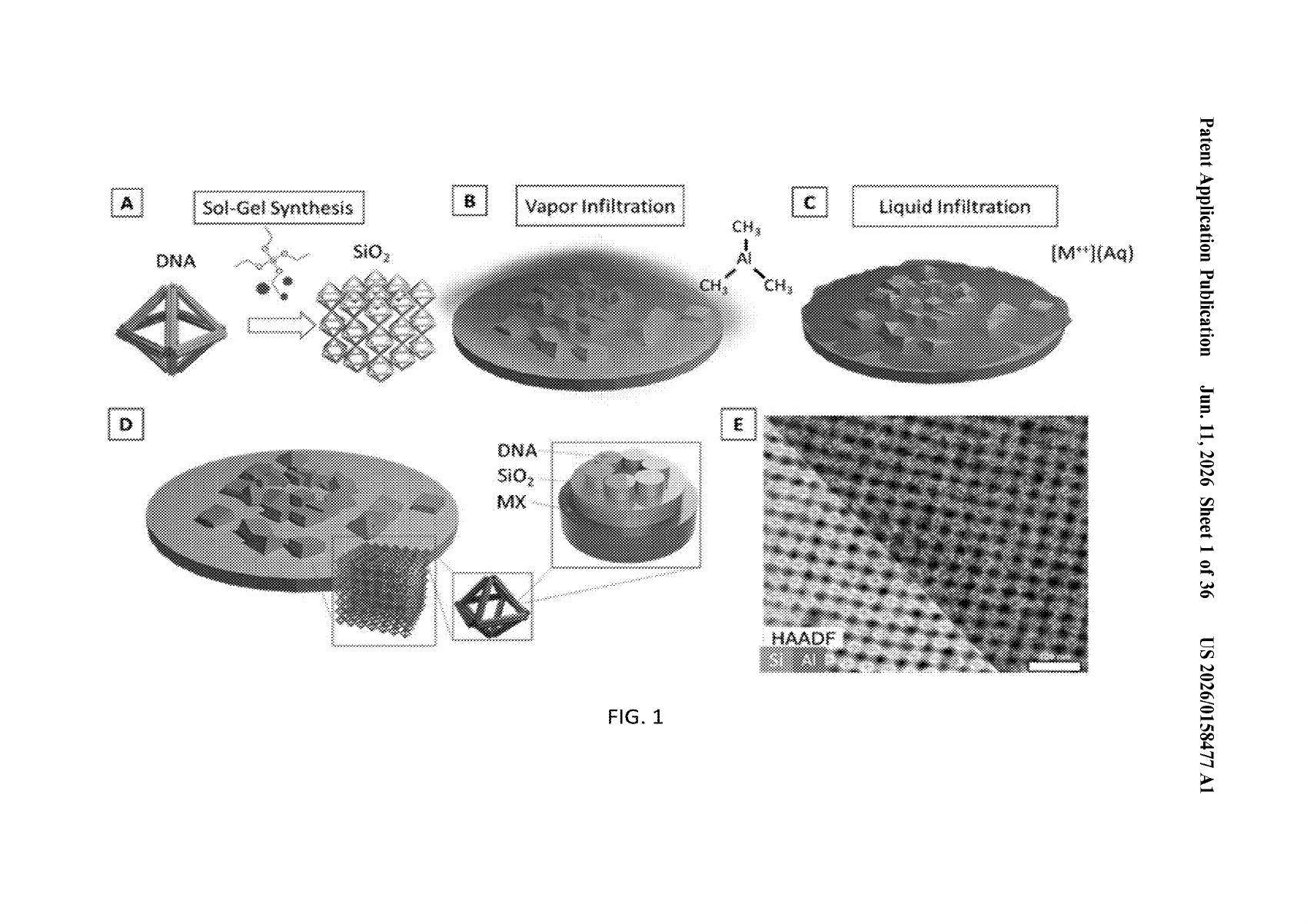
US patent publication; document page 2. Rotated for reading.
- A popular-science news article from ZME Science, headlined "Iron Man-inspired material made from DNA and glass is 5x stronger than steel — and 4x lighter."
- The abstract of a peer-reviewed paper, "High-strength, lightweight nano-architected silica" by Aaron Michelson et al., published in Cell Reports Physical Science (Cell Press), with a linked PDF.
- A list of eight patents attributed to the same research group, each with a short claim excerpt and a linked PDF.
The dossier is therefore a mixed-provenance aggregation: a press paraphrase, a primary scientific abstract, and legal claim language. The three layers carry very different evidentiary weight, and the article below keeps them separate.
The core scientific claim
The primary paper's abstract describes continuous nanolattices as "an emerging class of mechanical metamaterials" attractive for their superior strength-to-weight ratios, which "originate from their spatial architectures and nanoscale-sized elements possessing near-theoretical strength." It notes that rational design of frameworks below 50 nm is difficult because few methods exist to arrange small elements into complex architectures.
The reported fabrication route: silica frameworks with elements approximately 4 to 20 nm thick, made by self-assembly and silica templating of DNA origami nanolattices. The reported characterization: in situ micro-compression testing to examine mechanical properties.
The reported findings, in the abstract's own terms:
- Strong effects of lattice dimensions on yield strength (σy) and failure mode.
- Silica nanolattices "exhibit yield strengths higher than those of any known engineering materials with similar mass density."
- The "robust coordination of the nanothin and strong silica elements" yields a combination of lightweight and high-strength framework materials, offered as "an effective strategy for the fabrication of nanoarchitected materials with superior mechanical properties."
The density qualifier — "with similar mass density" — is part of the paper's claim and is central to reading it correctly. The comparison is density-normalized, not an absolute strength ranking.
How the mechanism is described
The abstract does not give a step-by-step protocol, but the mechanism it names has two stages:
- DNA origami nanolattice as a scaffold. Folded DNA nanostructures define a designed three-dimensional lattice geometry at the nanoscale.
- Silica templating. Silica is deposited onto (or grown around) that DNA scaffold, producing a continuous silica framework whose struts inherit the scaffold's geometry at roughly 4–20 nm thickness.
The strength argument then rests on the nanoscale of the elements: elements that small contain few defects, so they can approach the theoretical strength of the material rather than the defect-limited strength of bulk glass. The lattice architecture converts that element-level strength into a lightweight bulk framework. See Near-Theoretical Strength at the Nanoscale and DNA Origami Templating.
The press framing
The ZME Science article is quoted in the dossier as follows: scientists "successfully combined the intricate structure of DNA with the purity of glass to create a material that boasts both lightness and unprecedented strength. The resulting supermaterial is five times lighter yet four times stronger than steel. This makes it 'the strongest known' for its given density, according to the scientists who forged the material from the University of Connecticut, Columbia University, and Brookhaven National Lab."
Two things are worth separating here:
- The "5x lighter / 4x stronger than steel" multiplier is the journalist's conversion of a density-normalized comparison into a simple ratio. The paper's abstract does not state that ratio; it states a comparison against engineering materials of similar mass density.
- The "strongest known" phrase is retained in the press but the qualifier "for its given density" is what makes it consistent with the paper. Headlines that drop the qualifier overstate the result.
The "Iron Man-inspired" framing is editorial color and carries no technical content.
The press article attributes the work to three institutions: the University of Connecticut, Columbia University, and Brookhaven National Laboratory.
The patent layer
The dossier lists eight patents with short claim excerpts. These are claims, not demonstrated results; a patent is not proof of effectiveness. The list is also broader than the DNA–silica headline — several entries concern adjacent work by the same group (peptoid coatings, molecular amplification, nanoparticle crystallization) rather than the silica nanolattice itself.
US20260158477A1 — 3D Metal, Metal Oxides, And Semiconductor Nanoscale Frameworks Through Templating Of DNA-Programmable Lattice Scaffolds
Claim language as quoted in the source:
A composite, comprising: a three-dimensional (3D) silicate lattice, the silicate lattice comprising a first porous motif, the first porous motif optionally being characterized as polyhedral, the first porous motif optionally defining a pore size of from about 5 to about 100 nm; and a first inorganic layer superposed over the silicate lattice, the first inorganic layer optionally coupled to the silicate lattice. A device, the device comprising a composite according to the present disclosure. A method, comprising: forming a silicate layer superposed on a 3D nucleic acid lattice, the nucleic acid lattice comprising a first porous motif, the first porous motif optionally being characterized as polyhedral, the first porous motif optionally defining a pore size of from about 5 to about 100 nm; and forming a first inorganic layer superposed over the silicate layer, the first inorganic layer optionally coupled to the silicate layer.
This is the patent closest to the paper's subject matter: a 3D silicate lattice with a porous motif (pore size about 5–100 nm) and an inorganic layer superposed over it, plus a method of forming a silicate layer on a 3D nucleic acid lattice. See US20260158477A1 — 3D Metal, Metal Oxides, and Semiconductor Nanoscale Frameworks Through Templating of DNA-Programmable Lattice Scaffolds.
US12548243B2 — 3D-organized nanomaterials through DNA-prescribed and valence-controlled material
Claim language as quoted in the source:
The present subject matter relates to a voxel and methods of organizing an object into a three-dimensional (3D) array using the voxel. The voxel can include a plurality of frames including at least one single stranded (ss) DNA motif with at least one free base, wherein the at least one ssDNA motif hybridizes with a complementary strand fragment of other frames.
This describes a DNA "voxel" building block for 3D organization — the assembly logic underlying DNA-prescribed lattices. See US12548243B2 — 3D-Organized Nanomaterials Through DNA-Prescribed and Valence-Controlled Material.
US11739162B2 — Side chain modified peptoids useful as structure-stabilizing coatings for biomaterials
The current invention pertains compositions and methods to generate compositions providing stability to biomolecules, including providing physiologically stable and functional DNA origami-based drug/gene delivery carriers by surface coating with the oligo-ethylene glycol conjugated peptoids of Formulas (I), (II), and (III).
Adjacent work: stabilizing DNA origami structures with peptoid coatings, framed for drug/gene delivery rather than structural materials.
US11866775B2 — Methods for isothermal molecular amplification with nanoparticle-based reactions
The present method of detection involves increasing an amount of analyte molecules by an isothermal molecular amplification approach. In the present approach a starting molecule of interest may be amplified through a reaction it induces with specifically engineered and functionalized particles, namely protected particles A and storage particles B. This reaction may result in a set of output DNA molecules that is larger in number than the input DNA molecules. Thus the reaction between nanoparticles for amplification of a certain DNA sequence (input DNA molecules) may occur when there is a match with a targeted molecule (stored molecules on storage particles B) and if the DNA sequence of the input DNA molecules does not match (partially or completely) the targeted molecule the reaction may not occur. Without a certain molecular input of the input DNA molecule the reaction may not occur.
Adjacent work: nanoparticle-based isothermal amplification for detection — a sensing/diagnostics application, not a structural material.
US9751758B2 — Rational assembly of nanoparticle superlattices with designed lattice symmetries
A method for lattice design via multivalent linkers (LDML) is disclosed that introduces a rationally designed symmetry of connections between particles in order to achieve control over the morphology of their assembly. The method affords the inclusion of different programmable interactions within one linker that allow an assembly of different types of particles. The designed symmetry of connections is preferably provided utilizing DNA encoding. The linkers may include fabricated "patchy" particles, DNA scaffold constructs and Y-shaped DNA linkers, anisotropic particles, which are preferably functionalized with DNA, multimeric protein-DNA complexes, and particles with finite numbers of DNA linkers.
This is the lattice-design methodology — "lattice design via multivalent linkers" (LDML) — that underpins programmable lattice symmetry.
US2016176988A1 — Methods for the bio-programmable crystallization of multi-component functional nanoparticle systems
The bio-programmable crystallization of multi-component functional nanoparticle systems is described, as well as methods for such bio-programmable crystallization, and the products resultant from such methods. Specifically, the systems disclosed and taught herein are directed to improved strategies for the DNA-mediated self-assembly of multi-component functionalized nanoparticles into three-dimensional order superlattices, wherein the functionalization of the nanoparticles with DNA is independent of either the composition of the material, or the shape of the nanoparticles.
US2013137602A1 — Arbitrary assembly of nano-objects into designed 1D and 2D arrays
The present invention is directed to nanoscale fabrication of nano-materials with application in electronics, energy conversion, bio-sensing and others. Specifically, the invention is directed to arbitrary, that is periodic and non-periodic, assembly of nano-objects on I D and 2D arrays. The present invention utilizes self-organization properties of nanoscale bio-encoded building blocks, programmability of biomolecular interactions, and simple processing techniques for providing arbitrary by-design fabrication capability. Specifically, the present invention utilizes double stranded DNA attached to a surface and intercalating PNA-DNA hybrids attached to nano-objects to bind the nano-objects to the dsDNA in a site specific manner. The present invention allows for an integration of a large number of nano-components in unified well-defined systems. Accordingly, the present invention is applicable for fabrication of I D and 2D structures of various by-design placements of nano-objects of multiple types, including metal, semiconducting and organic nano-objects.
US8729012B2 — Controllable assembly and disassembly of nanoparticle systems via protein and DNA agents
The invention relates to the use of peptides, proteins, and other oligomers to provide a means by which normally quenched nanoparticle fluorescence may be recovered upon detection of a target molecule. Further, the inventive technology provides a structure and method to carry out detection of target molecules without the need to label the target molecules before detection. In another aspect, a method for forming arbitrarily shaped two- and three-dimensional protein-mediated nanoparticle structures and the resulting structures are described. Proteins mediating structure formation may themselves be functionalized with a variety of useful moieties, including catalytic functional groups.
Evidence assessment
| Layer | What it asserts | Evidence type | Weight |
|---|---|---|---|
| Michelson et al. paper abstract | Silica nanolattices with 4–20 nm elements; yield strengths higher than any known engineering material of similar mass density | Peer-reviewed report of in situ micro-compression testing | Strongest layer, but only the abstract is reproduced here |
| ZME Science article | "5x stronger than steel, 4x lighter"; "strongest known" for its density | Journalist paraphrase of the paper | Derivative; adds a multiplier the paper does not state |
| Patent claims | Compositions and methods for DNA-templated lattices and related nanomaterials | Legal claim language | Not experimental validation |
The mechanical claim rests on direct compression testing reported in a peer-reviewed venue — a materially stronger evidentiary position than the archive dossiers in this wiki that rest on press coverage, testimony, or patent text alone. However, this source reproduces only the abstract: no stress–strain curves, no sample counts, no error bars, no replication data. The claim is credible but not independently verifiable from this dossier alone.
Limitations and unresolved questions
- Abstract-only evidence. The full paper text was not ingested here. Numerical yield strengths, densities, sample sizes, and statistical treatment are not available from this source.
- Press multiplier vs. paper claim. "5x stronger than steel, 4x lighter" is the press's phrasing. The paper's claim is conditioned on similar mass density. The two are compatible but not identical, and the multiplier should be attributed to the press.
- Scope of "strongest known." The paper's comparison is explicitly density-conditioned. Any statement that the material is simply "the strongest material" would drop the paper's own qualifier.
- Patent breadth. The eight patents span peptoid coatings, molecular amplification, and nanoparticle crystallization. Presenting the whole list as "the DNA–silica patents" would overstate the connection to the headline result.
- Institutional attribution. The press names the University of Connecticut, Columbia University, and Brookhaven National Laboratory. The dossier itself does not break down which institution contributed which part of the work.
Related work and context
This dossier is another the source archive aggregation, following the archive's pattern of mixing press coverage, primary literature, and patent lists (compare sources/main-archive and sources/library-annex). It differs from most of the archive's inventor dossiers in that the headline claim is published in a peer-reviewed journal and backed by direct mechanical measurement rather than testimony or patent text alone. See DNA-Silica Claims vs. Evidence: The Press Multiplier, the Paper Abstract and the Patent List for the layer-by-layer comparison.
Topic guides this source touches: concepts/chemistry (silica templating, DNA chemistry), concepts/construction (structural materials), concepts/physics (nanomechanics, strength of materials).
Source notes & attribution
- rexresearch.com dossier: "Oleg GANG, et al. : DNA-Silica — 5x stronger than steel, 4x lighter ... articles & patents," https://rexresearch.com/GangDNASilica/GangDNASilica.html
- ZME Science: "Iron Man-inspired material made from DNA and glass is 5x stronger than steel — and 4x lighter," https://www.zmescience.com/science/news-science/mix-dna-with-glass-stronger-material-rep/
- Aaron Michelson et al., "High-strength, lightweight nano-architected silica," Cell Reports Physical Science , https://www.cell.com/cell-reports-physical-science/fulltext/S2666-3864(23)00254-0
- Patent PDFs linked from the dossier: US20260158477A1, US12548243B2, US11739162B2, US11866775B2, US9751758B2, US2016176988A1, US2013137602A1, US8729012B2
- https://rexresearch.com/GangDNASilica/GangDNASilica.html
Go deeper.
13 further articles3 min
DNA-Silica Claims vs. Evidence: The Press Multiplier, the Paper Abstract and the Patent List
The source archive DNA-Silica dossier bundles three layers of material with very different evidentiary weight. This comparison separates them and states what each layer does and does not support.
1 min
DNA Origami Templating
DNA origami templating is the fabrication strategy at the center of the source archive DNA-Silica dossier: a folded DNA nanostructure defines a designed three-dimensional geometry, and a second material is deposited or grown on that scaffold so that the final framework inherits the DNA's shape.
1 min
Silica Nanolattice
A silica nanolattice is a continuous three-dimensional framework of silica struts whose elements are nanoscale in thickness. In the source archive DNA-Silica dossier, the term refers specifically to the material reported by Michelson et al. in "High-strength, lightweight nano-architected silica": silica frameworks with approxima
1 min
US20260158477A1 — 3D Metal, Metal Oxides, and Semiconductor Nanoscale Frameworks Through Templating of DNA-Programmable Lattice Scaffolds
A patent listed in the source archive DNA-Silica dossier. Of the eight patents in the dossier, this one is closest to the subject matter of the silica nanolattice paper: it claims a 3D silicate lattice with a porous motif and an inorganic layer superposed over it, plus a method of forming a silicate layer on a 3D nucleic acid la
1 min
Oleg Gang
Oleg Gang is the named principal researcher behind the source archive dossier "Oleg GANG, et al. — DNA-Silica." The dossier attributes to his group a body of work on DNA-programmed nanomaterial assembly, including the silica nanolattice paper and a family of patents on DNA-templated lattices, nanoparticle superlattices, and rela
1 min
Columbia University
Columbia University appears in the source archive corpus in two distinct connections, drawn from two different source documents.
1 min
Near-Theoretical Strength at the Nanoscale
Near-theoretical strength at the nanoscale is the mechanism invoked in the source archive DNA-Silica dossier to explain why nanoscale structural elements can be far stronger than their bulk counterparts. The paper abstract states that continuous nanolattices are attractive because of "their spatial architectures and nanoscale-si
1 min
In Situ Micro-Compression Testing
In situ micro-compression testing is the experimental method named in the source archive DNA-Silica dossier for measuring the mechanical properties of the silica nanolattices. The paper abstract states that the authors "perform in situ micro-compression testing to examine the mechanical properties" of the fabricated silica frame
1 min
Mechanical Metamaterials
Mechanical metamaterials are materials whose mechanical properties derive from their spatial architecture rather than from composition alone. The source archive DNA-Silica dossier uses the term in the framing sentence of the paper abstract it reproduces: "Continuous nanolattices are an emerging class of mechanical metamaterials
1 min
US12548243B2 — 3D-Organized Nanomaterials Through DNA-Prescribed and Valence-Controlled Material
A patent listed in the source archive DNA-Silica dossier. It describes a DNA "voxel" building block and methods of organizing an object into a three-dimensional array using that voxel — the assembly logic behind DNA-prescribed 3D lattices.
1 min
Aaron Michelson
Aaron Michelson is the first author of "High-strength, lightweight nano-architected silica," published in Cell Reports Physical Science (Cell Press) and reproduced in abstract form in the source archive DNA-Silica dossier.
1 min
University of Connecticut
The University of Connecticut is named in the ZME Science article quoted in the source archive DNA-Silica dossier as one of three institutions behind the DNA–silica nanolattice material, alongside Columbia University and Brookhaven National Laboratory .
1 min
Brookhaven National Laboratory
Brookhaven National Laboratory is named in the ZME Science article quoted in the source archive DNA-Silica dossier as one of three institutions behind the DNA–silica nanolattice material, alongside the University of Connecticut and Columbia University .
The visual record.
1 archived figures · open to inspectThe source room.
Everything readable here stays on StrangewellArchived texts preserve what the source said. They may contain historical, speculative, or promotional claims; inclusion is not verification.
Source text5 min
Oleg GANG, et al. : DNA-Silica -- 5x stronger than steel, 4x lighter ... articles & patents
https://www.zmescience.com/science/news-science/mix-dna-with-glass-stronger-material-rep/ Iron Man-inspired material made from DNA and glass is 5x stronger than steel — and 4x lighter
Supporting documents (9)
“Captured” means saved for research; a full reading guide may still be pending.