Liquid wood
From lignin to a moldable material: process and patents.
Start here / 3 minute read
Arboform: from lignin to a mouldable composite
Arboform is a family of lignin-based composites associated with Helmut Nägele, Jürgen Pfitzer and Tecnaro. The useful idea behind “liquid wood” is processing: wood-derived constituents can be prepared as a granulate and shaped using plastics machinery. The name does not mean that an intact piece of timber becomes a liquid, or that every material in the surrounding patent portfolio has the same composition.
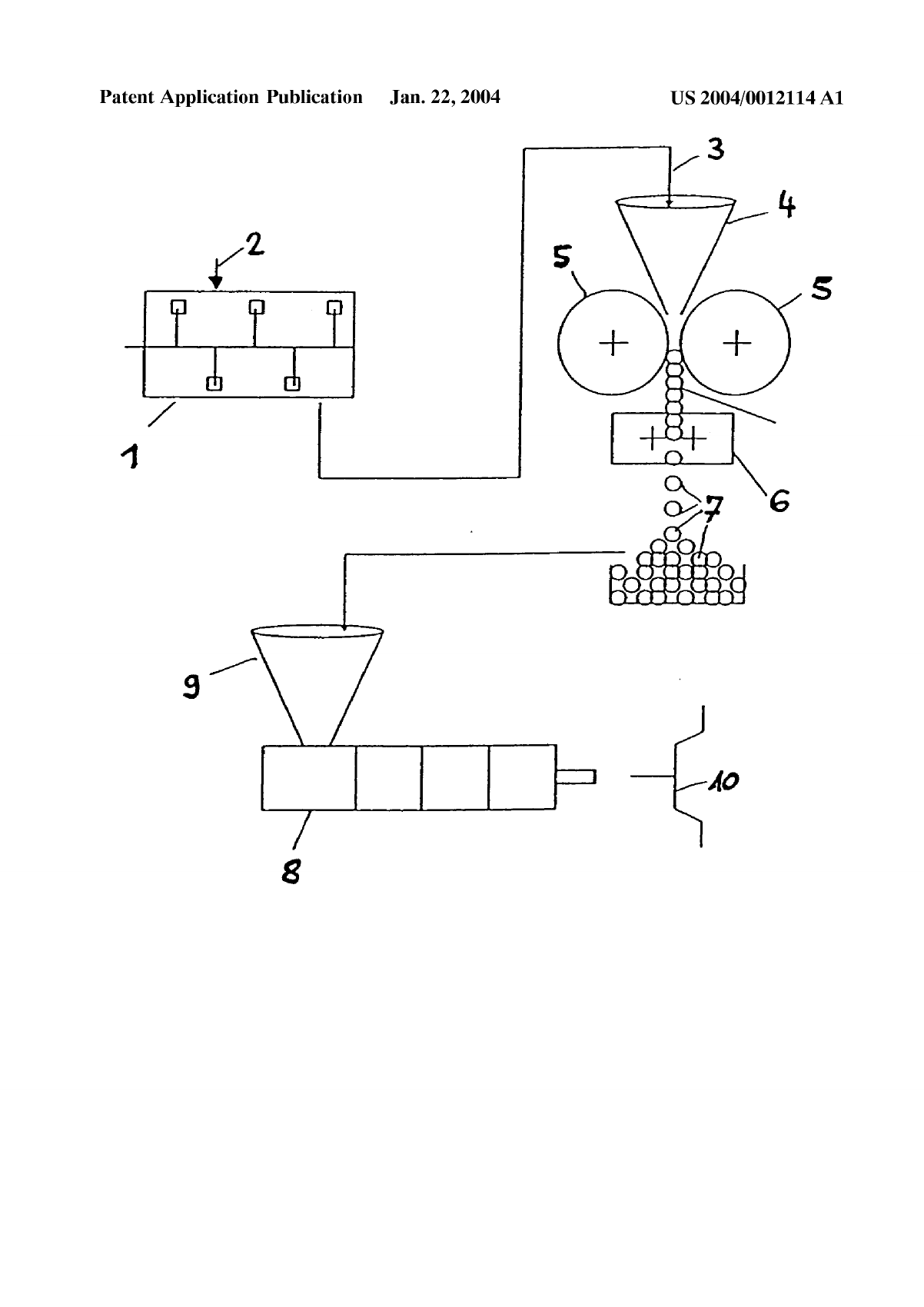
US patent publication; document page 2. Preserved page.
What each ingredient does
The source describes lignin, natural reinforcing fibres and additives. Lignin is a natural polymer recovered in large quantities during pulping. Fibres contribute reinforcement; the binder and additives affect processing, toughness and the finished surface. A formulation is therefore an engineering compromise. Raising fibre loading can change strength, flow through a mould and susceptibility to moisture together. A material description that only says “renewable” leaves those trade-offs unresolved.
The archived commercial description promotes renewable feedstocks, rigidity and a wood-like finish. It also makes environmental claims about biodegradation and carbon balance. Those are claims about a product under particular conditions, not a complete life-cycle assessment. To compare a finished part with a petroleum-based plastic, one would need its formulation, service life, manufacturing energy, transport and actual end-of-life route.
Why the granulate matters
US20040012114A1 addresses preparation of an intermediate granulate containing a finely divided thermoplastic or thermoelastic polymer and fillers. Its proposed distinction is to compact the powder mixture mechanically without first plasticizing the polymer. The agglomerates can subsequently be fed into a thermoplastic shaping process.
The patent's stated motivation is to avoid damaging the polymer and fillers during preparation while accommodating high filler proportions. This separates two operations that a casual description can collapse: making a manageable feedstock, then applying the heat needed to shape a part. The drawing in the visual record shows that processing sequence. It is a patent process diagram, not a photograph of a commercial Arboform production line or a measured performance comparison.
The source's numerical processing ranges should be read in this context. It reproduces both a description of mouldability below 160 °C and an injection-moulding range of 150–170 °C. Bench retains that difference in the source room. It should not be turned into a universal processing instruction for all grades.
A portfolio, not one recipe
Several documents in the source address different materials problems:
- US6509397B1, polymer blends: combines a lignin-based natural polymer with another natural or synthetic polymer to improve impact resistance. The scope is broader than an all-natural commercial formulation.
- US20040012114A1, intermediate granulate: concentrates on mechanically compacting polymer and filler powders before final shaping.
- WO2012110237A1, plasticizable material: describes natural polymers including polylactide or lignin combined with a polyamide based on dimer fatty acids, with optional reinforcing fibres and other additions.
- DE19852029A1, compound boards: concerns cellulose-fibre structures treated with a lignin-based bonding agent.
- DE10027862A1, renewable moulding composition: specifies shellac as its polymeric binder. Its inclusion does not make shellac the binder of every Arboform product.
This is why the dossier should be read as a material-development family. Treating every patent abstract as a single ingredient list produces contradictions that are not necessarily contradictions in the underlying inventions.
What can be concluded from the available evidence?
The source contains substantive technical material: patent abstracts, a review citation, processing descriptions and reported properties. The earlier short introduction understated that material. At the same time, a reported strength or heat-resistance value belongs to the sample and test that produced it. It cannot establish every grade's suitability for packaging, food contact or a medical application.
There are three useful levels of comparison. First, composition: how much is lignin, fibre and another polymer? Second, process: how is the feedstock prepared, shaped and cooled? Third, use: what load, humidity, temperature and lifetime must the final part withstand? A good comparison keeps those levels together instead of ranking materials by one appealing number.
How to read this dossier
Start with the granulation drawing, then open its preserved patent to follow the component numbers and claims. Read the source text for the broader commercial and historical framing. The linked concept articles explain the ingredients, but the patents distinguish the specific processing proposals. The remaining research task is a grade-by-grade comparison with identified test methods and independently documented service performance; this overview does not claim that comparison has already been completed.
Source notes & attribution
- https://rexresearch.com/NagelePfitzerArboformBioplastic/NagelePfitzerArboformBioplastic.html
Go deeper.
6 further articles7 min
Arboform: Lignin-Based Bioplastic, Reported Properties and the Patent Set
Arboform is a trade name for a thermoplastic material built mainly from lignin and cellulose fibers rather than from petroleum-derived polymers. Its developers and vendors market it as "liquid wood": a material that can be melted, injection-molded and machined like a plastic, yet is composed of the same natural polymers found in
7 min
Arboform: Lignin-Based Bioplastic, Reported Properties and the Verification Gap
Arboform is a trade-named thermoplastic composite built from lignin, cellulose fibres and natural additives, marketed under the nickname "liquid wood" because it looks and behaves like wood yet can be melted and moulded like a plastic. The dossier collected here assembles three kinds of secondary description — a vendor page, a W
5 min
Nägele
Nägele is one of the two inventors named in the source dossier on Arboform and "liquid wood," paired in the dossier title with Pfitzer . The source URL slug ( NagelePfitzerArboformBioplastic ) confirms the pairing as the page's organizing identity.
1 min
Arboform
Arboform is a lignin-based composite material presented in the source dossier as a plastic substitute and marketed under the name "liquid wood." According to the dossier, it is formulated from lignin , cellulose and natural additives, and can be processed with conventional thermoplastic techniques such as molding and extrusion.
1 min
Liquid Wood Claim
The "liquid wood" claim is the assertion, carried in the source dossier on Nägele and Pfitzer , that Arboform is a renewable, biodegradable plastic substitute made from lignin and cellulose that can be processed with conventional thermoplastic techniques.
1 min
Pfitzer
Pfitzer is one of the two inventors named in the source dossier on Arboform and "liquid wood," paired in the dossier title with Nägele . The source URL slug ( NagelePfitzerArboformBioplastic ) confirms the pairing as the page's organizing identity.
The visual record.
1 archived figures · open to inspectThe source room.
Everything readable here stays on StrangewellArchived texts preserve what the source said. They may contain historical, speculative, or promotional claims; inclusion is not verification.
Source text11 min
NagelePfitzerArboformBioplastic
Arboform [Bioplastic \ \ [ "Liquid Wood" ] \ \ * * \ \ https://biolastics.com.au/our-raw-materials/arboform/ Bioplastics Arboform is ‘Liquid Wood’ and brings together the\ most powerful material assets of two of the most used materials\ on the planet. It combines the precision, flexibility and\ durability of plastic with the
Supporting documents (15)
“Captured” means saved for research; a full reading guide may still be pending.
Keep following.
Thematic connections, not evidence of a shared mechanism32 / Matter & materials
DNA–silica
Molecular architecture as a route to strong, lightweight structures.
↗36 / Matter & materials
Flash Joule heating
Trace the pulse-heating process from papers to applications.
↗35 / Matter & materials
Living mineral systems
When microorganisms become part of a construction process.
↗