United States patent 2,460,707, "Electrotherapeutic Apparatus", names Thomas H. Moray as inventor. The patent does not say who he was; this dossier takes him to be T. Henry Moray, the subject of T. Henry Moray, and the rest of this page rests on that identification. The application (US485112A) was filed on 30 April 1943 and the patent was published as granted on 1 February 1949, with Moray holding it as an individual rather than through a company. It is classified under electrotherapy (A61N1/00) and radiation therapy (A61N5/00), and Google Patents lists it as expired. Readers of this dossier mostly meet the number second-hand: the memoir-style accounts behind Moray's Radiant Energy Receiver: The Swedish Stone, the Germanium Valve and the Twenty-Point Duplication Test and Moray's Radiant Energy Receiver: Reported Figures, the Germanium Valve and the Twenty-Point Duplication Test cite it for a material they call "Moray lead". This page sets out what the patent itself describes.
What the patent claims to be
The document presents a medical apparatus, not an energy source. Its stated aim is to apply high-potential, high-frequency electricity together with radioactive emanations and other radiation for therapeutic purposes. The patent asserts that different forms of radiant energy suit different ailments, and that it supplies several specially developed discharge tubes as treatment electrodes for that reason. These are the inventor's assertions. The patent reports no patient outcomes, no clinical trial and no measurements of what the tubes emit. Like any patent, it records what was described and granted, not that the treatment worked (see Patent as Evidence).
How the apparatus is said to work
Where does the power come from?
Everything runs from an ordinary 115 V supply. In the main design a transformer steps this up; the patent allows any type giving roughly 10,000 to 30,000 volts, though it favours a double magnetic circuit transformer with adjustable laminated magnetic shunts. A second design puts an Oudin-coil-type high-frequency generator after an ordinary high-voltage transformer, and the patent says the same set of treatment stations is used with it.
What is the "governor" for?
Connected across the high-voltage output is a part the patent calls a corona regulator or governor, described as "a sparking condenser of high capacity embodying a multitude of spark gaps." According to the patent it sets the current and protects the transformer. In practice it is a capacitor built from nested cylinders: a conductive core and a conductive outer shell with an insulating layer between them. The outer shell is stamped into many inward points (250 is offered as an example), which give off a brush discharge. The patent's preference is for the insulating layer to be sealed and pumped to a vacuum, with quartz suggested where it is left open. In the second design, one of several high-capacity vacuum tubes takes over this job.
What does each treatment station do?
The main design feeds five stations, lettered A to E.
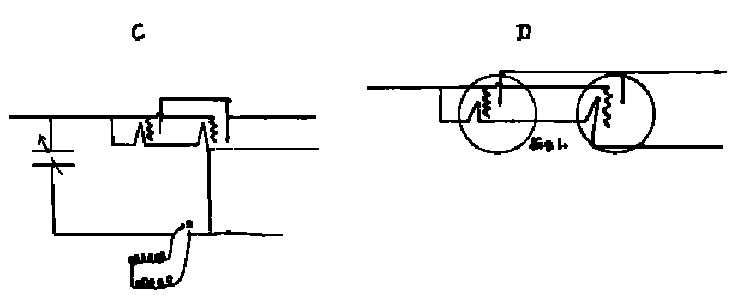
- Stations A, B and C all place a radioactive discharge tube on the patient as a single-terminal electrode. They differ only in what lies in the supply line: nothing extra at A, a condenser at B and an inductance at C.
- Station D uses a two-terminal tube the patent calls germicidal. It picks up its high voltage by induction from the supply line and, the patent says, charges the patient while delivering germicidal rays.
- Station E runs the same germicidal tube on its own from an ordinary 115 V supply, while the patient is charged separately through a soft pad with a coil embedded in it.
The patent also describes an insulated bath tub and an insulated shower or vapour stall, each fitted with treatment electrodes; in the bath, the electrode charges the conductive fluid the patient lies in.
What is actually radioactive?
In the legible text, the radioactive material sits in the tubes used at stations A to C. The patent gives two versions. In one, uranium salts, powdered carnotite or another radioactive ore line the inner side walls of an evacuated shell, which also holds triple-distilled mercury and, preferably, argon. In the other, powdered radioactive material is shaken into a hollow ball on the end of the discharge element; mercury is added mainly to absorb stray gas, and the walls may be coated as well. The germicidal tube is described as holding argon, mercury and a piece of lithium metal to absorb stray gas; no radioactive filling is described for it. Some of the vacuum tubes in the second design contain shields of lead or similar material meant to screen off X-rays, along with a slit screen, an inner glass or quartz tube with a filament and a bombardment element, a lens-shaped window and a reflector.
The safety reasoning it offers
The patent's safety case rests on a few design principles. Only one terminal touches the patient, so the body never completes a closed circuit. The patient is insulated from ground. The terminal is said to be "usually non-heat producing", and the patent adds that X-rays or other harmful rays are filtered out where a tube tends to produce them. The document asserts that the high-potential electricity can be applied without injury to a patient who is not grounded. It offers this as a statement, with no test data behind it. Nothing in the patent should be read as guidance for using such equipment.
The electrode alloy and "Moray lead"
The patent gives one material formula. The discharge element (cathode) in the station A tubes, and the terminals of the germicidal tube, are to be made from an alloy of copper, lead, sulphur and optionally aluminium. A satisfactory mix is given as 5.0% copper, 55.0% lead, 30.0% sulphur and 10.0% aluminium. If aluminium is left out, extra copper makes up the difference. The copper and aluminium are melted first, sulphur is stirred in, and molten lead is added after remelting; the published text of this passage breaks off before the method is complete.
That matters for this dossier because the memoir accounts link "Moray lead" to this patent. They say lead and similar metals changed their physical properties after treatment with the apparatus. The text on Google Patents is badly garbled by character recognition and fragmentary in places. In its legible parts, lead appears only as an alloy ingredient and as X-ray shielding, and no passage describes metals being altered by the apparatus. On the readable evidence, the link between the patent and "Moray lead" rests on the memoir's statement rather than on anything the patent can be shown to disclose.
What the patent does not show about the receiver
The legible text describes no antenna, no ground connection used as a collector, no ambient or "radiant" energy source, no germanium valve and no "Swedish Stone". Every part of the apparatus runs from the mains through a transformer or an Oudin-type coil. Even so, it has points of contact with the receiver story. It combines radioactive materials with evacuated, gas-filled discharge tubes. The memoir behind Moray's Radiant Energy Receiver: The Swedish Stone, the Germanium Valve and the Twenty-Point Duplication Test says that Moray's 1942 attempt to rebuild his detector led him into research on radioactive materials, and that the receiver used ionic cold-cathode tubes. The patent confirms that Moray worked with radioactive discharge tubes in the 1940s. It does not show that these tubes were the receiver's detectors, or that they could take in energy at all.
The citation record places the patent within an existing line of devices. The prior patents it cites include Louis Winkelmann's "Radioactive vacuum tube" (US1466777A, 1923), Frank A. Davis's "Monopolar vacuum-tube" (1910) and Robert Gallois's electrode combining high-frequency current with ultraviolet (1928). Later citers include two patents by Robert M. Lyden, filed in 2019, on devices for receiving energy from the earth and its atmosphere (US11588421B1, 2023; US12136824B2, 2024). Those citations show that a later inventor treated this patent as relevant prior art. They are not evidence about either device's performance.
Connections in the dossier
For how this patent fits Moray's wider record, see T. Henry Moray. That page records that his 1931 patent application was rejected, and the account it draws on states that none of his original patent applications are any longer available at the US Patent Office. This granted patent, by contrast, is published and can be read on Google Patents. The detector itself is discussed at Moray Valve, and the claim structure at Radiant Energy Receiver Claim.
References
- Moray, Thomas H. US 2,460,707, "Electrotherapeutic Apparatus", application US485112A filed 30 April 1943, published 1 February 1949. https://patents.google.com/patent/US2460707A/en
Source notes & attribution
- https://patents.google.com/patent/US2460707A/en