The "Lugano report", dated 6 October 2014, is an account of an extended test of Andrea Rossi's E-Cat (Energy Catalyzer) by the same collaboration that ran the March 2013 test. Its authors were Giuseppe Levi (Bologna University), Evelyn Foschi, Bo Höistad, Roland Pettersson and Lars Tegnér (Uppsala University) and Hanno Essén (Royal Institute of Technology, Stockholm). It describes a run of about 32 days, from late February to a shutdown on 29 March 2014, and makes two headline claims. The first is that the reactor gave out roughly 3.2 to 3.6 times the electrical power fed into it. The second is that its lithium and nickel fuel changed isotopic composition. The authors take both as signs of a nuclear process. They also call the missing radiation an open question.
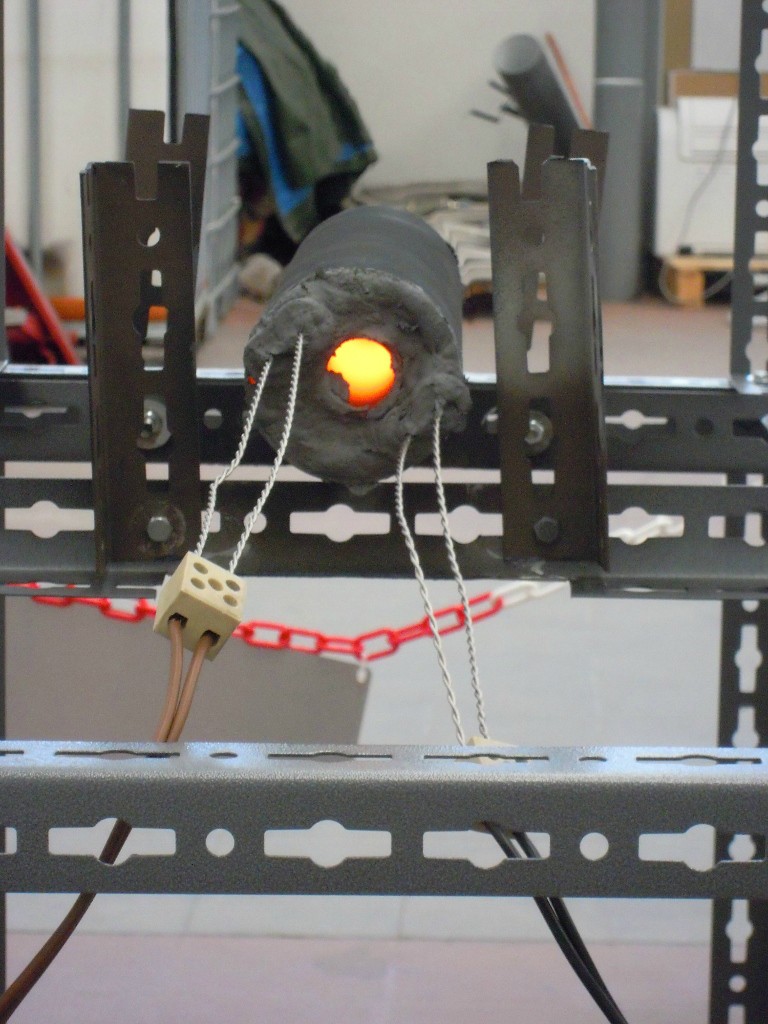
The device and the setting
The report says the team wanted a lab with no ties to Rossi's businesses. The test was therefore hosted at Barbengo (Lugano), Switzerland, in space provided by Officine Ghidoni SA. The authors also say the E-Cat technology had by then been transferred to Industrial Heat LLC in the United States, and that this reactor was an improved model that ran hotter than the one tested in March 2013.
The reactor was an alumina cylinder 2 cm across and 20 cm long. At each end was a fixed alumina "cap" 4 cm by 4 cm. The body was moulded with triangular ridges 2.3 mm high, which the report says improve convective cooling and prevent the internal melting seen in earlier models. Three Inconel resistor cables came out of each cap. The power cables ran inside alumina rods that extended 50 cm on each side. A TRIAC regulator, set by a potentiometer and a thermocouple, drove the coils, normally at 40–50 amps. The whole reactor weighed 452 g after the test. The fuel charge was about 1 g of powder.
The report states the limits of the team's control. By its account, Rossi switched the dummy run on and off, and he was also the one who intervened when the fuel went in, when the reactor was started and shut down, and when the spent powder came out. The authors say he intervened in nothing else and that the collaboration monitored every phase directly. The powder was poured in with a member of the team present, and the team took the fuel and ash samples for analysis itself. They also state that they did not know the reactor's internal structure. They could not exclude other charges inside besides the one they weighed. The make-up of the Inconel resistors was covered by trade secret.
How output was measured
The team did not use a coolant loop. They estimated heat output from the surface. Two Optris PI 160 thermal cameras, working at 7.5–13 μm, recorded surface temperatures. Radiated power was then calculated with the Stefan–Boltzmann law, and convection was estimated from standard correlations for cylinders and finned surfaces. Two PCE 830 analysers measured electrical input, one on each side of the control unit, and multimeters checked for any DC component. The report includes a wiring diagram and a harmonic analysis. It says the main harmonics fell within the 20th, which was inside the analysers' range.
Emissivity is at the centre of the method. The report notes that a thermal camera infers temperature from an emissivity value the user supplies, so the same number shapes both the temperature reading and the radiated power. The ridges made contact thermocouples unreliable, and reference "dots" could not survive the reactor's heat. The team therefore took an alumina emissivity-versus-temperature curve from the literature. A post-test X-ray analysis had found the shell was at least 99% pure alumina. Each image area was then adjusted step by step until the temperature and emissivity agreed with that curve. The report illustrates, for one image area of the dummy run (Area 5) at a single instant, that starting values of 1.00 and 0.5 both converge on an emissivity of 0.69; it presents this as proof of independence from the starting value, though the demonstration is that narrow. It assigns an uncertainty of ±0.01 to emissivity values read from the curve. Dots were used only on the cooler rods. There, one dot gave 235 °C against 237.5 °C from the literature emissivity.
The dummy run as a check
The team first ran the reactor without fuel for 23 hours, keeping power below 500 W to avoid damage. Input averaged 486 ± 24 W, or 479 W after subtracting about 7 W of cable heating. The calculated output was 446 ± 10 W. The authors read this as showing that their method does not overestimate, and may underestimate by up to 14%. They are explicit that the dummy run checked the method and was not a like-for-like comparison with the loaded reactor. The loaded reactor ran at much higher power and temperature, about 1260–1400 °C against roughly 450 °C on the dummy body.
Reported heat results
After start-up the body read 1260 °C at about 810 W input. After nearly ten days the team raised input to just over 900 W. The body then rose to almost 1400 °C within roughly 400 seconds. The report says about 100 W of extra input gave about 700 W of extra output. Across the 16 two-day data files, the COP ranges from 3.13 to 3.75. Net output rises from about 1660 W to about 2370 W. Summed over about 768 hours, the body of the report gives 1,618,194 Wh, or (5825 ± 10%) MJ. The abstract instead states a net total of about 1.5 MWh, roughly 0.12 MWh less than that sum. Assuming a 1 g charge, the energy density comes to 5.8 × 10^6 MJ/kg. The authors place this beyond any conventional source but still at least an order of magnitude below nuclear fuels such as U-235. Because they cannot rule out other charges inside, they repeat the sum using the whole 452 g reactor, which gives 1.3 × 10^4 MJ/kg; for this figure they say only that it still lies outside the region of the Ragone plot occupied by conventional sources. The team set the shutdown date in advance. They therefore present the results as lower limits and do not estimate how long a charge would last.
Fuel and ash analysis
The analysed sample totalled about 10 mg, taken from the 1 g charge and from the ash. Outside groups examined it with SEM, XPS, EDS, SIMS, ICP-MS and ICP-AES. Besides nickel, the fuel contained lithium, aluminium, iron and hydrogen. SIMS found hydrogen but no deuterium. The authors judge it plausible that the additive was lithium aluminium hydride, the same compound named in Rossi's patent fuel (see US 9,115,913 B1: Andrea Rossi's Granted Fluid Heater Patent and Its Nickel–Lithium–LiAlH4 Fuel Wafer (filed 2012)).
The fresh fuel showed natural isotope ratios. In the ash, 7Li fell from 93% to 7.9% by SIMS and to 42.5% by ICP-MS. Nickel shifted almost entirely to 62Ni, which reached 98.7% by SIMS and 99.3% by ICP-MS, up from a natural 3.6%. The authors offer rough energy budgets: about 0.72 MWh from a proton–lithium reaction and about 2.2 MWh from stepwise proton capture on nickel. They call these rough and speculative, yet conclude that the combined total of about 3 MWh makes the fuel amount "probably compatible" with the measured energy, adding that a quantitative statement would need detailed knowledge of the reactions. They also say the speculation "should only be considered as an example of reasoning and not a serious conjecture." The report itself says it is very hard to comprehend how such fusion could occur in the fuel at low energies. David Bianchini, a radiation-detection specialist, used a scintillation probe, a neutron detector, a Geiger probe and thermoluminescent dosimeters. The report says he applied his instruments to the powder before and after the run, and took similar readings on the reactor, and that no signs of activity were found. It adds that dosimeters near the reactor ran for all 32 days to detect neutrons, and gives the details in an appendix. The authors call this hard to reconcile with nuclear reactions.
What the report does and does not establish
The report documents a long, instrumented run. It also responds to several complaints made about the 2013 test (see Ericsson and Pomp's 2013 Critique of the Levi et al. E-Cat HT Test: Independence, Missing Data and a Resistive-Heating Model). The venue was not Rossi's. The team used its own calibrated instruments, published a wiring diagram and checked for DC. Its heat figure, however, depends on an emissivity curve taken from the literature, and that curve was never checked directly on the hot reactor body. The dummy run, which the authors describe as a check of the method rather than a comparison with the loaded reactor, held the body at roughly 450 °C against 1260–1400 °C for the loaded reactor, so it did not test the emissivity curve at those higher temperatures. The authors do not claim to know what is inside the reactor, and Rossi, not the team, intervened in loading, starting, stopping and emptying the reactor, though the team says it monitored each step and took its own samples. Its isotope results come from milligram samples whose composition, by the authors' own account, varied greatly from one granule to the next. It reports no radiation of the kind those isotope changes would be expected to produce. The document therefore states a claimed result with an unresolved conflict at its core, not an independent replication. It belongs to the contested Nickel–Hydrogen Excess Heat Claim and the wider Low-Energy Nuclear Reaction (LENR) debate, and to the evidence gap set out on E-Cat Claims vs. Evidence: The Dossier's Documents and the Absence of Independent Replication.
Source notes & attribution
- https://amsacta.unibo.it/id/eprint/4084/1/LuganoReportSubmit.pdf