This page covers a source dossier on a steam generator attributed to an inventor named Schaeffer. The dossier is an archive compilation — a folder of figures and accompanying text assembled by the source archive editor — rather than a peer-reviewed report, a patent grant, or an independently replicated experiment. It sits in the archive's energy cluster alongside other inventor dossiers on novel energy devices.
The dossier is identified by its source URL ([source note 3]) and by eight figure images. The supplied evidence contains substantial text: a 1977 NewsReal article by Tom Valentine, the full text of US Patent #3,791,349 (Karl Schaeffer, February 12, 1974), and a 1995 Infinite Energy piece by Michael Huffman reporting on later university and corporate tests. The patent describes a device that creates repeated water-hammer shock waves in a "distended" body of water to raise its temperature and pressure and produce steam. The NewsReal article and the Infinite Energy piece go further, asserting over-unity performance; those assertions are reported claims, not established findings. Everything below is framed as what the dossier reports, not as established fact.
What the subject is
A steam generator is a device that converts water into steam by applying heat. In conventional engineering, steam generators range from boiler drums in power stations to once-through coils in industrial process heat, and their performance is described by well-established quantities: heat input, steam output rate, pressure and temperature of the produced steam, and thermal efficiency (the fraction of input heat that appears as useful steam enthalpy).
The dossier's subject is a specific device attributed to Schaeffer, presented in the archive as an inventor submission. The archive's own framing — a named inventor, a folder of figures, a topic tag of energy — places it in the same editorial category as the archive's other "novel energy device" dossiers. That category is an editorial grouping, not a scientific one, and it does not by itself imply that the device departs from conventional thermodynamics.
How it is claimed to work
The patent describes the mechanism: a motor-driven rotor inside a stationary housing defines a "distended" chamber of interconnected passageways, including at least one closed-bottom channel and radial passages. Rotation throws water centrifugally outward, drawing water out of the closed-bottom channel and creating a vacuum; the water then snaps back, and the sudden extinguishment of flow at the closed bottom imparts a water-hammer shock. Repeated shocks are claimed to raise the water's temperature and pressure until steam is produced. The patent cites standard references on water hammer (King, Handbook of Hydraulics) and shock waves (Bradley, Shock Waves in Chemistry & Physics). Readers should treat the patent's efficiency and output claims, and the over-unity claims in the NewsReal and Infinite Energy pieces, as assertions by the inventor or reporters, not as verified results.
Two possibilities are worth keeping distinct, because they carry very different evidentiary weight:
- A conventional steam generator. A device that boils water using an external heat source and delivers steam at some rate and pressure. Claims here are ordinary engineering claims and are testable with standard instrumentation (flow, pressure, temperature, fuel or electrical input).
- A device claimed to produce more useful output than input. If the dossier asserts an efficiency at or above unity, or a novel energy source, that is an extraordinary claim. It would sit in tension with established thermodynamics and would require calorimetric measurement and independent replication before being treated as anything more than an assertion.
The supplied material does not allow a determination of which case applies. The article deliberately does not choose.
Figures
The dossier's only concrete technical artifacts are eight figure images. They are the primary visual evidence the archive provides, and they are reproduced here with factual captions limited to what the filenames and dossier context support. Captions do not assert what the figures depict beyond their role as dossier illustrations.
Figure 1a — dossier illustration accompanying the Schaeffer steam generator entry.
Figure 2a — dossier illustration accompanying the Schaeffer steam generator entry.
Figure 3 — dossier illustration accompanying the Schaeffer steam generator entry.
Figure 4 — dossier illustration accompanying the Schaeffer steam generator entry.
Figure 5a — dossier illustration accompanying the Schaeffer steam generator entry.
Figure 7 — dossier illustration accompanying the Schaeffer steam generator entry.
Figure 8 — dossier illustration accompanying the Schaeffer steam generator entry.
Figure 0nr2 — dossier illustration accompanying the Schaeffer steam generator entry.
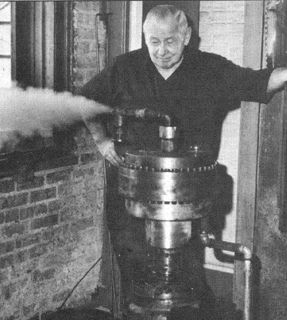
Whether these are engineering diagrams, photographs of a built device, or scanned patent drawings cannot be determined from the supplied evidence. The numbering (1a, 2a, 3, 4, 5a, 7, 8, plus a separate 0nr2 asset) suggests a sequence with gaps, but the gaps are not explained in the material available.
Reported claims
The dossier reports several performance claims, which should be attributed to their sources and treated as reported rather than established:
- Battelle tests (1973). The NewsReal article states that Sonaqua Inc took the device to Battelle in Columbus, Ohio, in September 1973, and that a report by L. J. Flanigan to George W. Moffitt Jr. dated October 4, 1973 listed efficiency over eight runs between 97.3% and 99.0%. The same article notes the report described much of the experimentation as "not definitive because shortcomings in the experimental apparatus introduced large uncertainties into the results," and quotes an engineer reporting readings above 100% (one said to be 117%).
- Aquasonics Delta-Tee. The Infinite Energy piece reproduces a report by Raymond E. Ross claiming the unit heated a 2,880 sq ft house with two 3-hp motors (13,200 BTUH) and that readings as high as 700% efficiency were observed. The report is described as a testimonial rather than a formal scientific report, with no description of device, protocol, or instrumentation.
- University tests. The Infinite Energy piece cites a May 5, 1989 report by Linda McDonald (North Park College) reporting efficiencies between 1.09 and 1.30 with a stated measurement accuracy of ±11%, and a March 8, 1990 report by Glen W. Zumwalt (Wichita State University) that used motor nameplate efficiencies and recommended a dynamometer to verify the calorimetry.
These are reported measurements and claims from the cited sources, not independently established findings.
Limitations and unresolved questions
- Archive-dossier status. the source archive dossiers compile inventor submissions, figures, and sometimes patent text. They are not peer-reviewed, and the archive does not present itself as having independently tested the devices it catalogues. This dossier should be read as an archive account.
- No measurements in the supplied material. Without input power, steam output, pressure, temperature, or efficiency figures, no quantitative assessment is possible.
- No patent number, date, or location in the supplied material. These would be needed to trace the device through patent offices or to establish priority and provenance.
- Inventor identity. The inventor is named in the source as Karl Schaeffer of Chicago, born in Germany, who described being inspired by water hammer in a Berlin washroom in 1924. The Infinite Energy piece states he sold the patent to the Aqua Corporation in 1988 for $1 shortly before he died.
- Figure content. The nature of the eight figures (diagram, photograph, or patent drawing) is unknown from the supplied material.
- Relationship to conventional steam engineering. Whether the device is a conventional boiler variant or is claimed to operate outside conventional limits cannot be determined here.
Related work
The dossier belongs to the archive's energy cluster. Related pages in this wiki include concepts/energy as the topic hub, Steam Generation for the general engineering concept, and the archive's other inventor dossiers on novel energy devices — for example the Bedini Motor/Generator/Charger and E-Cat (Energy Catalyzer) entries. Those are separate subjects with separate claims; nothing about them should be transferred to Schaeffer's device, and nothing about Schaeffer's device should be transferred to them.
For the archive's editorial pattern, see sources/main-archive and comparisons/source-types.
Source notes & attribution
- Rex Research dossier, "The steam generator" (dossier 22), rexresearch.com/schaeffe/schaeffer.htm . Native source file: rexresearch/db0fa1b0d0cccad3.md .
- Figure assets: 00fig1a , 00fig2a , 00fig3 , 00fig4 , 00fig5a , 00fig7 , 00fig8 , 0nr2 .
- rexresearch.com/schaeffe/schaeffer.htm
- https://rexresearch.com/schaeffe/schaeffer.htm