What the source is
The source archive page titled "Palmer Craig: Hall Effect Device (Battery, rectifier, amplifier)" is a dossier on a 1920s claim that a stack of thin bismuth plates could replace vacuum tubes and batteries in radio receivers. The page is not a single document. It layers four distinct kinds of material:
- A 1927 press account from Radio World (reprinted and echoed in Popular Science, May 1927) describing Craig's "electromagnetic detector and amplifier," including a claimed $100,000 Westinghouse offer and an immediate denial of that offer by RCA's Alfred N. Goldsmith.
- Craig's own 1926 Physical Review paper (27:772–778, June 1926), reporting an anomalously large Hall coefficient in thin bismuth films at very low magnetic fields and an additive behavior when films are stacked in series.
- Craig's 1931 U.S. Patent 1,822,129, "System & Apparatus Employing the Hall Effect," plus British patent GB274112 and a list of his other U.S. and Canadian patents.
- An explicit rebuttal layer: C. W. Heaps's 1927 Physical Review paper (29:332) reporting a null result for the anomalous low-field Hall coefficient, and Lieutenant Harry F. Breckel's 1927 U.S. Naval Institute Proceedings comment reporting hands-on tests in which the apparent rectification was traced to thermal junction and inductive artifacts.
A fifth layer, appended as a bibliography, lists later mainstream bismuth thin-film research — sono-electroplating, electrodeposition and magnetotransport, bismuth-film electrodes for stripping voltammetry, nanowire quantum confinement, photoconductance, and critical magnetic fields. None of that later work tests Craig's device.
The dossier's own framing calls the page a "bismuth battery." That framing is not supported by the patent, which describes a device that modifies and rectifies supplied current rather than generating power, and it is contradicted by the 1927 tests, which found no rectification attributable to the Hall effect.
The claim as it reached the public
The Radio World article of January 29, 1927 (byline Robert Bangs, p. 11) presented Craig's device as a solid-state replacement for the vacuum tube as amplifier and detector, and reported that Craig said it would displace batteries as well. The article stated that the plates "generate the energy necessary to operate the radio" and that Westinghouse Electric & Manufacturing Co. had offered $100,000 for the invention.
The same article records the denial. Alfred N. Goldsmith, chief broadcast engineer of the Radio Corporation of America, "denied that any such offer has been made" and "deprecates the idea that the peculiar property of bismuth can be used for the purpose claimed by Dr. Craig." The press account also notes that earlier attempts at bismuth rectification had failed on efficiency, dependability, and the supply of suitable metals.
This is an internal tension in the source itself: the "generates energy" framing appears in the press layer, while the patent layer describes current modification only.
Craig's published physics (1926)
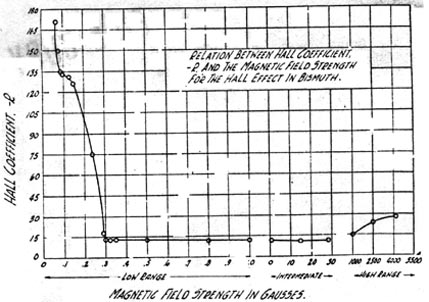
Craig's Physical Review paper is narrower and more defensible than the press framing. He measured the Hall effect in bismuth for fields between 0.07 and 1.00 gauss using improved methods, and reported that the Hall coefficient is abnormally large at very low fields. His Table I values (reproduced verbatim below) show -R ≈ 171 at 0.07 gauss, falling to about 12–13 by 0.3–1.0 gauss, about 11 at 15 gauss, and rising again to 29 at 4220 gauss.
| Gausses | Residual emf (µV) | Residual + Hall emf (µV) | Net Hall emf (µV) | -R |
|---|---|---|---|---|
| 0.07 | 14.0 | 15.5 | 1.5 | 171 |
| 0.08 | 14.1 | 15.6 | 1.5 | 150 |
| 0.09 | 14.2 | 15.7 | 1.5 | 135 |
| 0.10 | 14.2 | 15.8 | 1.6 | 133 |
| 0.13 | 14.4 | 16.1 | 1.7 | 131 |
| 0.15 | 14.3 | 16.9 | 2.6 | 126 |
| 0.24 | 14.0 | 16.3 | 2.3 | 75 |
| 0.29 | 14.6 | 21.1 | 6.5 | 18 |
| 0.30 | 14.5 | 19.8 | 5.3 | 14 |
| 0.32 | 14.4 | 19.6 | 5.2 | 13 |
| 0.35 | 14.8 | 20.5 | 5.7 | 13 |
| 0.50 | 14.6 | 22.7 | 8.1 | 13 |
| 0.80 | 14.6 | 26.6 | 12.0 | 12 |
| 1.00 | 14.6 | 29.6 | 15.0 | 12 |
| 1.0 | 14.5 | 29.5 | 15.0 | 12 |
| 15.0 | 14.3 | 35.1 | 20.8 | 11 |
| 28.5 | 14.4 | 60.4 | 46.0 | 11 |
| 1000 | 14.0 | 1889.0 | 1875.0 | 15 |
| 2500 | 14.0 | 7514.0 | 7500.0 | 24 |
| 4220 | 14.0 | 15324.0 | 15310.0 | 29 |
Craig defined the Hall coefficient as
R = Ed / IH
where R is the Hall coefficient, d the film thickness in cm, I the longitudinal current in abamperes, H the field in gausses, and E the net Hall emf. Each Table I value is reported as an average of about twelve readings, with reproducibility to roughly 0.1 µV.
Craig also reported that stacking films in series adds their Hall potentials — the "additive principle" he proposed to exploit for AC rectification, while noting in the source that the additive result "has little application where quantitative readings of a high degree of accuracy are desired." He compared film-preparation methods (casting, electroplating, evaporating, sputtering, and metallic spraying), finding the last three particularly successful, and reported that the Hall potential of one film placed in series with others yields a comparatively high Hall emf applicable as an AC rectifier in radio.
Apparatus details reported in the paper include an air-core solenoid of 100 turns on an 8 × 11 cm wooden form with 2.5 mH inductance, requiring 35.2 mA for 1 gauss at center; an electromagnet capable of 18,000 gausses; cathodic sputtering at 20,000 V secondary, 30 microns vacuum, 5 mA for about 20 minutes with a Crookes dark space of about 2 cm; a bismuth cathode disc 3.5 in diameter; a film 3.5 × 8.0 cm and 0.012 cm thick; a longitudinal current of 1.5 A; a potentiometer sensitivity increased tenfold; a galvanometer of 12.2 mm per MV; and two 6 µF condensers in the filter.
Craig's doctoral thesis, "The Hall effect with low magnetic fields" (Ph.D., University of Cincinnati, 1926, 8 pages; DP15709), is the academic root of the work.
The patent: US 1,822,129
Craig's U.S. Patent 1,822,129, "System & Apparatus Employing the Hall Effect," was granted September 8, 1931. It generalizes the film measurements into a stacked-plate device using bismuth, tellurium, or bismuth-antimony plates. The plates are connected in parallel at their ends and in series along the transverse axis, so that the transverse Hall potentials sum while the longitudinal current is shared. The patent gives the relation
E = HI/d
and names the Corbino effect — radial current in a disc under a perpendicular field producing a circular current — as a related phenomenon.
The patent describes the device as usable as a rectifier, amplifier, oscillator, and detector, and states that it may be combined with electron tubes. It calls the arrangement a "perfect rectifier" producing no distortion. Reported output figures include "several volts for only one milliampere flowing through the field coil and longitudinally through the conductive films in parallel," and about 50 µV per film, about 200 µV with transverse series connection, under 4 A at 60 Hz through a 12-turn coil.
The ten patent figures are listed as: Fig. 1 perspective; Fig. 2 end view showing field direction; Fig. 3 film arrangement; Fig. 4 rectifier wiring; Fig. 5 reflex receiving circuit; Fig. 6 detector circuit; Fig. 7 amplification/oscillation; Fig. 8 independent longitudinal-current source; Fig. 9 amplifier plus rectifier; Fig. 10 transverse field arrangement.
The British counterpart, GB274112, describes rectification by transverse potential difference from a longitudinal current through conducting plates in a perpendicular magnetic field. Alternating current is passed longitudinally through parallel plates 1, 2, 3 separated by insulating sheets and through a solenoid S producing the perpendicular field; the transverse potentials are connected in series at edges e, j. Because both the longitudinal current and the field alternate, the transverse potential difference is direct. A modification etches conducting material on an insulating base so that two systems of films are in parallel longitudinally and in series transversely, placed side by side rather than stacked.
The archive also lists Craig's other U.S. patents: US1778795, US1778796, US1792001, US1798658, US1825855, US1935738, US1956121, US1981583, US1992146, US2001836, US2001837, US2001838, US2296269, US2310304, US2327622, US2357727, US2393890, US2405089, US2414636, US2435202, US2444221, US2444222, US2463249, US2465202, US2520383, US2615062, US2937351, US3008882, plus CA386489, CA296979, CA456916, and US3197651A.
The rebuttals
Heaps (1927): the anomalous Hall coefficient is not reproducible
C. W. Heaps, in "The Hall Effect in Bismuth with Small Magnetic Fields" (Physical Review 29:332, February 1927; DOI 10.1103/PhysRev.29.332), measured a bismuth plate of 0.011 × 0.9 × 2.0 cm over 0.07–2.40 gauss. He obtained an average R of 11.5, with variations with field smaller than experimental error — against Craig's reported factor-of-ten rise at the lowest fields. At larger fields Heaps found R falling from 13.5 at 650 gauss to 5.9 at 8600 gauss. His primary current was 1.3 A; each R value was the average of at least five readings; his galvanometer was 16.6 ohms at 17.3 mm per microvolt; reversing the plate to reverse the earth's field gave a 24 mm deflection.
Heaps concluded that Craig's data were erroneous, probably from insulation leakage or uncompensated thermomagnetic effects. His methodological critique: Craig grounded his potentiometer to increase stability, which Heaps reads as evidence of variable-resistance leaks; Craig did not report reversing the magnetic field to average out thermal effects; and Craig measured Thomson and allied potentials only at the instant the longitudinal current was broken, without testing the field's effect on them. The recommended control is to reverse the magnetic field and average, since the Hall emf reverses with the field while thermal effects do not.
Heaps prepared his own thin bismuth plates by molten-drop casting: a vertically clamped glass tube holding a bismuth rod, with a clean horizontal glass plate about 10 cm below, heated until a single large drop falls and spreads into a thin uniform circular film. He used bismuth supplied as c.p. by Eimer and Amend.
Breckel (1927): the rectification is a thermal junction artifact
Lieutenant Harry F. Breckel, U.S.N.R., a consultant in the commercial radio field, published a comment in U.S. Naval Institute Proceedings (Vol. 53/8/294, August 1927; Craig's own article appeared in the April 1927 issue at p. 482). Breckel tested the device at Craig's Macon, Georgia laboratory and at a large commercial laboratory, with the inventor supervising, in view of purchasing rights under the pending patents.
His findings:
- The apparent rectification was a thermal junction effect from lead and copper contacts on the bismuth films, producing a unidirectional transverse current of the order of a few millivolts, with very low output-to-input efficiency.
- Current and voltage readings were largely due to inductive effects on wires and meters sitting in the strong magnetic field; readings fell to absolute zero when the meters were moved away.
- Radio reception results were zero. The assembled plates acted as a condenser, feeding antenna current through to conventional vacuum tubes that did the actual work.
Breckel concluded that the Hall effect principle as applied to radio was "entirely without merit at this time."
The appended bibliography of later bismuth-film research
The final layer of the page lists mainstream bismuth thin-film work from the 1940s onward. It is background, not a test of Craig's device, and the source does not assert any connection between it and the 1920s dispute.
- Epitaxial growth. Partin, Heremans, Morelli, Thrush, Olk and Perry (General Motors Research Laboratories, Phys. Rev. B 38:3818, 1988) report MBE-grown 0.1–2 µm epitaxial films on BaF₂ ⟨111⟩, with room-temperature mobilities around 2 m² V⁻¹ s⁻¹ rising above 10 at 20 K and 100 at liquid-helium temperatures, carrier density (4–8)×10²⁴ m⁻³ at room temperature falling to about 5×10²³ m⁻³ below ~50 K, and Shubnikov–de Haas oscillations at 4.2 and 0.4 K.
- Quantum size effects. Garcia et al. (Phys. Rev. B 5:2029, 1972) report thickness-dependent resistivity, Hall coefficient, and transverse magnetoresistance, with small oscillations at 12 K attributed to the quantum size effect, and a Hall-coefficient thickness dependence in striking disagreement with the infinite-potential-well model. Bollmann, van Gastel, Zandvliet and Poelsema (University of Twente / FOM, Physical Review Letters, 2011) report that thin bismuth films adopt different crystal structures than bulk, with layer spacing set so that film thickness equals a multiple of the Fermi wavelength.
- Photoelectric threshold and photoconductance. Weber and Eisele (Physical Review, 1941) report a photoelectric threshold wavelength averaging 2497 Å independent of thickness for the first 44 atom layers, a shift between 44 and 111 layers, and a steady increase above ~111 layers. Weber and Friedrich, S.J. (Saint Louis University, Phys. Rev. 66:248–252, 1944) report that the photoconductance effect observed in films under about 292 atom layers disappears with thickness more rapidly for liquid-air-deposited films, and conclude that true photoconductance is absent, assigning the effect to photo-electric emission between patch-like film structures — an explicitly negative result.
- Critical magnetic fields. Lazarev, Semenenko and Tutov (Physicotechnical Institute, Academy of Sciences of the Ukrainian SSR, Khar'kov, Sov. J. Low Temp. Phys. 3:9, 1977) measured critical fields for 70–18 Å films. H_c(T) is linear for freshly condensed films on liquid-helium-cooled substrates; dH_c/dT rises as thickness falls, reaching 95,000 Oe/deg for the thinnest; the critical field is far above the paramagnetic limit, attributed to large spin–orbit scattering; the density of states falls by roughly a factor of two as thickness drops from 40 to 10 Å.
- Thermal transformation. Surovoi, Bugerko, Surovaya and Bin (Russian Journal of Physical Chemistry A) report thermal transformation kinetics in 3–120 nm films at 373–673 K described by linear, inverse logarithmic, cubic, and logarithmic laws, with a Bi–Bi₂O₃ energy-band diagram and transformation model.
- Magnetoresistance. Rosenbaum reports parallel-field magnetoresistance maxima followed by B⁻¹ decreases, interpreted with a Landau tube "sweeping" model.
- Electrodeposition and sono-electroplating. O'Brien, Plaza, Zhu, Perez, Chien and Searson (J. Phys. Chem. C 112(31):12018–12023, 2008) report that film texture depends strongly on deposition potential and Bi(III) concentration but weakly on thickness, and that magnetoresistance depends strongly on morphology and grain size. Chiba and Kojima (e-Journal of Surface Science and Nanotechnology 7:688–692, 2009) report best sono-electroplating conditions of 0.10 mol/dm³ BiY⁻, pH 4.0–5.5, 298 K, 10 mA/cm², with smoother, denser films than stationary plating.
- Bismuth-film electrodes. Hutton, Hocevar and Ogorevc (Analytica Chimica Acta 537(1–2):285–292, 2005) report ex situ bismuth film microelectrodes (BiFMEs) pre-plated potentiostatically onto a single carbon fibre, with AdCSV detection limits of 70 ng/l for Co(II) and 90 ng/l for Ni(II) and RSD of 2.4% and 2.9% at 1 µg/l (n = 10) using 2 min preconcentration in the presence of dissolved oxygen; the electrodes were also demonstrated for ASV of Cd(II) and Pb(II), and are described as showing a "distinct practical advantage" over mercury film microelectrodes. Serrano, Díaz-Cruz, Ariño and Esteban (Electroanalysis 22(13):1460–1467, 2010) report ex situ deposited bismuth film on screen-printed carbon electrodes as a disposable device for stripping voltammetry of heavy metal ions. Jacobsen, Duwensee, Wachholz, Adamovski and Flechsig report directly heated bismuth film electrodes on gold microwires, with a wider potential window than bare gold, higher signals for picric acid, temperature pulse amperometry enhancement, and preliminary detection of 3 ppm picric acid.
- Nanowire quantum confinement. Black, Lin, Cronin, Rabin and Padi (DTIC record ADP011026) report 10–120 nm diameter single-crystalline Bi nanowires in amorphous alumina templates, with a small effective mass predicting significant quantum confinement, subbands modifying the dielectric function, and a strong absorption peak near 1000 cm⁻¹ depending on polarization, wire diameter, and Sb/Te doping.
- Other. A picosecond infrared holography report gives 5% diffraction efficiency at 1730 lines/mm for 50 mJ/cm² at 1.06 µm. Murata Manufacturing Co., Ltd. holds a 1994 patent on an electroless bismuth plating bath, a process previously regarded as impossible. David Edward Williams wrote a 1974 University of Auckland PhD thesis on anodic films on bismuth.
Limitations, contradictions and unresolved questions
- Craig's anomaly versus Heaps's null result. Craig reported a factor-of-ten rise in -R below 0.3 gauss; Heaps, measuring over the same range, found R essentially constant at about 11.5 with variations below experimental error. The source presents both without adjudicating beyond reproducing Heaps's stated error mechanisms.
- Rectification claim versus artifact finding. Craig's patent claims a "perfect rectifier"; Breckel's tests found the rectification to be a thermal junction effect of a few millivolts with very low efficiency, with meter readings dominated by inductive pickup and reception results of zero.
- "Bismuth battery" framing versus the patent. The dossier's title frames the page as a battery, but the patent describes current modification, not primary generation, and the 1927 tests found no generation.
- No response from Craig. The source does not include any published reply by Craig to Heaps or Breckel.
- Relationship between the 1926 and 1927 Craig papers. The archive lists both Physical Review 27:772 (1926) and Physical Review 30:964 (1927) but reproduces only the 1926 abstract.
- Later literature is not a test. The appended bibliography neither supports nor refutes Craig's 1926 claim; the source does not assert a connection, and any such connection would be a reader's inference.
- Source-text defect. The nanowire citation states that significant quantum confinement is expected in wires with diameter less than "5O microns," which is inconsistent with its own stated 10–120 nm diameter range; the "5O" appears to be a typographical corruption, likely of "50 nm."
- Missing bibliographic data. Several entries (the jim.or.jp review, the Bi/Au magnetoresistance paper, the spin–orbit paper) lack dates, volumes, or page numbers.
- Images. The archive page carries eight image files (cra1.jpg through cra10a.jpg) whose contents are not described in the text; the ten patent figures are listed by number and subject only.
Related work in this archive
The page follows the same structure as other the source archive claim-versus-evidence dossiers: an inventor's claim, a patent, a press account, and then independent rebuttal. See Ferlini Portal Claims vs. Evidence: The Book, the Forum Retelling and the Video Disclaimer, HDR Claims vs. Evidence: The Gibbs Account, the Marcum Case and the Chronovisor and Bajak Claims vs. Evidence: The Two-Watch Experiment, Replication Reports and the Schematic Error for parallel cases. The materials-science side connects loosely to Mixed-Valence Metal Oxides and concepts/supercapacitance through thin-film preparation and characterization, and to Magnetic Barrier and Critical Distance through shared interest in magnetic-field effects on materials.
Source notes & attribution
- Craig, Palmer H. "The Hall Effect in Bismuth with Low Magnetic Fields." Physical Review 27:772–778, June 1926.
- Craig, Palmer H. Physical Review 30:964, 1927 (listed only).
- Craig, Palmer H. "System & Apparatus Employing the Hall Effect." U.S. Patent 1,822,129, granted September 8, 1931.
- Craig, Palmer H. GB274112, "Application of Hall effect and similar electrical phenomena to radio and allied subjects."
- Craig, Palmer H. "The Hall effect with low magnetic fields." Ph.D. thesis, University of Cincinnati, 1926, 8 pages; DP15709.
- Bangs, Robert. Radio World , January 29, 1927, p. 11.
- Popular Science , May 1927.
- Heaps, C. W. "The Hall Effect in Bismuth with Small Magnetic Fields." Physical Review 29:332, February 1927. DOI 10.1103/PhysRev.29.332.
- Breckel, Harry F. U.S. Naval Institute Proceedings , Vol. 53/8/294, August 1927 (Craig's article at p. 482, April 1927).
- Partin, D. L., Heremans, J., Morelli, D. T., Thrush, C. M., Olk, C. H., Perry, T. A. Phys. Rev. B 38:3818, 1988.
- Garcia, N. et al. Phys. Rev. B 5:2029, 1972.
- Bollmann, Tjeerd R. J., van Gastel, Raoul, Zandvliet, Harold J. W., Poelsema, Bene. Physical Review Letters , 2011.
- Weber, Alfred H., Eisele, Louis J. Physical Review , 1941.
- Weber, Alfred H., Friedrich, Lawrence W., S.J. Phys. Rev. 66:248–252, 1944.
- Lazarev, B. G., Semenenko, E. E., Tutov, V. I. Sov. J. Low Temp. Phys. 3:9, 1977.
- O'Brien, B., Plaza, M., Zhu, L. Y., Perez, L., Chien, C. L., Searson, P. C. J. Phys. Chem. C 112(31):12018–12023, 2008.
- Chiba, A., Kojima, T. e-Journal of Surface Science and Nanotechnology 7:688–692, 2009.
- Hutton, Emily A., Hocevar, Samo B., Ogorevc, Bozidar. Analytica Chimica Acta 537(1–2):285–292, 2005.
- Serrano, Núria, Díaz-Cruz, José Manuel, Ariño, Cristina, Esteban, Miquel. Electroanalysis 22(13):1460–1467, 2010.
- Williams, David Edward. "Anodic films on Bismuth." PhD thesis, University of Auckland, 1974.
- Archive page: rexresearch.com/craig/craig.htm (native source: rexresearch/738634f037041caf.md).
- https://rexresearch.com/craig/craig.htm