What this source is
This is the source archive dossier page assembled around a single research claim: that a strontium- and calcium-doped barium titanate ceramic powder, Ba₀.₉Sr₀.₀₅Ca₀.₀₅TiO₃ (abbreviated BSCT), can whiten teeth, promote remineralization of enamel and dentin, and shift the oral microbial community toward a healthier balance when applied as a tooth powder and activated by the mechanical vibration of brushing or by ultrasound.
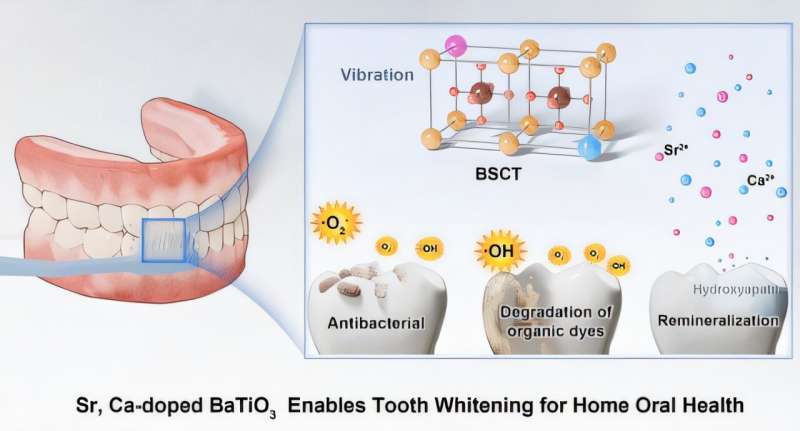
The page is a composite of four layers, in the pattern typical of this archive:
- A press write-up from phys.org, "Toothbrush-activated powder whitens, repairs and protects teeth," attributed to Min Xing et al.
- The abstract of a peer-reviewed paper in ACS Nano (DOI
10.1021/acsnano.5c16997), titled Sr-, Ca-Doped BaTiO₃ with Synergistic Piezoelectric Catalysis and Microbial Balance Effects Enables Tooth Whitening for Home Oral Health, with a link to its Supporting Information PDF. - The text of Chinese patent CN119430910, "Piezoelectric ceramic powder for whitening and mineralizing teeth as well as preparation method and application of piezoelectric ceramic powder," including its sol-gel preparation steps and preferred embodiment.
- A list of related Chinese and Japanese patent titles on calcium-doped barium titanate powders and ceramics.
The dossier therefore presents the authors' own summary of their work plus the patent that claims it. It does not contain the full paper, the raw data, statistical analysis, sample sizes, controls, or any independent replication. Everything below should be read as source assertions, not as validated clinical efficacy.
The material: BSCT
BSCT is a doped variant of the well-known piezoelectric ceramic barium titanate (BaTiO₃). The chemical formula given in the patent is:
Ba(1-2x)Sr(x)Ca(x)TiO3
with a preferred embodiment of x = 0.05, giving Ba₀.₉Sr₀.₀₅Ca₀.₀₅TiO₃. Strontium and calcium substitute for barium in the perovskite lattice in equal molar amounts, so that the A-site is occupied by Ba, Sr and Ca together.
Reported characterization of the prepared powder:
- Particle size approximately 80 nm.
- Elemental composition: Ti, Ba, Ca, O and Sr, uniformly distributed.
- Piezoelectric evidence: amplitude and phase diagrams show "obvious contrast changes" and "distinct butterfly-shaped displacement–voltage curves and phase change curves," indicating that the polarization direction of the powder changes under applied voltage and exhibits hysteresis. The patent reads this as evidence that the powder is piezoelectric.
The butterfly-shaped displacement–voltage loop is the standard signature of ferroelectric/piezoelectric switching, so this is a plausible characterization claim — but the dossier shows only the authors' description of the curves, not the curves themselves or their numerical values.
Preparation: sol-gel route (CN119430910)
The patent describes a sol-gel synthesis. The steps, preserved as given:
(1) Based on the chemical formula Ba(1-2x)Sr(x)Ca(x)TiO3,
    weigh barium acetate (99% purity), calcium acetate (99% purity),
    and strontium acetate (98% purity) according to the molar ratio
    of (1-2x):x:x, dissolve them in acetic acid, then mix them evenly
    at 60-90 °C for 30 min, and then cool them naturally to room
    temperature to obtain solution A;

(2) Dissolve tetrabutyl titanate in 1 mL of acetylacetone and 9 mL
    of ethylene glycol methyl ether according to the stoichiometric
    ratio to form homogenized solution B;

(3) Mix and stir solutions A and B for 5 hours and age for 24 to 96
    hours to form homogenized solution C, and then dry it at 90 to
    150 °C to form dry sol;

(4) The dry sol was heat-treated at 600-1200 °C (heating rate
    5 °C/min) for 2h to form BaSrCaTiO3-based ceramic powder (BSCT).
Preferred embodiment parameters stated in the patent:
- x = 0.05, stirring temperature 70 °C (step 1)
- aging time 72 hours, drying temperature 120 °C (step 3)
- heat treatment temperature 900 °C (step 4)
The worked example in the dossier adds detail: 30 mL of acetic acid for the acetate dissolution, magnetic stirring at 70 °C for 30 min, drying of homogenized solution C at 120 °C for 24 h, then calcination at 900 °C at 5 °C/min for 2 h.
Note: the patent text contains a garbled identifier, "BaSrCaTiO_NER12," which appears to be an OCR or formatting artifact rather than a real material name. It should not be treated as a distinct compound.
Claimed mechanisms
1. Piezoelectric catalysis (piezocatalysis)
The central mechanism. When BSCT is mechanically strained — by the vibration of brushing or by applied ultrasound — its internal polarization field separates charge, and the separated charges drive the formation of reactive oxygen species. The abstract states that BSCT "can generate •O₂⁻ and •OH in situ under mechanical vibration."
Reported evidence in the dossier:
- After ultrasonic treatment, "obvious superoxide radical peaks and hydroxyl radical peaks can be captured in BSCT powder," indicating generation of •O₂⁻ and •OH. The dossier does not name the spectroscopic method (the analysis notes it as an ESR-type measurement), and no spectra are reproduced.
- Indigo carmine decolorization: with the ultrasonic instrument set to 2 W for 40 minutes, "the blue color of the indigo carmine solution in the piezoelectric powder group gradually faded, and the absorbance intensity at 600 nm decreased with the extension of time." Indigo carmine is a standard dye probe for oxidative degradation; the 600 nm absorbance is its characteristic visible band.
The patent claims these active oxygens "can not only effectively decompose and remove stains on the tooth surface, such as coffee stains, tea stains, tobacco stains, etc., but also have a good piezoelectric effect and can be used for teeth whitening."
2. Biomimetic remineralization
Ca²⁺ and Sr²⁺ ions released from BSCT are claimed to form "localized ion-enriched zones on enamel and dentin surfaces, promoting remineralization of minerals." The patent adds that this "enhanc[es] the hardness and anti-caries ability of the teeth."
Reported evidence:
- SEM: "obvious crystalline particle deposits can be observed on the enamel and dentin surfaces of teeth treated with BSCT powder."
- XRD: "the appearance of weak peaks attributed to hydroxyapatite, indicating that BSCT powder helps mineralize the tooth surface."
The XRD evidence is explicitly described as weak peaks, which is a modest signal for a remineralization claim.
3. Antibacterial mechanism via proton motive force
The abstract states the mechanism directly: "the piezoelectric polarization field enhances antibacterial efficacy by disrupting the bacterial membrane potential and structural integrity, weakening the proton motive force (PMF), and subsequently inhibiting F₀F₁-ATP synthase activity to block ATP synthesis."
This is a mechanistic chain — polarization field → membrane potential disruption → weakened PMF → inhibited F₀F₁-ATP synthase → blocked ATP synthesis — asserted in the abstract. The dossier does not reproduce the membrane-potential, PMF or ATP measurements that would support each link.
4. Microbial community regulation
The abstract calls this "an innovative discovery": BSCT "selectively inhibits dominant pathogenic bacteria while promoting the restoration of beneficial microbial communities, thereby facilitating the reconstruction of oral ecological homeostasis."
This is the most novel and the least corroborated claim in the dossier. No community-level sequencing data, taxonomic profiles, or quantitative microbial results appear in the source material shown here.
Reported observations
- Tooth color: "the tooth color changed significantly after powder treatment and became similar to the color before treatment." This is a qualitative color comparison, not a measured shade change (e.g., no ΔE or shade-guide values are given).
- Biocompatibility: human gingival fibroblasts were isolated from healthy gingival tissue collected from patients and cultured in DMEM high-glucose medium supplemented with 15% FBS and 1% penicillin and antibiotics. An extract was prepared from DMEM high-glucose medium containing 1 mg/mL BSCT powder and collected after 48 h. The patent claims the powder "has good biocompatibility, ensuring its safety in the oral environment and the feasibility of long-term use."
Limitations and unresolved questions
- No independent validation. The dossier contains the authors' abstract, selected characterization statements and patent claims. There is no third-party replication, no clinical trial, and no human whitening measurement beyond a qualitative color comparison.
- "Nondestructive" claim without wear data. The source calls the strategy "nondestructive" and frames it as avoiding "tooth damage caused by excessive use of bleaching agents." Yet the application is a mechanically agitated powder; no enamel wear, surface-loss or abrasion data are provided to support the nondestructive characterization.
- Microbiome claim unsupported in the dossier. Selective pathogen inhibition with restoration of beneficial flora is asserted as a discovery but is not backed by community-level data in the material shown.
- Biocompatibility scope. A single 48 h fibroblast extract test at one concentration does not establish long-term oral safety, despite the patent's "long-term use" language.
- Patent vs. paper framing. The patent claims broad beneficial effects (stain removal, mineralization, biocompatibility, long-term use feasibility); the paper abstract is more measured. The dossier does not reconcile the two registers.
- Missing quantitative detail. No sample sizes, no statistics, no error bars, no dose–response, and no control conditions are visible in the dossier.
Related patents listed (context only)
The dossier lists a cluster of patents on calcium-doped barium titanate powders and ceramics. These are titles only, included as family context; they are not evidence for the BSCT efficacy claims.
- CN118183830 — Calcium-doped barium titanate powder as well as preparation method and application thereof
- CN116534893 — Solid-phase synthesis method of calcium-doped barium titanate powder
- CN120965307 — Method for preparing calcium-doped barium titanate ultrafine powder under alkaline condition
- CN115959703 — Calcium-doped barium titanate powder as well as preparation method and application thereof
- CN113353973 — Preparation method of calcium-doped barium titanate powder
- CN114853468 — High-dielectric low-loss doped barium calcium titanate ceramic and preparation method thereof
- JP4441306 — Method for producing calcium-doped barium titanate
Related work and wiki context
This dossier is another the source archive composite page, consistent with the archive's pattern of assembling press reports, paper abstracts and patents (see sources/main-archive and comparisons/source-types). It is a direct instance of the pattern discussed in Patent as Evidence: a patent and a press release describe intended effects, while the evidence actually shown is limited to the authors' in vitro characterization.
The source extends the wiki into new territory — piezoelectric ceramics, piezocatalysis and dental materials — rather than reinforcing existing claims. See BSCT (Ba₀.₉Sr₀.₀₅Ca₀.₀₅TiO₃), CN119430910 — Piezoelectric Ceramic Powder for Whitening and Mineralizing Teeth, Piezoelectric Catalysis (Piezocatalysis), Biomimetic Remineralization, Proton Motive Force and F₀F₁-ATP Synthase Inhibition, Reactive Oxygen Species (ROS) and BSCT Claims vs. Evidence: The Tooth Powder Dossier Without Clinical Data.
Source notes & attribution
- Source dossier: rexresearch/2c4c599eb56a6df3.md (rexresearch.com, retrieved 2026-09-17).
- Original page: https://rexresearch.com/XingBaTiCaToothpaste/XingSrCaBaTiO3Toothpaste.html
- Press write-up: https://phys.org/news/2026-01-toothbrush-powder-whitens-teeth.html
- Paper: ACS Nano , DOI 10.1021/acsnano.5c16997 (Supporting Information PDF linked from the dossier).
- Patent: CN119430910 — Piezoelectric ceramic powder for whitening and mineralizing teeth as well as preparation method and application of piezoelectric ceramic powder.
- https://rexresearch.com/XingBaTiCaToothpaste/XingSrCaBaTiO3Toothpaste.html