US20090315337A1, Method and Apparatus for Direct Energy Conversion, is the original application by the inventor Eddie Sines. According to the Google Patents record, the application (US12/308,049) was filed on 13 June 2007 and claims priority from provisional application No. 60/813,341 of 14 June 2006. It was published on 24 December 2009, and the record lists US8736085B2 as its granted version, issued on 27 May 2014. The record also shows an assignment from Sines to AQEDD, INC on 30 August 2018, a current status of expired (fee related) and an adjusted expiration date of 31 December 2028.
US patent publication; document page 2. Rotated for reading.
One of its classifications is H02N11/00. In the patent office's classification scheme, that group covers generators and motors not provided for elsewhere, and its heading also takes in "alleged perpetua mobilia" driven by electric or magnetic means. That is a filing category, not a finding about the device.
What the application claims
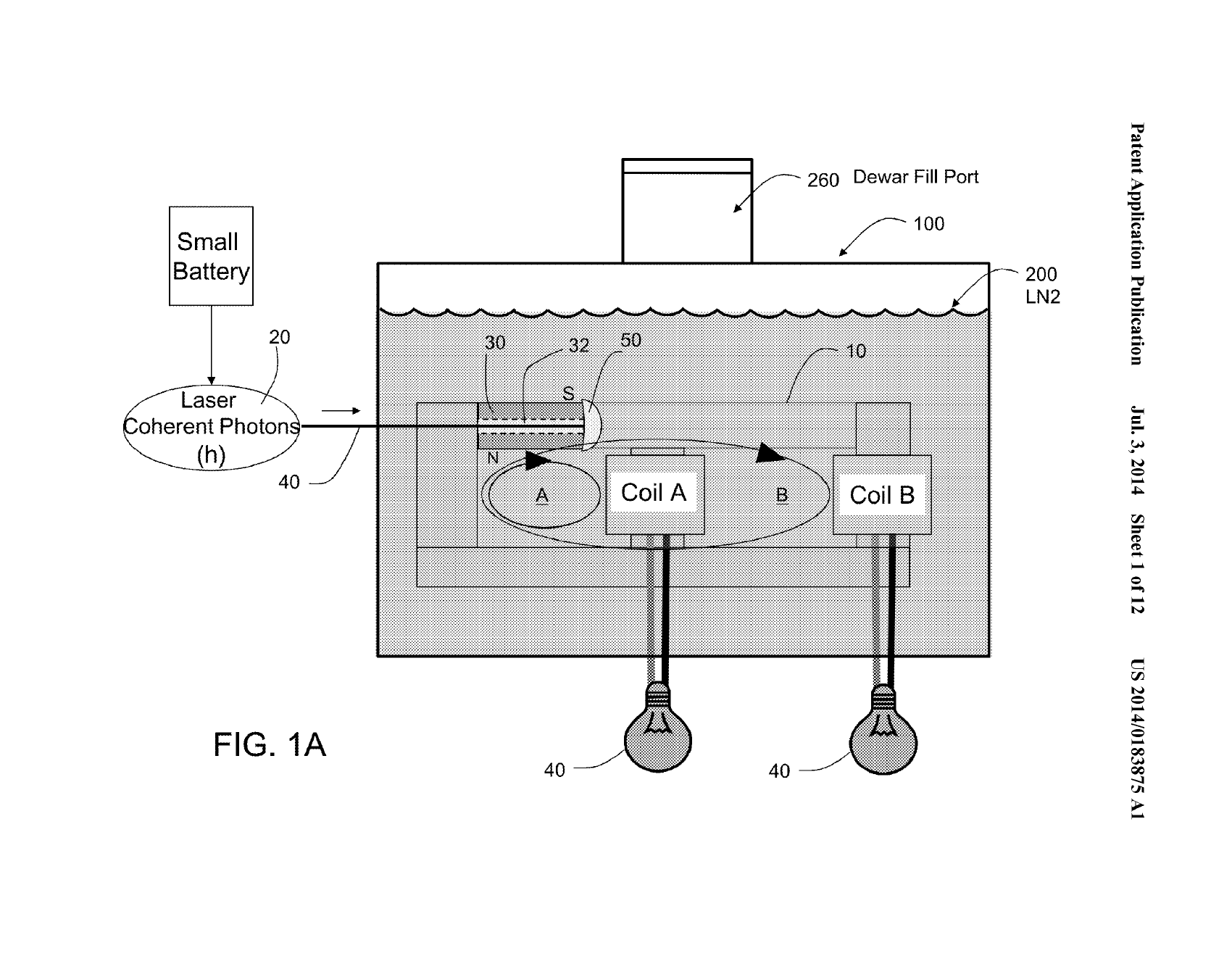
The patent asserts that a generator with no moving armature can draw electricity from the steady field of a permanent magnet (or an electromagnet). In its account, the magnet sits in a magnetic circuit with two return paths, A and B, each running through its own transformer winding. Between them sits a superconducting component the patent names the vortex channel, which is said to work as a magnetic switch. A laser, switched on and off by a control circuit using pulse-width modulation, is said to knock the channel in and out of the superconducting state. According to the patent, each change of state moves the magnet's static flux from one path to the other, and that changing flux induces a voltage in the windings through ordinary Faraday induction.
How the device is said to work
The patent describes the two states of the vortex channel as follows:
- Superconducting. The channel is said to behave like an ideal inductor of unlimited permeability. Flux is said to be pinned along the axis of each tube and held away from the superconducting film. The patent says the flux therefore returns by path B, through the channel and coil B, which it describes as a route needing about a millionth of the energy of the alternative.
- Normal. Here the patent treats the channel as a ceramic or insulator with the permeability of air, in effect a large air gap. It says the flux then returns through path A and coil A.
The application claims a permeability swing at the channel's upstream end of more than 1 × 10^6, with the flux modulated between 1 × 10^0 and 1 × 10^6. It names the laser toggling photon Cooper breaking: photons are said to split the paired electrons, setting off an avalanche that returns the film to its normal state. The document invokes self-organised criticality to explain this, comparing the photon to one ball dropped onto a tray of set mousetraps loaded with ping-pong balls, which sets the rest off in a chain. When the laser is off, the electrons are said to drop back into pairs.
The background section covers standard superconductivity physics: Kamerlingh Onnes's discovery in 1911, Cooper pairs, the Meissner effect, Type I and Type II behaviour, the lower and upper critical fields H c1 and H c2, Abrikosov vortex lattices and the flux quantum h/2e. The patent also credits conventional theory with a picture of Cooper pairs spinning on the surface as one large pair, setting up a current sheet that reflects flux back like a moving mirror. It cites no source for that picture, and this article cannot confirm that it reflects conventional theory. The concept the patent presents as its own is what it calls atomic elastic force, which treats paired electrons as compressed springs storing potential energy that photons release. The detailed description adds a rotating disk of virtual high permeability at the upstream end of each tube.
The exemplary design
The application gives one embodiment with specific figures.
The vortex channel. The application specifies a bundle of approximately 500 glass tubes, each at most 0.0125 inch across on the outside and 1.0 inch long. The working layer on each tube is to be a YBCO thin film. Two buffer layers are specified beneath it, each with a stated purpose. A coating of Y2O3 stabilised with ZrO2 is meant to stop silicon from the glass migrating into the superconductor. A cerium oxide (CeO2) layer on top is said to give the YBCO a good base, and the patent asserts that it cuts the lattice mismatch to about 0.5%. Before coating, the glass is to be cleaned of SiO2, for example with an Excimer laser in a vacuum. The application calls for a very thin outer layer of Parylene to insulate the tubes electrically from one another, which the patent says lets each tube's vortex act independently.
Light and magnet. The application specifies a 930 nm laser with output of approximately 1 watt and an electron-photon quantum efficiency of at least 30%. It picks this wavelength because, it asserts, YBCO has a very sharp resonance at 930 nm and absorbs strongly there; the document offers no supporting measurement or citation. In the design, light is to travel by fibre optics through an axial bore in a magnet, preferably cylindrical, and a diffusing lens is to spread it across the front of the channel. The magnet's flux density is given as approximately 2000 gauss at the poles. The transformer is described as having a ferromagnetic core, soft ferrite for example.
Cooling and control. The patent says a cryogenic liquid, liquid nitrogen in a Dewar vessel, would keep the film below its transition temperature. A battery is to power the laser and the control circuit, and the circuit is also meant to regulate the output for a given load.
The patent also refers to earlier research that reported a quantum efficiency of up to 340 per photon, but it does not say which publication.
Performance claims
The application says the generator would turn about 99.8% of its energy into electricity, losing about 0.2% as waste heat. It sets this against roughly 25% for a nuclear power plant. Elsewhere it asserts, without supporting data, that the conversion performed by toggling the vortex channel is almost 99.999% efficient, which it says is far better than the hysteresis losses of ordinary inductor materials. In its seven-step process, a feedback loop powers the laser, and a surplus of 10 KW supplies outside loads until the nitrogen has boiled off. The patent links the generation rate to how fast the laser is switched, with a theoretical optimum near 1 megahertz. Its suggested uses include a one-litre unit for an average home, an electric car with a range of 200+ miles per nitrogen fill, and spacecraft that, shaded from the Sun at a background of 3 Kelvin, would need no cryogenics.
What the document does and does not establish
The application reports no measurements. It says the energy curve in FIG. 8 is based on "a hypothetical prototype design". It describes the Table 2 data behind that curve as only an estimate, worked out from standard design parameters for switch-mode power supplies. It never reports that a vortex channel was built, cooled or switched, or that any output was measured.
Some points in the document itself remain open:
- Energy source. The patent says power comes from modulating a permanent magnet's flux. It also describes the generator as taking an unidentified store of potential energy and turning it into kinetic energy. It gives no energy balance to show where a 10 KW surplus over the laser's input would come from.
- Saturation. The patent says YBCO saturates at about 2000 gauss. It proposes avoiding this by spreading the field over about 500 tubes at about 4 gauss each, a figure reached by dividing the magnet's flux density by the number of tubes. It then admits that 4 gauss is still well above what YBCO normally carries without saturating. Its answer is that rotating Cooper pairs pin the flux to the centre of each tube, where it never touches the film, so saturation is supposedly avoided. The document gives no measurement or calculation to back this.
- Lossless channel and net gain. The patent describes the flux-pinned vortex channel as a near-lossless path and says the counterforce that pins the flux costs no energy beyond keeping the film at liquid-nitrogen temperature. It never explains how such a channel would yield more energy than goes into running it.
- Energy of pair breaking. Atomic elastic force and the spring-like stored energy of Cooper pairs are the concepts the document presents as its own, as distinct from the surface-spin picture it attributes to conventional theory. The patent gives the pair binding energy as on the order of milli-electron volts. It offers no calculation showing that breaking pairs releases more energy than the laser supplies.
The record lists a grant, as US8736085B2. A grant is not evidence that a device works (see Patent as Evidence).
Place in the Sines dossier
This application sets out Sines's central claim in detail: that the static flux of a permanent magnet can be made to yield electricity with no moving parts. One of its stated objects is to convert the potential energy of permanent magnets into kinetic energy by modulating their flux, and it goes as far as suggesting that the process could eventually replace the planet's entire energy infrastructure. As a patent filing, it documents the claim and the proposed mechanism. It does not test them.
Source notes & attribution
- https://patents.google.com/patent/US20090315337