Using live bacteria against tumours is an old idea with a long research literature and a thin clinical record. A review by Weihong Mao and Chunmin Deng, published in Discover Oncology (received 25 March 2026, accepted 14 July 2026, collection date December 2026), surveys the field as it stood in 2026: what bacteria are thought to do to tumours, how researchers engineer them to do more, and why so little of the work has reached patients. It is general background on bacteria-mediated tumour therapy and does not discuss Ewingella americana at any point, so nothing in it speaks for or against any particular strain outside the ones it names.
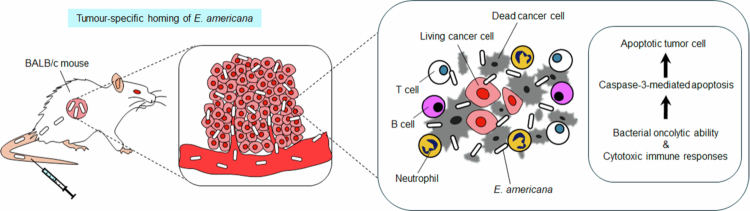
© 2025 Iwata et al., Gut Microbes 17(1), 2599562. CC BY-NC 4.0. Figure unaltered.
How bacteria are said to act on tumours
Ask what a live bacterium is supposed to accomplish once it is inside a tumour, and the review gives three answers. All three are presented as the rationale the field works from — statements the authors assert and attribute to the literature, not results they generated or tested.
The first is a matter of geography. Obligate and facultative anaerobes, the authors write, preferentially colonise the hypoxic, immune-suppressed centre of a solid tumour, which is the region passive drug carriers reach worst. A colony established there can keep manufacturing a therapeutic molecule on the spot; the review's term for this is in situ "micro-bioreactors".
The second is direct damage: following intratumoral administration, the authors say, bacteria can lyse tumour cells.
The third is immunological, and the review leans on it hardest. Structural components of the bacteria themselves — it names lipopolysaccharide and flagellin — are described as potent activators of innate and adaptive immunity, capable of remodelling an immunosuppressive tumour microenvironment. In the field's shorthand, a tumour with sparse cytotoxic T cell infiltration is "cold"; the asserted effect of bacterial colonisation is to turn it hot. The review's own discussion then qualifies this: excessive inflammation provoked by bacterial intervention may, under some pathological conditions, accelerate tumour progression instead — a possibility the authors say cannot be ignored in translational work.
Against synthetic nanomedicine, the claimed advantages are mechanical rather than immunological. Bacteria have their own motility, hypoxia tropism and capacity to degrade extracellular matrix, so they are said to penetrate dense tumour tissue that carriers relying on passive accumulation cannot. The review cites early statistics that roughly 0.7% of administered nanoformulations successfully accumulate in solid tumours, while noting that this classic value has been repeatedly questioned and revised as active-targeting methods improved.
A long history of false starts
The review dates clinical exploration to 1813, when it reports that Vautier and colleagues observed spontaneous tumour regression in patients who also had gas gangrene infections. In 1891 William Coley prepared toxins from mixed bacterial strains to elicit antitumour immune responses, which the authors call the earliest prototype of tumour immunotherapy.
In the authors' telling, what cost that line of work its standing is that nothing about it could be pinned down. A mixture of strains left the mechanism obscure, since there was no way to say which component produced which effect; the benefit would not hold still from one patient to the next; and the safety record was poor. Once radiotherapy and chemotherapy became the mainstream modalities, the review says, bacterial therapy fell out of use for decades; genetic engineering and the construction of attenuated Salmonella and Clostridium strains are what revived it.
The authors divide the whole arc into four phases: early clinical observation, mid-twentieth-century stagnation and clinical neglect, revival with rational strain design in the late twentieth century, and the current era of engineering modification and multimodal combination therapy. The lesson they draw from the first phase is about method rather than biology. What those early attempts had no access to, on their reading, was any shared yardstick for measuring benefit, any way of steering what the organism did once it was inside a patient, or any attenuation of the strains themselves — which is why, they argue, the results came out neither safe nor repeatable. Translation, in their view, will turn on standardised engineering rather than on trying things and watching.
What engineering has added
Most of the review is a tour of preclinical designs, each attributed to a named group and drawn from that group's published work. It is important to read the results in that register: these are animal-model findings the review summarises from the cited papers, not experiments the review carried out or re-analysed. Outcomes are mostly stated in qualitative terms — growth suppressed, survival prolonged — with a number attached only occasionally, as with the 63 °C ablation temperature below. The host models also differ: the hepatocellular carcinoma work was done in immunodeficient BALB/c nude mice, and the review does not treat that as a limit on what such a result can show about an effect that depends on a working immune system.
The gene-restoration designs come mostly from one group. He and colleagues built Escherichia coli Nissle 1917 (EcN) strains overexpressing Tum-5 under the hypoxia-responsive promoter Pvhb. Tum-5 binds integrin αvβ3 on tumour neovascular endothelium and suppresses FAK, PI3K and PKB signalling; in a B16 melanoma xenograft mouse model, the review reports, the engineered strain blocked tumour angiogenesis, upregulating Bax, downregulating Bcl-2 and activating Caspase-3 in endothelial cells. The same group then fused Tum-5 to p53 using the matrix metalloproteinase cleavage sequence PLGLWA as a linker; the resulting EcN (Tum-5-p53) is described as markedly inhibiting growth of human SMMC-7721 hepatocellular carcinoma cells in tumour-bearing BALB/c nude mice. The authors note that more than half of human malignancies carry p53 mutation or functional inactivation, which is the rationale for restoring it. They also concede that this whole strategy performs relatively poorly against large and metastatic tumours, and that long-term ectopic gene expression may disturb the host genome in ways nobody has yet systematically evaluated.
A second family of designs borrows a switch from the tumour's own chemistry or from the clinician's hands. Yao and colleagues grew tellurium nanorods inside EcN by feeding the culture sodium tellurite, producing a near-infrared-responsive hybrid — though the review notes the intracellular nanorods impair the bacteria's own ability to proliferate. Wang and colleagues put cytolysin A, a pore-forming toxin, under a thermosensitive promoter in E. coli K-12 (MG1655) and coated the strain with gold nanoparticles grown on its surface, so near-infrared light heats the cell and that heat turns on the toxin. Leventhal and colleagues used the hypoxia-inducible promoter PfnrS to drive cyclic dinucleotide synthesis in EcN, activating the STING pathway in intratumoral antigen-presenting cells. Xie and colleagues attached doxorubicin to EcN through acid-labile linkers for release in the acidic tumour interstitium. The review sorts such systems into three classes by what trips the switch: an external stimulus, a tumour-microenvironment signal, or the bacteria's own quorum-sensing density. It is candid that all of them currently suffer from weak response sensitivity, background expression when they should be off, and unstable behaviour in a real tumour.
Oxidative chemistry is the third strand. Because tumour tissue carries more hydrogen peroxide than normal tissue, several groups use bacteria to deliver catalysts that convert it into hydroxyl radicals through Fenton-like reactions — see Reactive Oxygen Species (ROS) for the species involved. Li and colleagues coated Bifidobacterium infantis with an iron-based metal-organic framework loaded with doxorubicin and calcium peroxide, reporting suppressed tumour growth and longer survival in 4T1 breast tumour xenograft models. Fan and colleagues took the opposite route, engineering E. coli MG1655 to overexpress the respiratory enzyme NDH-2 so the bacteria generate hydrogen peroxide themselves, then anchoring Fe₃O₄ nanoparticles to the surface to react with it. The review's caution here is chemical: Fenton-like catalysis is sensitive to the pH and oxygen levels that tumours vary most in, and accumulated metal ions raise toxicity questions that preclinical papers frequently skip.
Photothermal designs close the tour. Chen and colleagues conjugated indocyanine green to the hypoxia-targeted attenuated Salmonella YB1, whose asd gene sits under a hypoxia-responsive promoter; under near-infrared irradiation the review reports local tumour temperature reaching 63 °C, which it says ablates the tissue and destroys the residual bacteria at the same time. Liu and colleagues polymerised dopamine on the surface of Lactobacillus to form a polydopamine shell carrying doxorubicin. The acknowledged limits are physical — light does not penetrate far enough for deep-seated tumours, and heat induces thermal resistance.
What has actually happened in patients
The review's comparative table is where the clinical record appears, and it is short. Salmonella VNP20009, attenuated by ΔpurI and ΔmsbB deletions, reached phase I in melanoma and renal cell carcinoma with a maximum tolerated dose of 3 × 10⁸ CFU/m²; the table records it as well tolerated but with limited objective response. Its cytosine-deaminase variant TAPET-CD showed tumour colonisation and 5-FU production in a phase I intratumoral study. Clostridium novyi-NT entered phase I (NCT01924689), and in combination with anti-PD-1 reached phase Ib with a 25% objective response rate and manageable safety; a Clostridium spore product is listed at phase I/II in China for advanced solid tumours. SYNB1891, the EcN STING-agonist strain, reported manageable safety and interferon and T-cell activation in phase I (NCT04167137). The Listeria-based vaccines went furthest on paper — ADXS11-001 to phase III in cervical cancer, CRS-207 to phase II in pancreatic cancer — with safety and immune activation observed. Bifidobacterium work, the table says, remains mainly preclinical.
The barrier the review names is safety, not efficacy
Biosafety, the authors state, is the core barrier restricting clinical application — not the question of whether the therapy works. It is worth asking why safety is the sticking point, and the answer is in what kind of product this is. A conventional drug is a fixed quantity that the body clears on a known schedule. A living agent sets its own schedule: it keeps dividing after it is given, it can take up residence in tissue nobody aimed at, and it brings along the molecules that make the immunological argument work whether or not anyone wants them switched on.
The review's hazard list follows from exactly that. Uncontrolled multiplication is the first problem, and the authors attach organ damage, infection risk and body-wide inflammation to it, with colonisation of healthy tissue listed as a separate route to unexpected side effects. The second problem is that the structural components doing the therapeutic work — lipopolysaccharide and flagellin again — can carry immune activation past the point of benefit and into cytokine storm. The third shows up only over time, and here the authors concede the assessment simply has not been done: insertional mutation, exogenous genes that go on expressing long after they are wanted, and escape of the organism out of the patient.
Every remedy the review names is an attempt to put a limit back into a self-amplifying system. Deleting genes lowers how much harm a strain is capable of in the first place. Tying therapeutic expression to tumour-microenvironment signals narrows where it acts. A built-in suicide circuit gives the colony an end point, and quorum sensing gives it a ceiling on how large it can get. The authors present this toolkit as reducing virulence, avoiding non-specific effects and making survival in the body controllable — the groundwork, on their account, for safe clinical use rather than evidence that it has been achieved.
Two further limits matter for reading any strong animal result in this literature. The authors note that most preclinical data come from immunocompetent mouse models, which leaves efficacy in immunodeficient hosts and advanced-stage patients unpredictable. And they argue that preclinical work has no shared yardstick at all: how much to give, by which route, how to detect the organism afterwards and how to judge whether it helped all vary from paper to paper, which in their view leaves findings hard to reproduce and hard to set side by side. Manufacturing and oversight compound the problem. Because a live agent replicates, it needs an evaluation framework of its own rather than the one used for conventional drugs and nanomedicines, and the authors state that regulators in the major jurisdictions have yet to settle on a single agreed rulebook for medicines that are themselves living microbes.
The review reports that no datasets were generated or analysed for it. It is explicit that current reviews in this field leave gaps — among them outer membrane vesicles as a cell-free platform, bacteria-assisted sonodynamic therapy, bacterial membrane-camouflaged nanoparticles, and the absence of a systematic sorting of completed and ongoing clinical trials. What it does establish is that the proposed mechanisms are widely studied and that the clinical record it tabulates comes to early-phase safety and immune-activation findings, a single reported objective response rate (25%, for C. novyi-NT with anti-PD-1 at phase Ib), and one phase III listing. The work was supported by the Suzhou Municipal Health Commission (QNXM2024091) and the Suzhou Science and Technology Bureau (SYWD2024238); the authors declare no competing interests.
Source notes & attribution
- https://pmc.ncbi.nlm.nih.gov/articles/PMC13486457/