The source dossier compiles material on the French polymath Maurice Allais and the anomalous pendulum behaviour he reported during solar eclipses. It is a heterogeneous compilation rather than a single paper: a Wikipedia-derived summary of the "Allais effect," Allais's own 1959 Aero/Space Engineering memoir titles, a set of journal abstracts proposing explanations, and a reference list in the source's own citation format. The page is hosted at [source note 1] and links out to the Maurice Allais Foundation and to allais.maurice.free.fr.
The subject is a long-running contested-physics case. Allais, a Nobel laureate in Economics (1988), reported that the plane of oscillation of a pendulum precesses anomalously during a solar eclipse, and argued that the accepted theory of gravitation cannot account for it. Over more than five decades, other teams have reported both positive and negative results, and the source itself does not adjudicate between them.

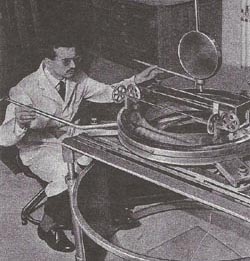
What the paraconical pendulum is
Allais's instrument is described in the source as a pendulum mounted on an anisotropic support, and is explicitly distinguished from both a torsion pendulum and an ordinary Foucault pendulum. The distinction matters because the reported anomaly is a change in the precession of the plane of oscillation, not a change in the pendulum's period or in the local value of g.
Allais's own framing, quoted in the source, separates two classes of observation:
The observed effects are only seen when the pendulum is moving. They are not connected with the intensity of weight (gravimetry), but with the variation of weight (or of inertia) in the space swept by the pendulum. Actually, while the movement of the plane of oscillation of the pendulum is inexplicable by the theory of gravitation, the deviations from the vertical are explained perfectly by that theory. The deviations from the vertical […] correspond to a static phenomenon, while my experiments correspond to a dynamic phenomenon.
This dynamic-versus-static distinction is the core of Allais's claim. Static deviations from the vertical, he concedes, are fully explained by gravitational theory; only the moving pendulum's precession is claimed to be anomalous. See Paraconical Pendulum and Allais Effect.
The original observations
The source reports two founding observations:
- 30 June 1954 — Allais observed anomalous precession of the plane of oscillation of a Foucault pendulum during a solar eclipse.
- 2 October 1959 — Allais repeated the observation using the paraconical pendulum he had invented.
The 1959 work earned him the 1959 Galabert Prize of the French Astronautical Society and made him a laureate of the U.S. Gravity Research Foundation for his 1959 memoir on gravity. Allais published the work in two parts in Aero/Space Engineering in September and October 1959 under the title "Should the Laws of Gravitation Be Reconsidered?" — Part I on abnormalities in the motion of a paraconical pendulum on an anisotropic support, Part II on the experiments connected with those abnormalities. He later summarised the experimental work in English in a 1999 memoir prepared for NASA (Memoir C-6083).
Reported positive results
The source lists a series of observations that it presents as supporting or partially supporting the effect:
- Jeverdan, Rusu and Antonescu (15 February 1961) — Romanian physicists monitoring a Foucault pendulum reported a change in oscillation period during the eclipse. This is the so-called Jeverdan–Rusu–Antonescu effect (or Jeverdan effect). The authors offered two hypotheses: that the Moon screens the Sun's gravitational attraction (indirectly increasing the Earth's attraction, a phenomenon they suggested could also be studied with tides), or, if screening is wrong, that the variation of Earth's gravity might result from diffraction of gravitational waves.
- Saxl and Allen (7 March 1970) — reported strong anomalous changes in the period of a torsion pendulum during the eclipse and concluded that "gravitational theory needs to be modified."
- Savrov (11 July 1991, Mexico; 3 November 1994, Brazil) — Leonid Savrov of the Sternberg Astronomical Institute built a dedicated paraconical pendulum for these eclipses. He reported "the increase of rotational velocity of the pendulum oscillation plane in the direction of the Foucault effect during the eclipse," writing "It seems that we have some kind of special effect." Notably, he could not confirm Allais's claim of a diurnal periodicity in the motion of a paraconical pendulum.
- Atomic clock and gravimeter anomalies — teams reported significant anomalous gravitational effects during eclipses in China (1992), India (1995) and China (1997), which the source says could not be attributed to tidal effects, gravimeter drift, or high-frequency noise.
- Romanian team (22 September 2006 annular eclipse) — presented results the following year confirming the Allais and Jeverdan–Rusu–Antonescu effects, with a reported "quantization" of the behaviour of the paraconical pendulum.
- Ukrainian and Romanian teams (1 August 2008) — working hundreds of kilometres apart with different apparatus (five independent miniature torsion balances; two independent short ball-borne pendulums; a long Foucault pendulum), all three teams reported "unexplained and mutually correlated disturbances."
- Pugach and Olenici (26 January 2009 annular eclipse) — repeated a dual experiment outside the umbra and reported the same significant correlation between light torsion balances and a Foucault pendulum.
- Underground salt-mine experiment (1 June 2011 partial eclipse) — reported similar anomalies using a Foucault pendulum and a very light torsion balance located underground with minimal interference.
Reported negative or inconclusive results
The source gives comparable space to results that failed to detect the effect:
- Slichter (15 February 1961, Florence) — using a gravimeter, Louis B. Slichter failed to detect an associated gravitational signal. The published paper is titled "An experiment concerning gravitational shielding."
- Finland and Belomorsk (22 July 1990) — no anomalous period increase of a torsion pendulum was detected independently by a Finnish team or by a team in Belomorsk, USSR.
- NASA 1999 international campaign (11 August 1999) — NASA's Marshall Space Flight Center inquired about experimental protocols from Allais and coordinated a worldwide effort across observatories and universities in seven countries (United States, Austria, Germany, Italy, Australia, England, and four sites in the United Arab Emirates). The lead supervisor stated that the initial interpretation pointed to "a systematic error, a local effect, or the unexplored," and that different instruments in a distributed global network would be used to eliminate the first two possibilities. After the eclipse, Allais criticised the experiments in his final NASA report, writing that the period of observation was "much too short […] to detect anomalies properly." The lead supervisor left NASA shortly afterwards with the gathered data, and the NASA study has never been published.
- Yang and Van Flandern — further observations by the team led by Xin-She Yang yielded much weaker evidence than their first 1997 study. The authors first proposed a conventional explanation based on temperature changes causing ground tilting, then suggested this was unlikely, and finally proposed (with Tom Van Flandern) that the anomaly is due to the gravitational effect of an increased air-density spot in the upper atmosphere created by cooling winds during the eclipse. They concluded there have been "no unambiguous detections [of an Allais effect] within the past 30 years when consciousness of the importance of [experimental] controls was more widespread," and that "the gravitation anomaly discussed here is about a factor of 100,000 too small to explain the Allais excess pendulum precession […] during eclipses" — from which they conclude the original Allais anomaly was due to poor controls.
- China 2009 (22 July 2009) — eight gravimeters and two pendulums were deployed across six monitoring sites. Although one scientist involved described observing the Allais effect in an interview, no result has been published in any academic journal.
- Argentina 2010 (11 July 2010) — an automated Foucault pendulum found no evidence of a precession change of the oscillation plane, with an upper bound of < 0.3 degree per hour.
Allais's aether hypothesis
Allais's own interpretation of a related anomaly — the lunisolar periodicity in variations of the azimuth of a pendulum — is that space exhibits anisotropic characteristics, which he ascribes to motion through an aether partially entrained by planetary bodies. This is treated in detail on Aether Anisotropy (Allais).
The source summarises the argument as follows. Allais's hypothesis implies a speed of light that depends on direction with respect to a terrestrial observer, because the Earth moves within the aether while the rotation of the Moon induces a "wind" of about 8 km/s. He therefore rejects Einstein's interpretation of the Michelson–Morley experiment and of Dayton Miller's later verification experiments. In particular, he argues Michelson–Morley did not give a zero speed difference but at most 8 km/s, without detecting any regularity — a difference conventionally attributed to measurement uncertainty. Miller's experiments, he argues, corroborated these results over a long period but could not explain the source of the irregularities; at the time, temperature problems were invoked, as concluded by Robert S. Shankland. Re-analysing Miller's data using sidereal time rather than the civil time Miller used, Allais reported a periodicity: a daytime sidereal variation of the speed of light over a period of 23 hours 56 minutes with an amplitude of about 8 km/s.
Applying a generalised Titius–Bode law to the Earth–Moon system, Allais calculates an aether "wind" of 7.95 km/s, comparable to the Michelson and Miller values. He deduces that the aether turns with the stars, as proposed by the aether drag hypothesis, and is not fixed as Hendrik Lorentz thought. Since the constancy of the speed of light in vacuum is a postulate of special relativity, Allais considers that postulate unfounded. The source notes that measuring a change in the speed of light would require revisiting the definition of the 1960 metre, since current metrology uses constancy of the speed of light as an axiom.
Allais detailed the hypothesis in the books L'Anisotropie de l'Espace (1997) and L'Effondrement de la Théorie de la Relativité (2004). A book on his scientific legacy, Should the Laws of Gravitation be Reconsidered?: The Scientific Legacy of Maurice Allais, edited by Héctor A. Múnera, appeared in 2011. The source states plainly that his aether hypothesis has not gained significant traction among mainstream scientists, and that experiments on the Allais effect continued after his death in 2010.
Proposed explanations from other authors
The compilation includes several single-author proposals, none of which the source presents as established:
- Anisotropic Dark Flow Acceleration (Bjarne Lorenzen, 2017) — In International Journal of Astronomy and Astrophysics 7(2), Lorenzen claims the cause of the Allais effect is solved by an anisotropic acceleration directed in the same direction as Dark Flow, based on a kinematic analysis of 21 Allais effect measurements. He calculates the magnitude of the anisotropic acceleration at around 35 μGal (3.5×10⁻⁷ m/s²) and argues pendulums remain the most effective instrument, while advanced instruments cannot be used successfully.
- Gravitomagnetic tensor (Delso J) — A short paper arguing that the gravitomagnetic tensor generates the extra force needed to explain the anomalous behaviour of pendulums during a solar eclipse.
- Gravitational tilt / circular anisotropy (J. D. Francis, unconv-science.org) — Postulates an addition to the existing laws of gravitation: that the horizontal direction of gravitational tilt rotates in an undulating manner with varying magnitude, producing sharp increases in angular acceleration and hence horizontal torque, which is offered as the reason sensitive instruments such as paraconical pendulums and torsion balances react as reported. The paper states these effects are sensitive to the tilt of Earth's axis and the tilt of the lunar orbit with respect to the ecliptic.
- Gravitational shielding / screening — The hypothesis, raised by Jeverdan et al. and tested by Slichter, that the Moon screens the Sun's gravitational attraction during an eclipse. Yang and Wang's 2002 paper is titled "Gravity Anomaly During the Mohe Total Solar Eclipse and New Constraint on Gravitational Shielding Parameter."
- Upper-atmosphere air-density spot (Yang and Van Flandern) — The conventional explanation described above, in which cooling winds during the eclipse create a denser spot in the upper atmosphere whose gravitational effect perturbs the pendulum.
Later and continuing work
The source records that a pendulum experiment was conducted during the total solar eclipse of 9 March 2016 over Indonesia (Mahasena, Putra, Irfan, Setiawan, Sulaeman and Hidayat), reporting apparatus, measurement method, and points contributing to uncertainty. Jean-Bernard Deloly of the Maurice Allais Foundation published a 2016 "state of the situation (2015)" continuation report on Allais's experimental work. The source also references a French-language summary, "Le pendule de Maurice Allais: phénomènes découverts," and a Revue du Conseil National des Ingénieurs et Scientifiques de France article by Jean-Pierre Bouyssonnie and Henry Aujard on "unforeseen repercussions of the eclipse of August 11th, 1999 in the field of gravitation."
Limitations and unresolved questions
- The source is a secondary compilation. It is the source archive mirror of a Wikipedia article plus journal abstracts and foundation reports, not a primary experimental report. Claims should be attributed to the named experimenters rather than treated as established.
- The replication record is mixed. Positive results (Jeverdan et al., Saxl and Allen, Savrov, the Romanian and Ukrainian teams, the salt-mine experiment) and negative results (Slichter, Finland/Belomorsk, Yang and Van Flandern, Argentina 2010) appear in roughly comparable measure, and the source does not resolve them.
- Direct contradiction. Allais attributes the effect to a gravitational anomaly inexplicable in current theory; Yang and Van Flandern attribute the original anomaly to poor controls and calculate the gravitational anomaly is about 100,000× too small to explain the reported precession.
- Partial contradiction within the positive camp. Savrov confirmed increased rotational velocity during eclipses but could not confirm Allais's claimed diurnal periodicity.
- An unpublished gap. The NASA 1999 campaign was designed to resolve the question but was never published; Allais criticised its observation period as too short. The China 2009 campaign likewise produced no journal publication.
- No independent replication of the paraconical pendulum specifically is claimed beyond the named teams' own reports.
- Allais's aether hypothesis is presented as his own interpretation, not as accepted physics.
Reference list as given in the source
The source's principal structured data is its bibliography, preserved here in the source's own citation format:
- Hecht, Laurence (24 October 2010). "In Appreciation of Maurice Allais (1911-2010) The New Physical Field of Maurice Allais" (PDF). 21st Century Science & Technology. pp. 26–30.
- Allais, M. (September 1959). "Should the Laws of Gravitation Be reconsidered? Part I – Abnormalities in the Motion of a Paraconical Pendulum on an Anisotropic Support" (PDF). Aero/Space Engineering: 46–52.
- Allais, M. (October 1959). "Should the Laws of Gravitation Be reconsidered? Part II – Experiments in Connection with the Abnormalities Noted in the Motion of the Paraconical Pendulum With an Anisotropic Support" (PDF). Aero/Space Engineering: 51–55.
- Allais, Maurice (1959). New theoretical and experimental research work on gravity. Memoir (Report).
- Allais, Maurice (November 1999). The 'Allais Effect' and my experiments with the paraconical pendulum (1954-1960) (PDF). Memoir C-6083 prepared for NASA (Report).
- Jeverdan, G. T.; Rusu, G. I.; Antonescu, V. I. (15 February 1961). "Date preliminare asupra comportarii unui pendul Foucault in timpul eclipsei de soare de la 15 februarie 1961". Annals of the Alexandru Ioan Cuza University (in Romanian). 7 (2): 457.
- Jeverdan, G. T.; Rusu, G. I.; Antonescu, V. I. (1981). "Experiments using the Foucault pendulum during the solar eclipse of 15 February, 1961" (PDF). The Biblical Astronomer. 1 (55): 18–20.
- Saxl, Erwin J.; Allen, Mildred (15 February 1971). "1970 Solar Eclipse as 'Seen' by a Torsion Pendulum" (PDF). Physical Review D. 3 (4): 823–825. Bibcode:1971PhRvD...3..823S. doi:10.1103/PhysRevD.3.823.
- Savrov, L. A.; Yushkin, V. D. (January 1995). "Paraconical pendulum as a detector of gravitational effects during solar eclipses (processing data and results)" (PDF). Measurement Techniques. 38 (1): 9–13. doi:10.1007/BF00976738.
- Savrov, L. A. (March 1995). "Paraconical pendulum as a detector of gravitational effects during solar eclipses (processing data and results)" (PDF). Measurement Techniques. 38 (3): 253–260. doi:10.1007/BF00977602.
- Savrov, L. A. (April 2009). "Improved determination of variation of rate of rotation of oscillation plane of a paraconic pendulum during the solar eclipse in Mexico on July 11, 1991". Measurement Techniques. 52 (4): 339–343. doi:10.1007/s11018-009-9291-6.
- Savrov, L. A. (June 1997). "Experiment with paraconic pendulums during the November 3, 1994 solar eclipse in Brazil". Measurement Techniques. 40 (6): 511–516. doi:10.1007/BF02504372.
- Zhou, S. W.; Huang, B. J.; Ren, Z. M. (1995). "The abnormal influence of the partial solar eclipse on December 24th, 1992, on the time comparisons between atomic clocks". Il Nuovo Cimento C. 18 (2): 223–236. doi:10.1007/BF02512022.
- Mishra, D. C.; Rao, M. B. S. Vyaghreswara (1997). "Temporal variation in gravity field during solar eclipse on 24 October 1995". Current Science. 72 (11): 782–783.
- Wang, Q.S.; Yang, X.S.; Wu, C.Z.; Guo, G.H.; Liu, H.C.; Hua, C.C. (14 July 2000). "Precise measurement of gravity variations during a total solar eclipse" (PDF). Physical Review D. 62 (4): 041101. arXiv:1003.4947. doi:10.1103/PhysRevD.62.041101.
- Popescu, V. A.; Olenici, D. (August 2007). A confirmation of the Allais and Jeverdan-Rusu-Antonescu effects during the solar eclipse from 22 September 2006, and the quantization of behaviour of pendulum (PDF). 7th Biennial European SSE Meeting. Røros, Norway.
- Goodey, T. J.; Pugach, A. F.; Olenici, D. (2010). "Correlated anomalous effects observed during a solar eclipse". Journal of Advanced Research in Physics. 1 (2).
- Pugach, A. F.; Olenici, D. (2012). "Observations of Correlated Behavior of Two Light Torsion Balances and a Paraconical Pendulum in Separate Locations during the Solar Eclipse of January 26th, 2009" (PDF). Advances in Astronomy. 2012: 263818. doi:10.1155/2012/263818.
- Slichter, L. B.; Caputo, M.; Hager, C. L. (15 March 1965). "An experiment concerning gravitational shielding". Journal of Geophysical Research. 70 (6): 1541–1551. doi:10.1029/JZ070i006p01541.
- Kuusela, T. (15 March 1991). "Effect of the solar eclipse on the period of a torsion pendulum". Physical Review D. 43 (6): 2041–2043. doi:10.1103/PhysRevD.43.2041.
- Jun, Luo; Jianguo, Li; Xuerong, Zhang; Liakhovets, V.; Lomonosov, M.; Ragyn, A. (15 October 1991). "Observation of 1990 solar eclipse by a torsion pendulum". Physical Review D. 44 (8): 2611–2613. doi:10.1103/PhysRevD.44.2611.
- Leslie Mullen (1999). "Decrypting the Eclipse". Archived copy of NASA web page.
- Dave Dooling (12 October 1999). "French Nobel Laureate turns back clock". NASA.
- Thomas Goodey (2000). "Information available about what happened in the NASA 1999 Eclipse Experiments". allais.info.
- Yang, Xin-She; Wang, Qian-Shen (October 2002). "Gravity Anomaly During the Mohe Total Solar Eclipse and New Constraint on Gravitational Shielding Parameter" (PDF). Astrophysics and Space Science. 282 (1): 245–253. doi:10.1023/A:1021119023985.
- Van Flandern, T.; Yang, X. S. (15 January 2003). "Allais gravity and pendulum effects during solar eclipses explained" (PDF). Physical Review D. 67 (2): 022002. doi:10.1103/PhysRevD.67.022002.
- Phil McKenna (19 July 2009). "July eclipse is best chance to look for gravity anomaly". NewScientist.
- "Eclipse at Sheshan Hill". The Atlantic. July 2009.
- Salva, Horacio R. (15 March 2011). "Searching the Allais effect during the total sun eclipse of 11 July 2010". Physical Review D. 83 (6): 067302. doi:10.1103/PhysRevD.83.067302.
- Allais, Maurice (1997). L'Anisotropie de l'Espace. Clément Juglar Editions. ISBN 978-2908735093.
- Miller, Dayton C. (July 1933). "The Ether-Drift experiment and the determination of the absolute motion of the Earth" (PDF). Reviews of Modern Physics. 5 (3): 203–254. doi:10.1103/RevModPhys.5.203.
- Allais, Maurice (1998). "The experiments of Dayton C. Miller (1925-1926) and the theory of relativity" (PDF). 21st Century Science & Technology. pp. 26–32.
- Shankland, R. S.; McCuskey, S. W.; Leone, F. C.; Kuerti, G. (April 1955). "New Analysis of the Interferometer Observations of Dayton C. Miller". Reviews of Modern Physics. 27 (2): 167–178. doi:10.1103/RevModPhys.27.167.
- Deloly, Jean-Bernard. "The re-examination of Miller's interferometric observations and of Esclangon's observations". Maurice Allais Foundation.
- Allais, Maurice (2004). L'Effondrement de la Théorie de la Relativité – Implication irréfragable des données de l'expérience. Clément Juglar Editions. ISBN 978-2908735185.
- Múnera, Héctor A., ed. (May 2011). Should the Laws of Gravitation be Reconsidered?: The Scientific Legacy of Maurice Allais. Apeiron. ISBN 978-0986492655.
- Deloly, Jean-Bernard (22 April 2016). "Continuation given to Maurice Allais's experimental works. State of the situation (2015)" (PDF). Maurice Allais Foundation.
- Lorenzen, Bjarne (June 2017). "The Cause of the Allais Effect Solved". International Journal of Astronomy and Astrophysics. 7 (2).
- Delso J. "On Allais Effect Explained by The Gravitomagnetic Tensor". ospublishers.com.
- Mahasena, Putra; Irfan, Mochamad; Setiawan, Agus; Sulaeman, Maman; Hidayat, Taufiq (2016). "An experiment to detect Allais effect around total solar eclipse of 9 March 2016". Journal of Physics: Conference Series. 771: 012001.
- Francis, J. D. "The Allais Effect and an Unsuspected Law of Gravity". unconv-science.org.
Related pages
- Maurice Allais — the researcher and inventor of the instrument
- Paraconical Pendulum — the device
- Allais Effect — the alleged eclipse anomaly
- Aether Anisotropy (Allais) — Allais's aether interpretation
- Allais Effect Claims vs. Evidence: Positive Reports, Negative Results and the Unpublished NASA Study — positive and negative results side by side
- physics, mechanics, research-method — topic guides
Source notes & attribution
- rexresearch.com/AllaisParaconicalPendulum/AllaisParaconicalPendulumExperiments.html
- https://rexresearch.com/AllaisParaconicalPendulum/AllaisParaconicalPendulumExperiments.html