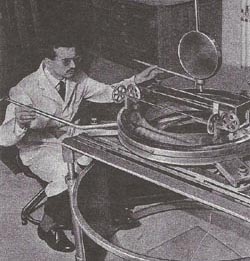
The paraconical pendulum is the instrument invented by Maurice Allais and used in his 1959 eclipse observations. The source describes it as a pendulum on an anisotropic support, and explicitly distinguishes it from both a torsion pendulum and an ordinary Foucault pendulum.
What it measures
The quantity of interest is the precession of the plane of oscillation — the rate at which the pendulum's swing plane rotates — not the pendulum's period and not the local value of g. This is the basis of Allais's distinction between a dynamic phenomenon (the moving pendulum's precession, which he claimed is inexplicable by gravitational theory) and a static phenomenon (deviations from the vertical, which he conceded are explained perfectly by that theory).
Use in eclipse experiments
Allais used the instrument for his 2 October 1959 observation. Later, Leonid Savrov of the Sternberg Astronomical Institute built a dedicated paraconical pendulum to test the effect during the solar eclipse of 11 July 1991 in Mexico and the eclipse of 3 November 1994 in Brazil. Savrov reported an increase in the rotational velocity of the pendulum oscillation plane in the direction of the Foucault effect during the eclipse, but could not confirm Allais's claim of a diurnal periodicity in the motion of a paraconical pendulum.
A Romanian team reported a "quantization" of the behaviour of the paraconical pendulum during the annular solar eclipse of 22 September 2006. Pugach and Olenici (2012) reported correlated behaviour of two light torsion balances and a paraconical pendulum in separate locations during the eclipse of 26 January 2009.
Related pages
- Maurice Allais
- Allais Effect
- Allais Effect Claims vs. Evidence: Positive Reports, Negative Results and the Unpublished NASA Study
Source notes & attribution
- https://rexresearch.com/AllaisParaconicalPendulum/AllaisParaconicalPendulumExperiments.html