What this source is
This is a source dossier built around a single named material system, Si₂HSb₂, attributed to an inventor named Henson, and a single referenced patent, US5252176. The page presents the material as an amplifier — a silicon–hydrogen–antimony composition that is claimed to perform signal amplification.
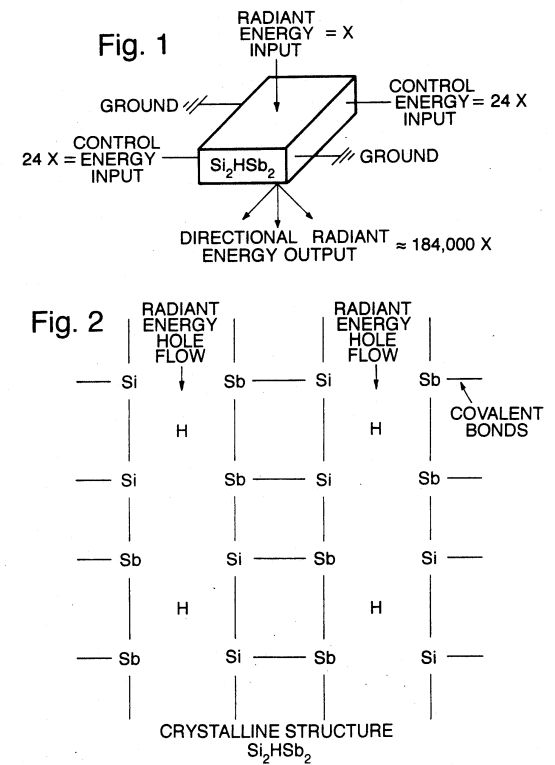
The dossier reproduces the full US5252176 specification text, including the abstract, background, summary, description of the preferred embodiment, chemical reaction equations, and one image reference (us5252176.jpg). It gives a multi-step fabrication procedure (silicon and antimony with dilute nitric acid, heating at 490-510 °C; a second route via pure water at 490-510 °C; combination of Si₂HSb₂ and Si₂NSb₂; prolonged heating of Si₂HSb₃ at 370-380 °C) and states quantitative claims: an amplification factor of 184,000 times the power input and a control power of approximately 24 times the input power. It does not describe a circuit or report independent measurements.
The claim
The core assertion is that a composition written as Si₂HSb₂ functions as an amplifier, with the source's header explicitly claiming '184,000x Power Amplification.' Read literally, the formula denotes a compound of two silicon atoms, one hydrogen atom and two antimony atoms. That stoichiometry is not a standard semiconductor formulation. Silicon device technology normally uses antimony as a dopant — an n-type impurity introduced at trace concentrations (parts per million or lower) into otherwise pure silicon — not as a bulk constituent at a 2:2 ratio with silicon. The source itself acknowledges the distinction, stating the invention 'has nothing to do with semiconduction as it relates to solid state electronics.'
The dossier does not explain how the material is made, what its crystal structure is, whether it is a bulk crystal, a film or a powder, or how it is incorporated into a device. It also does not state whether the Si₂HSb₂ designation originates in the patent itself or was coined by the dossier author. That distinction matters: a formula taken from a patent claim carries different weight than a formula invented as a page label.
Technical details and methods
The source supplies a fabrication procedure and some device description, but no independent measurements. It provides:
- a multi-step fabrication method (silicon + antimony + dilute nitric acid; heating at 490-510 °C; a second water-based route; combination of Si₂HSb₂ and Si₂NSb₂; prolonged heating of Si₂HSb₃ at 370-380 °C);
- a device description: the compound is poured into a mold with electrodes molded into it, radiant energy enters the top and exits the bottom, and electrical potentials applied to the sides control the 'holes' in the lattice;
- claimed quantitative figures: 184,000x power amplification and a control power of approximately 24 times the input power;
- no doping levels, carrier concentrations or mobility figures;
- no gain, bandwidth, noise or frequency-response measurements;
- no comparison against conventional silicon or compound-semiconductor amplifiers.
The technical anchor is the patent specification reproduced in the dossier. See US5252176 — Referenced Patent in the Si₂HSb₂ Dossier for what can and cannot be established about it from this material.
Observations and evidence
There is no experimental evidence in this source. No test data, no measurements, no replication reports, no independent validation, and no third-party assessment appear anywhere in the supplied material. The dossier is, in substance, a patent reference plus an image.
This places it in the same methodological category as other patent-only or press-only the source archive dossiers, such as the Schaeffer steam generator and d'Angelo inter-atomic ion motor records. In each case the archive preserves a claim and its documentary trace, not a demonstration.
Limitations, contradictions and unresolved questions
- Patent-only evidence. A patent documents a filing and a grant; it is not proof that the described device works as claimed. See Patent as Evidence.
- Unverified stoichiometry. Si₂HSb₂ is not a recognized semiconductor compound in the standard literature as presented here, and the source offers nothing to support it.
- No device description. Even if the material existed, the source does not show how it would be wired as an amplifier.
- Attribution ambiguity. Whether "Henson" is the patent holder, the dossier compiler, or both is not resolved by the supplied text.
- No contradiction with existing wiki content, but also no corroboration.
Open questions that the supplied material cannot answer: What does US5252176 actually claim? Is the Si₂HSb₂ formula from the patent or from the dossier author? Has anyone attempted replication?
Related work
- Henson (Si₂HSb₂ amplifier inventor) — the inventor named in the dossier.
- US5252176 — Referenced Patent in the Si₂HSb₂ Dossier — the referenced patent.
- Si₂HSb₂ Amplifier Claim — the technical claim as stated.
- Si₂HSb₂ Amplifier Claims vs. Evidence: A Patent Reference Without Test Data — the claim set against the available evidence.
- Topic guides: concepts/electricity, concepts/chemistry, concepts/energy.
Source notes & attribution
- source dossier: rexresearch/72336d85c6d120da.md (native source filename).
- Referenced patent: US5252176 (image reference us5252176.jpg in the dossier).
- https://rexresearch.com/hensonsihsb/henson.html