What this source is
This source is an archive page hosted in the gibbstime/ subdirectory of the source archive (the source archive). It presents the Hyper-Dimensional Resonator (HDR), a claimed device attributed to Steven Gibbs (also given as Steven L. Gibbs), together with the device's own diagrams and photographs. The page is a device description plus image set: it explains what the apparatus is said to be, how it is said to be built, and what it is claimed to do.
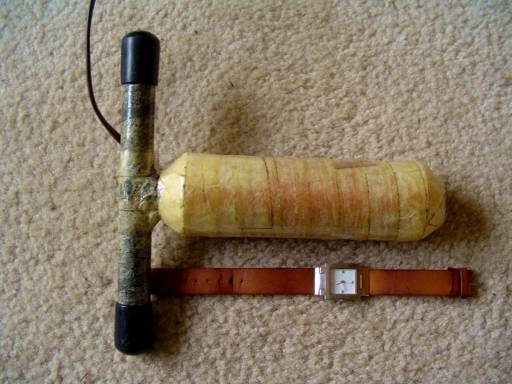
It is a self-published / archive-hosted account, not a laboratory report, a peer-reviewed paper, or a replication study. Nothing in the source reports an independent measurement of the device's output, a controlled test of its claimed function, or a third-party reproduction. The page was captured cleanly by the archive (the audit classifies it under physics_devices with a low capture-problem probability), but clean capture means only that the text and images were preserved faithfully — it says nothing about whether the claims are true.
The claimed device
The HDR is described as a small, hand-built electromagnetic apparatus. In the account it is assembled from:
- Twin electromagnetic coils wound on a core, described in the radionics tradition as a "caduceus" winding — a paired, opposed or interleaved winding pattern named after the double-serpent staff.
- A "witness" well — a small recess intended to hold a physical sample associated with a target (in radionics practice, typically a photograph, a lock of hair, or another object said to link the device to a person or place).
- A rubbing plate — a surface the operator is said to stroke or rub, which in the account acts as the operator interface for tuning or "tuning in" the device.
- Associated electronics and controls that drive the coils.
The page's own images document the build: exterior views of the assembled unit, interior views showing the coil and well arrangement, and supplementary diagrams. These are the source's own photographs and drawings of the device, not independent documentation.
Claimed function
Per the account, the HDR enables "hyper-dimensional" effects — variously described as travel or perception across time and dimensions, and as producing "astral" phenomena experienced by the operator. The mechanism is asserted rather than derived: the coils, the witness well and the rubbing plate are said to interact to produce the effect, with the "hyper-dimensional" framing supplying the explanatory vocabulary.
This is the central tension of the source. The device is presented simultaneously as an ordinary physical object — copper windings, a core, a power supply, a hand-operated plate — and as an apparatus operating on principles outside ordinary electromagnetism. The account does not bridge the two: no field model, no energy budget, and no measurement is offered that would connect the physical build to the claimed non-physical effect.
Evidence and its limits
| Aspect | What the source provides |
|---|---|
| Device description | Yes — components, build, images |
| Claimed function | Yes — "hyper-dimensional" travel/perception, "astral" phenomena |
| Independent measurement | None reported |
| Peer review | None reported |
| Replication by third parties | None reported |
| Operator instructions | Described in the account |
The evidence base is therefore testimonial and promotional. The source asserts what the device does; it does not demonstrate it. Under Bench policy this material is presented as an account — a record of what is claimed and how the device is described — and not as established fact.
Attribution discipline
All functional claims in this article belong to the HDR and to the Gibbs account specifically. The wiki's other claimed-device pages — the Marcum Time Machine account, the Chronovisor claim, and the various over-unity-claims dossiers — are parallel cases, not supporting evidence. Similarity of vocabulary ("resonance", "time", "dimensions") is not transfer of efficacy in either direction. Where this source is compared with those, the comparison is stated explicitly and sourced.
Open questions
- The source names the inventor as Steven Gibbs (Steven L. Gibbs) and describes him as a Nebraska farmer who built the HDR in 1985, improving on an earlier 1981 Sonic Resonator. No separate figure named John E. W. Gibbs appears in the source.
- Whether the images are original to the source or reproduced from elsewhere is not stated on the page.
- The page gives no dates for the device's construction, no version history, and no account of who, if anyone, has operated it.
Related work
- Hyper-Dimensional Resonator (HDR) — the device entity page.
- john-e-w-gibbs — the attributed inventor.
- Hyper-Dimensional Resonator Claim — the mechanism/claim concept.
- Witness Well and Caduceus Coil — the two distinctive build features.
- HDR Claims vs. Evidence: The Gibbs Account, the Marcum Case and the Chronovisor — how this account compares with the Marcum and Chronovisor cases.
- Time-Displacement Claims and Chronovisor Claim (Time-Viewing / Retrocognition Devices) — the existing sibling claim pages.
Source notes & attribution
- Source file: rexresearch/66695c6c936dbab6.md (Rex Research, gibbstime/ subdirectory).
- Source images referenced by the page: hdr-elmag.jpg , gibbs1.jpg , hdrc.jpg , hdr_sup.jpg , hdr_inside.jpg , hdr2.gif , hdr-th.jpg , hdr1.gif .
- rexresearch.com/gibbstime
- https://rexresearch.com/gibbstime/gibbs.htm