These two studies concern the low-temperature carbonization method associated with Lewis Cass Karrick, but they were written by other authors. The evidence reviewed here shows that the first capture is not a Karrick-authored dossier but a 1933 University of Utah thesis by S. C. Jacobsen and G. W. Carter, and that the second is a plant-design study by Larsen and Stutz. Karrick appears in both as the originator of the low-temperature carbonization (LTC) method being tested, not as the author of the documents.
The source text supplies the verified author identities, the thesis table of contents, the cannel-coal definition the thesis quotes, and the historical coal-oil industry context. It also records what the reviewed excerpts do not contain: the test results, heat calculations and yield figures that the thesis places in its later sections.
The two native sources
| Identity | URL | What it is |
|---|---|---|
| [source note 4] | [source note 5] | Jacobsen & Carter, Engineering Factors Relating to the Utilization of the Cannel Coals of Southern Utah, thesis submitted to the Faculty of the University of Utah, 15 May 1933 |
| [source note 6] | [source note 7] | Larsen & Stutz, Design of Plant for Low Temperature Carbonization Treatment of Utah Coal by Karrick Process |
Both are hosted in the Karrick subdirectory of the source archive, which is why the archive's framing had been read as a single-inventor record. The evidence scope for this source text is Jev-reviewed retrieved passages, not complete source coverage; the full originals remain in the native raw source library.
The 1933 thesis: scope and structure
The thesis is titled Engineering Factors Relating to the Utilization of the Cannel Coals of Southern Utah. Its frontispiece is described as "The Great White Throne (showing members contiguous to the cannel coal measures)" and is not included in the capture. The table of contents is preserved verbatim below; it is the only structured content in the reviewed excerpts.
1. Acknowledgement
2. Introduction
3. Cannel Coal
4. Utah's Cannel Coal Deposit
5. Object of Plant Tests
6. Description of Apparatus
7. General Test Procedure
8. Description of Individual Tests
9. Heat Calculation for Test Run # 6
10. Discussion of Results
11. Summary
12. Bibliography
Sections 1, 2 and 4 are marked "[Not included here]" in the capture. The reviewed excerpts cover sections 3, 5 and the opening of section 6. Sections 8, 9 and 10 — the individual test descriptions, the heat calculation for test run #6, and the discussion of results — are not present in the excerpt set. Any yield figure, operating temperature or residence time would live in those sections, and none is asserted here.
What the thesis says about cannel coal
Section 3 defines the feedstock by quoting two authorities rather than reporting the authors' own measurements.
Ashley (reference 11) is quoted describing cannel coal as:
"a massive, non-caking, tough, clean block coal of fine, even, compact grain, dull luster, commonly conchoidal cross fracture, having a low fuel ration, a high percentage of hydrogen, easy ignition, long yellow flame, black to brown greasy streak, and moderate ash, which is pulvurent in burning. It is essentially a rock derived by solidification and partial distillation or oxidation of water-laid deposits consisting of or containing large quantities of plant spores and pollen grains and more or less comminuted remains of low orders of water plants and animals".
David White (reference 12), writing on his microscopical study of the Utah cannel coal, is quoted as finding "very little if any vestiges of the cell structures of higher plants", the fuel being made up largely of "lemon-yellow, more or less lenticular, or globular, translucent bodies embedded in a brownish black groundmass".
The thesis then states the generally accepted origin distinction: bituminous coals resulted from woody materials, whereas cannel coals appear to have formed from decayed spores, pollen, leaves and cuticle material. Those waxy ingredients are given as the reason for the high oil yield possible from most cannel coals — "usually two to three times the yield from bituminous coals" — and the same organic constituents are said to be largely responsible for the oil obtainable from oil shales. This is a reported claim citing Ashley and White, not an original measurement by Jacobsen and Carter.
The thesis also records the fuel's practical character: cannel coal is adapted to the common uses of bituminous coal except coke manufacture, is described as an ideal and long-accepted "deluxe" fireplace fuel, burns without disintegration and therefore smokes less than high-volatile bituminous coal, and was used extensively in the eastern USA for coal gas enrichment because of its high volatile content and the high candle power of those volatiles.
Historical coal-oil context
Section 3 carries a historical passage on the pre-petroleum coal-oil industry. As early as 1846 oil was manufactured from coals; by 1860, the year the thesis gives for the first real discovery of petroleum, there were 55 coal-oil plants operating in the US, the largest with a distilling capacity of 6000 barrels of oil per day. Kerosene (coal oil), light lubricants, greases and wax are named as the principal refined products, with gasoline having no market value at that time. Most plants were in Pennsylvania, Kentucky and West Virginia, with one large plant in Boston. The principal cannel coal deposits are listed as Pennsylvania, Kentucky, West Virginia, Indiana, Ohio, Tennessee, Missouri, Iowa, Arkansas, Texas and Utah. These are historical assertions, not test results.
Object of the plant tests and the Karrick method
Section 5 states that a 1932 visit to the cannel coal deposit established that it was extensive and accessible enough to large markets by truck and rail to justify early development, and that the coal's superiority for domestic fuel and as a source of road oil and motor fuel motivated a study of processing the slack coal. The study was planned to examine both the heat requirements of treating the coal and the products formed.
The thesis states that advantage was taken of 1920 studies of this coal by the State of Utah and the Federal Government, in which laboratory processing data were obtained (reference 9) and by which "excellent yields and quality of oil were obtained". The destructive distillation method used steam as the heat-transferring fluid: exhaust steam from power plant engines or turbines was superheated and then passed directly through bodies of sized, dust-free coal. The thesis identifies this method as the Karrick LTC Process (reference 13), notes it had subsequently been developed for commercial uses (reference 5) and appeared to have many advantages, and states that it was adapted for the thesis study of the cannel coal.
The design objectives for the test apparatus are given as minimizing radiated heat losses under all processing conditions, and taking temperature and heat-flow data throughout the coal charges and the apparatus so that products obtained could be correlated with the most economical use of heat.
The thesis closes section 5 by noting that the coal-treating method used "is one of a group being offered to the Utah Research Foundation [by Lewis C. Karrick]". This is the point at which Karrick enters the document: as the originator of the offered method, not as its author.
Apparatus and the figure
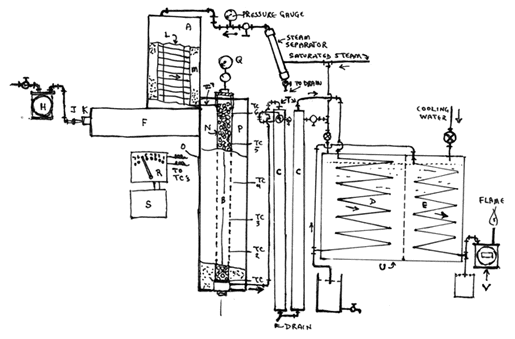
Section 6 states that a small distilling plant was constructed for the investigation, and that Figures 2 and 3 are respectively a schematic plant layout and a photograph of the test setup. Only Figure 2 is reproduced in the capture, as jacarfig.gif.
The second source: Larsen and Stutz
The second capture, [source note 6], is titled Design of Plant for Low Temperature Carbonization Treatment of Utah Coal by Karrick Process and is attributed to Larsen and Stutz. Only the title and source URL are present in the reviewed evidence; no body text, figures or design data from this document were retrieved. It is recorded here as a related primary document on the same process and feedstock, and its content should not be inferred from the title alone.
Evidence status and limits
The reviewed excerpts establish the scope, method and framing of the 1933 thesis. They do not establish its results. Specifically:
- No yield figures, product analyses, operating temperatures or residence times appear in the excerpts; those belong to sections 8–10, which are not included.
- The "two to three times the yield from bituminous coals" figure is a reported claim attributed to Ashley and White, not a measurement by the thesis authors.
- The 55 plants and 6000 barrels per day figures are historical assertions about the 1860 US coal-oil industry.
- The Karrick process is described in the thesis as having been developed for commercial uses, citing references 5 and 13; those references are not reproduced here.
- The Larsen and Stutz document is present only as a title.
The archive's broader framing of LTC as a suppressed competitor to petroleum-derived liquid fuel is not supported or refuted by these excerpts; it is recorded as framing. See Karrick Claims vs. Evidence: The Dossier's Assertions and the Absence of Test Data for the standing comparison of Karrick dossier claims against available evidence.
Related work
- Low-Temperature Carbonization (LTC) — the process class the thesis tests.
- karrick-process — the named variant, using superheated steam as heat-transfer fluid.
- cannel-coal — the feedstock and its spore/pollen origin.
- Coal Carbonization vs. Coal Liquefaction — route comparison.
- Lewis Cass Karrick — originator of the offered method.
- s-c-jacobsen, g-w-carter — thesis authors.
- larsen-and-stutz — authors of the plant-design study.
- university-of-utah — host institution of the thesis.
Source notes & attribution
- S. C. Jacobsen and G. W. Carter, Engineering Factors Relating to the Utilization of the Cannel Coals of Southern Utah , thesis submitted to the Faculty of the University of Utah, 15 May 1933. Native source: rexresearch/5a6e8e4a6f35263c.md ; https://rexresearch.com/karrick/1jacar.htm
- Larsen and Stutz, Design of Plant for Low Temperature Carbonization Treatment of Utah Coal by Karrick Process . Native source: rexresearch/d7457570dbc786b7.md ; https://rexresearch.com/karrick/1larstz.htm
- Figure 2, jacarfig.gif , reproduced from the Jacobsen & Carter capture.
- rexresearch/5a6e8e4a6f35263c.md
- https://rexresearch.com/karrick/1jacar.htm
- rexresearch/d7457570dbc786b7.md
- https://rexresearch.com/karrick/1larstz.htm
- https://rexresearch.com/karrick/karric.htm
- https://rexresearch.com/karrick3/karrick3.htm
- https://rexresearch1.com/CoalMiningLibrary/karrick/1jacar.htm
- https://rexresearch1.com/CoalMiningLibrary/karrick/1larstz.htm
- https://rexresearch.com/karrick/1ketch.htm
- https://rexresearch.com/karrick2/kltcusp.htm
- https://rexresearch.com/ketchum/1ltcre.htm