Lester Jennings Hendershot, a railroad fireman and mill worker from West Elizabeth, Pennsylvania, built a small electrical machine in the winter of 1927–28 that he said drew its power from the Earth itself. The claim reached the public through a cluster of New York Times articles published within a few days of each other in February 1928, and again in November of that year. Those articles — four dated pieces, plus a much later retrospective — are the substance of this source. They record what witnesses said they saw, not what instruments measured.
What the device was claimed to be
Hendershot's machine was described in the press as a "fuelless motor." The designers' stated principle was that it ran on an electromagnetic effect, drawing force "directly from the earth's field" and converting those currents into power delivered at a propeller shaft. Hendershot's own later formulation, quoted in the November 1928 article, called it a "magnetic induction" motor: it took an initial impulse from a precharged magnetic core and its "secondary and greatest power impulse by magnetic induction from the earth."
The mechanism was never stated consistently. Across the four articles the energy source shifts between "earth currents," "the earth's magnetic field," a precharged core, and magnetic induction. Hendershot's wife told a reporter that the idea had come to him in a dream several years earlier, and that he believed the earth currents responsible for the aurora borealis could be harnessed to drive an engine. He began building in November 1927, after his four-year-old son's toy airplane failed to fly; the first miniature model was assembled from parts of a worn-out radio given to him by an uncle.
The two models and their reported performance
The February 27 article, built around an interview with Major Thomas G. Lanphier, commandant at Selfridge Field, Michigan, gives the most concrete physical description in the source.
The first model was built around a ring magnet less than three inches in diameter. Coils were wound around the magnet "rigged as only Hendershot knows how to rig them," and a second set of coils passed through the center of the ring. Lanphier said this model was hooked to a small sewing-machine motor, which it not only ran but burned out, and that it kept a 6-watt lamp lit for 26 hours.
The second model, which Lanphier said he helped build from parts picked up at the field, used a ring magnet with an outside diameter of seven inches and an inside diameter of six inches. With it, Lanphier said, they lit two 110-watt lamps, and he added that he thought the second model held "enough electricity in this second model to kill a man." He noted that the larger model had not yet been connected to a motor capable of delivering power to a crankshaft.
The February 26 article, reporting from Detroit, describes a demonstration held secretly the previous day in a hangar at Selfridge Field, witnessed by Lanphier, Charles A. Lindbergh and others. The model shown was described as roughly the size of a vacuum-cleaner motor — far smaller than a machine that could lift an airplane. W. B. Stout, head of Stout Air Lines and designer of the all-metal tri-motored Ford monoplane, said he had seen a demonstration two weeks earlier in Pittsburgh and called it "very impressive" and "actually uncanny." Stout identified the novel armature winding as the "revolutionary feature," and reported that Hendershot claimed to have wound it so that it drew energy from currents existing constantly in the air or ground. Stout added that the small model "appeared to operate exactly as Hendershot explained that it did."
Neither Lindbergh nor Lanphier would comment at length on the test. Lanphier referred all questions to Hendershot, saying "he is the only one who knows all about it," and stated that Lindbergh "has nothing to do with it, although he saw it." William B. Mayo, chief engineer for the Ford Motor Company, was reported in conference with Lanphier, Hendershot and Peat that day.
The same article reports that the motor was said to have made between 1,500 and 2,000 revolutions per minute during tests at Bettis Field, and that pilots and mechanics there believed it would be a practical success as an airship motor. It also reports, unattributed, that capitalists were close to arranging purchase of the invention or control of its production, and that Lindbergh's inspection had been made in their interest.
The compass behavior
The February 26 article records a detail that recurs in later retellings: the original model "works somewhat on the principle of a compass." It would operate when pointing north or south but would not move when pointed east or west. Hendershot reportedly spent nearly two years trying to overcome this directional dependence before bringing a motor to Bettis Field that appeared to work in any orientation. That motor was installed in a small model airplane, which flew but crashed because it was not rigged properly.
The motor-versus-generator dispute
The February 27 article opens with a direct contradiction of the "motor" label. According to Lanphier, the Hendershot machine "is not a motor at all but a generator." Lanphier said he had first dismissed it as "more or less bunk" before seeing it work. He was not prepared to explain why the generator behaved as it did, or where the energy came from, beyond quoting Hendershot's theory that it drew energy from the Earth's magnetic field. He declined to describe the device in detail until pending patents were received.
This distinction matters for how the claims should be read. The "generator" framing is Lanphier's characterization, not Hendershot's; the Earth-field mechanism is Hendershot's theory as relayed by Lanphier; the "uncanny" assessment is Stout's. The source does not merge these voices, and neither should a summary of it.
The radio-station alternative
The February 27 article records that it was suggested the Hendershot engine might be "stealing" power from a large radio broadcasting station. Lanphier said they had considered that, but had run the device for 26 hours "when stations were going and when they were not" and obtained the same results. This is the only alternative explanation addressed in the source, and it is dismissed on the basis of Lanphier's recollection rather than any measurement.
The November 1928 claims
By November, the framing had changed. A short article reports that Representative M. Clyde Kelly of Pennsylvania planned to seek a Congressional patent for the motor — a route that would give the patentee full protection for 17 years — if five scientists approved the invention as practical. The article notes that the invention had first been announced in March and that "in some quarters it was regarded with skepticism."
In this article Hendershot is quoted saying several of his motors had been built, and that one developing 60 horsepower had operated for two weeks without recharging the magnetic core. This is the inventor's own assertion; no independent verification is reported.
A fourth article, dated February 28, 1928, carries Hendershot's own explanation of the mechanism: shifting the magnetic field to east and west causes rotary motion. The excerpt of this article is truncated.
The 1989 retrospective
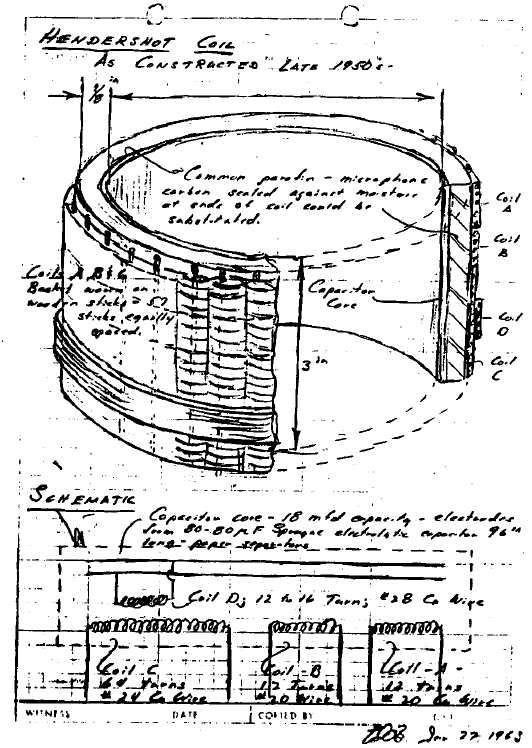
The source page also carries a much later item: a report by Edward O'Brian, described as a retired patent attorney, published in Borderland Science in the March–April 1989 issue, accompanied by two circuit images. The excerpt supplies no captions, component values or measurements for those images, so they cannot be assessed here. The retrospective is a secondary account written six decades after the events and adds no contemporaneous evidence.
What the evidence does and does not establish
The record in this source consists of contemporaneous newspaper reporting of demonstrations that named witnesses said they attended. It is not independent instrumented measurement. The source reports no efficiency figures, no input/output power balance, no controlled test protocol, and no replication by an independent laboratory. The 26-hour runtime and the lamp wattages are witness recollections. The 60-horsepower and two-week figures are the inventor's claims. The radio-station explanation was raised and dismissed without measurement.
The source also contains an internal tension that should be kept visible: the press record gathered here is uniformly favorable, while the wider Hendershot dossier includes a later counter-demonstration that reportedly failed. This source does not mention it. Readers should consult Hendershot's Fuelless Motor: Claims, Witnesses and the Hochstetter Counter-Demonstration for the claims-versus-evidence picture across the whole cluster, and The 1928 Hendershot Fuelless Motor Press Record: hendershot3.htm and the Mark Hendershot Memoir for the sibling page in the same the source archive collection.
Thematically the Hendershot claim belongs with other ambient-field and free-energy proposals in this archive — radiant-energy-claim-bedini and universal-currents-claim — but its proposed mechanism, a ring magnet with a novel armature winding drawing on the Earth's field, is distinct from both.
Open questions
Whether the 60-horsepower, two-week claim was ever independently verified is not answered by this source. The exact winding geometry — the feature Stout called revolutionary — is not described. The relationship between the February demonstrations and the later counter-demonstration is not addressed here and remains the central unresolved question in the Hendershot record.
Source notes & attribution
- New York Times , "Fuelless Motor Impresses Experts," Sunday, February 26, 1928.
- New York Times , "Fuelless Motor Is A Generator," February 27, 1928.
- New York Times , "Explains Magnet In Fuelless Motor," February 28, 1928.
- New York Times , "May Seek Motor Patent," November 12, 1928.
- Edward O'Brian, report in Borderland Science , March–April 1989.
- Rex Research, Lester Hendershot page: https://rexresearch.com/hendershot/hendershot.htm
- https://rexresearch.com/hendershot/hendershot.htm
- https://rexresearch.com/hendershot2/hendershot.htm
- https://rexresearch.com/hendershot3/hendershot3.htm