Holophonics
The recording claims and the experience of spatial sound.
Start here / 10 minute read
Hugo Zuccarelli and Holophonics
This source dossier collects material about Holophonics, a binaural recording and reproduction system created by the Argentine inventor Hugo Zuccarelli in 1980 while he was studying at the Politecnico di Milano. The page is an aggregation rather than a study: it combines a Wikipedia-derived summary of Holophonics, abstracts of two Zuccarelli patents describing a head-shaped acoustic monitoring device, a list of commercial recordings said to use the system, and a set of later patents and library links that use the word "holophonic" in several different senses.
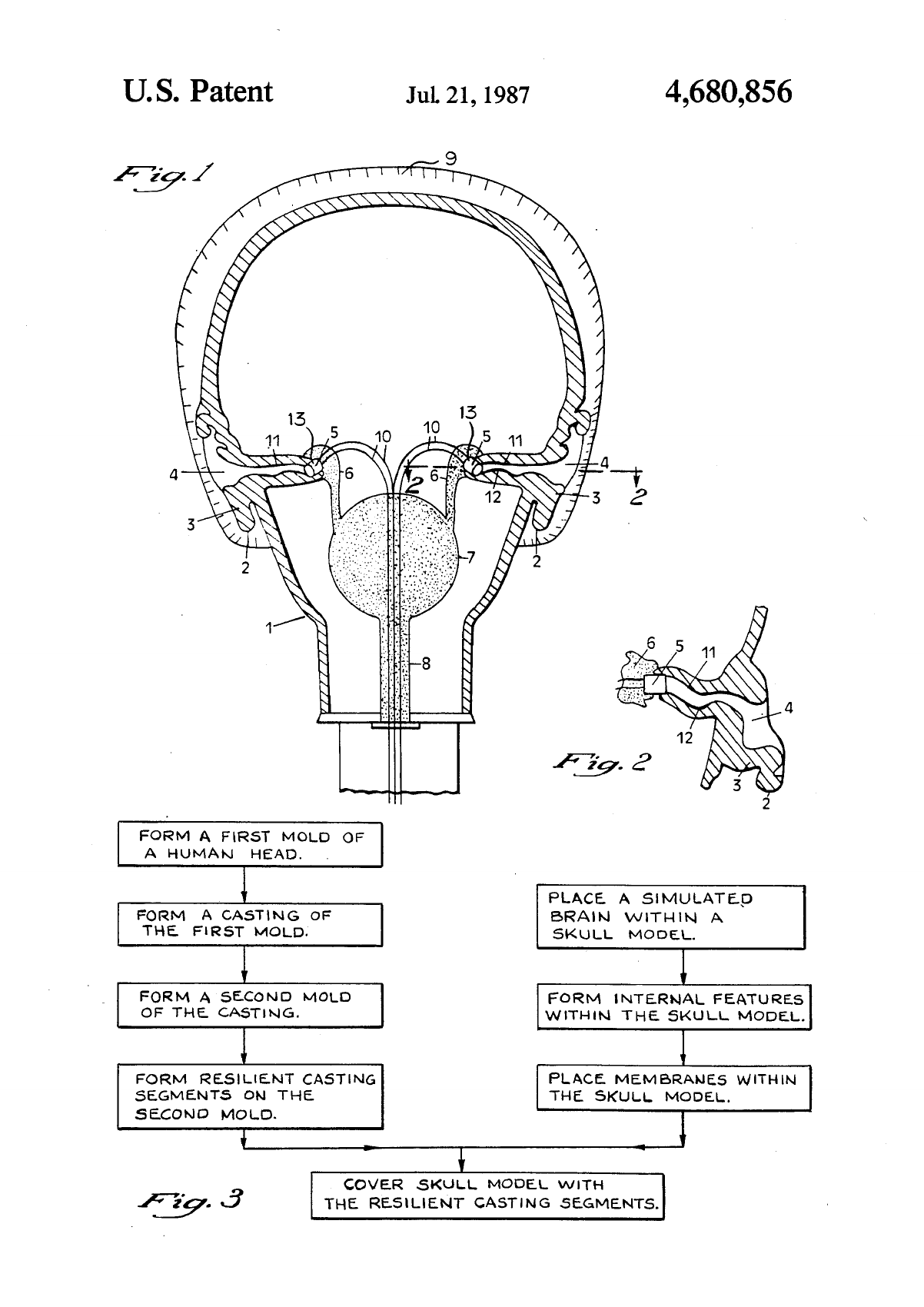
US patent publication; document page 2. Preserved page.
The dossier's most important feature is an internal tension. It presents Zuccarelli's theory — that the human auditory system works as an interferometer — and then, in the same Wikipedia-derived text, states plainly that no evidence supports that theory and that ordinary binaural recording and head-related transfer function (HRTF) synthesis explain the same perceptual effects. The demonstrations are treated as real; the proposed mechanism is not.
What Holophonics is claimed to be
According to the dossier, Holophonics is a binaural recording system "based on the claim that the human auditory system acts as an interferometer." It relies on phase variance, as stereophonic sound does. The sound characteristics are said to be most clearly heard through headphones, though the source says they can also be demonstrated with two-channel stereo speakers provided those speakers are phase-coherent. The word "holophonics" is related to "acoustic hologram."
The system was created in 1980. In 1983 Zuccarelli released a UK recording titled Zuccarelli Holophonics (The Matchbox Shaker), produced by CBS, consisting entirely of short demonstration sounds: a shaking matchbox, a haircut and blower, bees, a balloon, a plastic bag, birds, airplanes, fireworks, thunder and racing cars.
The claimed mechanism: the auditory interferometer
Zuccarelli's stated theory, as reproduced in the dossier, is that the human auditory system is a sound emitter: it produces a reference sound that combines with incoming sound to form an interference pattern inside the ear. The nature of that pattern is claimed to be sensitive to the direction of the incoming sound. Under the hypothesis, the cochlea detects and analyzes the pattern as if it were an acoustic hologram, and the brain interprets the data to infer the direction of the sound.
An article by Zuccarelli presenting this theory appeared in New Scientist in 1983. The dossier notes that it was "soon followed by two letters, casting doubt on Zuccarelli's theory and his scientific abilities."
The dossier's own counter-evidence
The Wikipedia-derived text in the dossier does not endorse the interferometer theory. It states:
- "To date, there has been no evidence provided that any acoustic emissions are used for sound localization."
- Holophonics, like binaural recording, instead reproduces the interaural differences (arrival time and amplitude between the ears), as well as rudimentary head-related transfer functions (HRTF), creating the illusion that sounds from a speaker membrane emanate from specific directions.
- While otoacoustic emissions do exist, "there is no evidence to support the assertion that these play a role in sound localization, nor is any mechanism for this 'interference' effect claimed by Zuccarelli supported."
- "On the contrary, there is abundant literature proving that properly presented spatial cues via HRTF synthesis (mimicking binaural heads) or binaural recording is adequate to reproduce realistic spatial recordings comparable to real listening, and comparable to the Holophonics demonstrations."
The cited counter-evidence base is Gilkey & Anderson, Binaural and Spatial Hearing in Real and Virtual Environments.
The practical resolution the dossier implies is therefore narrow: the Holophonics demonstrations are comparable to what binaural recording and HRTF synthesis already achieve, while the theory attached to them is unsupported.
The Zuccarelli patents
Two patents in the dossier are attributed to Zuccarelli and describe the concrete artifact behind the system: a head-shaped microphone.
US4680856 — Process for forming an acoustic monitoring device
Inventor: ZUCCARELLI HUGO [IT]. The abstract describes an acoustic monitoring device for sound sensing in recording, reproduction, broadcasting or transmission, shaped like a human head with anatomical features accurately reproducing the shape of the auricles, the auditory meatus, the Eustachian tubes, and the nasal and oral cavities. Membranes responsive to sound pressures sit at the positions of the eardrums or other auditory organs. The manufacturing process is described as:
- forming a first mold on a human head;
- forming a casting from that mold;
- forming a second mold on the casting;
- painting the second mold with a liquid silicone rubber, allowed to dry to form resilient casting segments simulating the human head.
Anatomical features simulating the brain and internal members defining the Eustachian tubes and the nasal and oral cavities are provided within a skull model. A pair of membranes is placed within the skull model at the location of the eardrums or other auditory organs. These membranes are coupled to acoustic members that provide electrical signals on wires exiting the skull model. The silicone rubber casting segments are transferred to the exterior of the skull model, giving the device the appearance and characteristics of the original human head.
EP0050100 — Device for the spatial codification of sounds
The abstract describes a microphonic support shaped like a human head, equipped with auricles and internal cavities that faithfully reproduce the auditory meatus, the Eustachian tubes and the oral cavity. It includes a wig that provides asymmetry for front and back discrimination, and two microphones arranged in the meatus cavity in the exact position and orientation of the eardrum, communicating at the back with the cavities acting as the Eustachian tubes. The oral cavity is in communication with the outside.
The wig detail is notable: it is an explicit design element for breaking left–right symmetry so that front/back cues can be captured.
Recordings released using Holophonics
The dossier lists the following releases as having used the system:
| Release | Label / catalogue | Year |
|---|---|---|
| Pink Floyd, The Final Cut | Harvest/E.M.I, 7243 8 31242 2 0 | 1983 |
| Paul McCartney, "Keep Under Cover" | — | 1983 |
| Roger Waters, The Pros and Cons of Hitchhiking | Harvest, CDP 7 46029 2 | 1984 |
| Psychic TV, Dreams Less Sweet | Some Bizzare | 1983 |
The dossier also states that the system "has been used in film soundtracks, popular music, television and theme parks," and that most famous sound effects were recorded in Modena at Umbi's Studios by sound engineer Maurizio Maggi. It then states that "Holophonic is patented and registered by Umberto Maggi (Italy)." The relationship between Zuccarelli and the Maggi name is not explained, and the two names (Maurizio and Umberto) are not reconciled in the source.
Later patents using the word "holophonic"
The dossier reproduces abstracts of several later patents that use "holophonic" or "holophone" in a spatial-audio or information-processing sense. These are legal documents describing methods and devices; none of them is evidence that Zuccarelli's interferometer theory is correct.
WO2014049268A1 — Method and device for generating audio signals to be delivered to a sound reproduction system
Inventor: CORTEEL ETIENNE et al. The method generates audio signals for a reproduction system with a first set of loudspeakers at a reference height and a second set at a higher height that are vertically more directive. It identifies the position of at least one sound object in the input signal, then generates first and second audio signals by applying delay and/or gain plus a sound spatialisation technique to each set, taking into account the identified position and the loudspeaker positions. At least one sound spatialisation technique is a holophonic technique, and the delays and/or gains are selected so that the combination of the two sets verifies a defined sound restitution effect at at least one reference spatial position.
US9319794B2 — Holophonic speaker system with filters that are pre-configured based on acoustic transfer functions
Inventor: BETLEHEM TERENCE. A surround sound system reproduces a holographic spatial sound field in a sound control region within a room having at least one reflective surface. It comprises multiple steerable loudspeakers around the control region, a control unit connected to each loudspeaker, and a sound field recording system with a microphone array in the control region. Each loudspeaker has multiple speaker input signals, each controlling one of several individual directional beam response patterns; the overall directional response is the combination of those patterns. In playback mode the control unit receives input spatial audio signals representing the holographic field and applies pre-configured filters to generate the speaker input signals. The holographic field is formed from direct sound plus reflected sound from the room's reflective surfaces. The filters are pre-configured in a configuration mode based on acoustic transfer function data measured by the microphone array in response to test signals generated by each loudspeaker for each of its directional beam patterns.
DE102011011115A1 — Method for generating and discharging temporal spatial crossed holophonic wave pattern
Inventor: KIRCHHOF AXEL. The method forms a spatial-temporal crossed sound pattern dependent on a music input signal by interference reflection. The pattern is formed by non-linear, chaotic initial conditions "corresponding to a neuronal pattern-building process." Independent claims cover a speaker (particularly an interference resonator) for a speaker arrangement, a speaker arrangement (particularly an acoustic wave field generator) for generating and discharging a temporally interfering acoustic wave pattern with multiple superposed interference resonators, and a method for correcting, controlling and manipulating an audio signal. The "neuronal pattern-building process" language is speculative and unsupported within the source.
US6430293B1 — Recording and play-back two-channel system for providing a holophonic reproduction of sounds
Inventor: FINSTERLE LUCA GUBERT. A two-channel recording and playback system. The recording side uses cables and electronic apparatus for stereophonic-type recording, with multiple microphones arranged in an adjoining mutually angled relationship to provide a stereophonic effect from phase differences at each frequency and an intensity difference at least for middle-high acoustic frequencies. The playback side comprises a source, a two-channel amplifying system, and multiple diffusers arranged at the corners of a parallelogram, with the listening point preferably at the center. The front or rear diffusers receive the recorded signal unmodified, while the opposite pair receives a signal whose sound pressure is adjusted by a perspective corrector from −15 dB to +9 dB, modified in frequency response and with delayed emission, to broaden the sound range up to 360°.
CN101325822A — Rotating dynamic recording playback holography acoustic system
A rotary dynamic recording-playing holophone system composed of a sound pickup device, a record power amplifier, and a playing device. The playing device comprises a step motor, a gear transmission system, and a revolving pickup rotor. During recording the device revolves at a certain rotating speed to record sound dynamically, then transmits the signal to the record power amplifier to record or directly amplifies it and sends it to the playing device. The playing device performs dynamic revolving play at the same rotating speed and direction as the recording device, "thereby recording the holophone in the original recording scene."
US3855578A — Holophone information storing and/or processing device
Associated with C. J. H. Watson's paper "Plasma Echo and Spin Echo Holophones." The abstract describes certain natural physical systems — a collisionless plasma excited by a sequence of spatially periodic electrostatic pulses, or a material possessing net nuclear or electron spin in an external magnetic field — adapted for information processing, for example searching a mass of stored information for the presence of information related to a particular "cue."
This is a different sense of "holophone": plasma/spin-echo information processing, not Zuccarelli's audio system. The dossier places it in the same collection, but the two should not be conflated.
Bibliographic items cited in the dossier
- Zuccarelli, Hugo, "Ears Hear by Making Sounds," New Scientist, 438–440 (1983).
- Baxter, A. J., and Kemp, David T., "Zuccarelli's Theory," New Scientist, 606 (1983).
- Mabbett, Andy, and Miles, Barry, Pink Floyd: The Visual Documentary, Omnibus Press, ISBN 0-7119-4109-2 (1994).
- Mabbett, Andy, Pink Floyd – The Music and the Mystery, London: Omnibus, ISBN 978-1-84938-370-7 (2010).
- Zuccarelli, Hugo, "Holophonics in Media," Acoustic Integrity (2017).
- Gilkey & Anderson, Binaural and Spatial Hearing in Real and Virtual Environments.
- Carpentier, Thibaut; Barrett, Natasha; Gottfried, "Holophonic Sound in IRCAM's Concert Hall: Technological and Aesthetic Practices."
- Greguss, Pal, and Illényi, A., "Holophonics: a spread-out of the basic ideas on holography into audio-acoustics," SPIE Proceedings.
- Watson, C. J. H., "Plasma Echo and Spin Echo Holophones."
Limitations and unresolved questions
- No primary data. The dossier contains no measurements, no experimental protocol, and no independent replication. Its strongest evidential content is the negative assessment carried in the Wikipedia-derived text.
- Patents are not validation. US4680856 and EP0050100 describe a device and a manufacturing process; they do not demonstrate that the interferometer theory is correct. See Patent as Evidence.
- Attribution ambiguity. The text says Holophonic is "patented and registered by Umberto Maggi," while the patents listed name Zuccarelli. The relationship is unexplained.
- Terminological drift. "Holophonic" appears in at least three distinct senses: Zuccarelli's binaural system; generic spatial-audio patents (Corteel, Betlehem, Finsterle, Kirchhof); and Watson's plasma/spin-echo information-processing "holophone."
- Source tier. This is a secondary/tertiary compilation mixing a Wikipedia article, patent abstracts, and library links — not primary literature. The 1983 New Scientist article and the two critical letters would materially strengthen any assessment if obtained.
- No images are present in the supplied source.
Related work in this wiki
- Holophonics — the system and its claimed mechanism.
- Auditory Interferometer Hypothesis — Zuccarelli's specific claim.
- Binaural Recording and Head-Related Transfer Function (HRTF) — the established techniques the source says explain the effects.
- Otoacoustic Emissions — the real phenomenon at the pivot of the dispute.
- Holophonics Claims vs. Evidence: The Interferometer Theory, the Demonstrations and the Binaural Explanation — the claims-versus-evidence comparison.
- sound — the parent topic.
Source notes & attribution
- Rex Research dossier: https://rexresearch.com/ZuccarelliHolophonics/ZuccarelliHolophonics.html
- Wikipedia, "Holophonics": https://en.wikipedia.org/wiki/Holophonics
- US4680856 — Process for forming an acoustic monitoring device (Zuccarelli, Hugo).
- EP0050100 — Device for the spatial codification of sounds.
- WO2014049268A1 — Method and device for generating audio signals (Corteel, Etienne et al.).
- US9319794B2 — Holophonic speaker system with filters pre-configured based on acoustic transfer functions (Betlehem, Terence).
- DE102011011115A1 — Method for generating and discharging temporal spatial crossed holophonic wave pattern (Kirchhof, Axel).
- US6430293B1 — Recording and play-back two-channel system for providing a holophonic reproduction of sounds (Finsterle, Luca Gubert).
- CN101325822A — Rotating dynamic recording playback holography acoustic system.
- US3855578A — Holophone information storing and/or processing device (Watson, C. J. H.).
- https://rexresearch.com/ZuccarelliHolophonics/ZuccarelliHolophonics.html
Go deeper.
9 further articles4 min
Holophonics
Holophonics is a binaural recording and reproduction system created by the Argentine inventor Hugo Zuccarelli in 1980, during his studies at the Politecnico di Milano. The source dossier describes it as "a binaural recording system ... based on the claim that the human auditory system acts as an interferometer." It relies on pha
3 min
Holophonics Claims vs. Evidence: The Interferometer Theory, the Demonstrations and the Binaural Explanation
This comparison sets the claims made for Holophonics against the evidence the source dossier itself supplies. The dossier is unusual in that its own Wikipedia-derived text carries the counter-evidence, so the comparison is largely internal to the source.
2 min
Auditory Interferometer Hypothesis
The auditory interferometer hypothesis is the theoretical claim that Hugo Zuccarelli attached to Holophonics . It holds that the human auditory system acts as an interferometer: the ear emits a reference sound that combines with incoming sound to form an interference pattern inside the ear, whose nature is sensitive to the direc
2 min
Hugo Zuccarelli
Hugo Zuccarelli is an Argentine inventor, described in the source dossier as the creator of Holophonics , a binaural recording and reproduction system. He created Holophonics in 1980 during his studies at the Politecnico di Milano.
1 min
Binaural Recording
Binaural recording is the established technique of capturing sound in a way that reproduces the spatial cues a listener would receive at their two ears. In the source dossier on Holophonics , binaural recording is named as the technique that actually explains the perceptual effects attributed to Holophonics.
1 min
US4680856 — Process for Forming an Acoustic Monitoring Device
US4680856 is a patent reproduced in the source dossier on Holophonics . Inventor: ZUCCARELLI HUGO [IT]. It describes both an acoustic monitoring device and the process for forming it.
1 min
Head-Related Transfer Function (HRTF)
A head-related transfer function (HRTF) describes how the anatomy of the head, pinnae and torso filters incoming sound before it reaches the eardrum, as a function of the direction of the sound source. In the source dossier on Holophonics , HRTF synthesis is named as one of the mechanisms that adequately explains spatial-audio r
1 min
EP0050100 — Device for the Spatial Codification of Sounds
EP0050100 is a patent reproduced in the source dossier on Holophonics . It describes a device for the spatial codification of sounds.
1 min
Otoacoustic Emissions
Otoacoustic emissions are sounds produced by the inner ear — the ear does emit sound. In the source dossier on Holophonics , otoacoustic emissions serve as the pivot between a real phenomenon and an unsupported extension of it.
The visual record.
1 archived figures · open to inspectThe source room.
Everything readable here stays on StrangewellArchived texts preserve what the source said. They may contain historical, speculative, or promotional claims; inclusion is not verification.
Source text10 min
Hugo ZUCCARELLI : Holophonics -- 3D sound, articles & patents
https://www.youtube.com/@holophonics3dsounds406 3D Sound https://www.youtube.com/watch?v=hXmSf2X3ZCQ Zuccarelli Holophonics Original "Matchbox Shake" recorded in 1984 (Amazing 3D Sound) // Holophonics 3D Sounds
Supporting documents (11)
“Captured” means saved for research; a full reading guide may still be pending.
Keep following.
Thematic connections, not evidence of a shared mechanism16 / Mind & perception
Morphic resonance
Read the hypothesis and the arguments surrounding it.
↗02 / Matter & materials
Chirality & spin
Follow the boundary between spin physics and extraordinary interpretations.
↗07 / Mind & perception
The Pleiades embassy
An archive of contact narratives, off-world visas and belief.
↗