On October 31, 1957 the United States Securities and Exchange Commission announced a stop order against Horton Aircraft Corporation of Las Vegas, Nevada, suspending two stock registration statements on the ground that they contained false and misleading representations. The notice appears in the Commission's daily News Digest for that date. It is a financial regulator's summary, not an aeronautical report, but it gives regulator-reported figures for the test flights of William E. Horton's aircraft, whereas the material described in Horton Wingless Plane: The Lifting-Body Claim, the N39C Photographs and US2734701 is a patent, a set of photographs and a secondary narrative. See also Horton Wingless Plane: The Image Dossier and the Absence of Flight Data.
What the company was and what it tried to sell
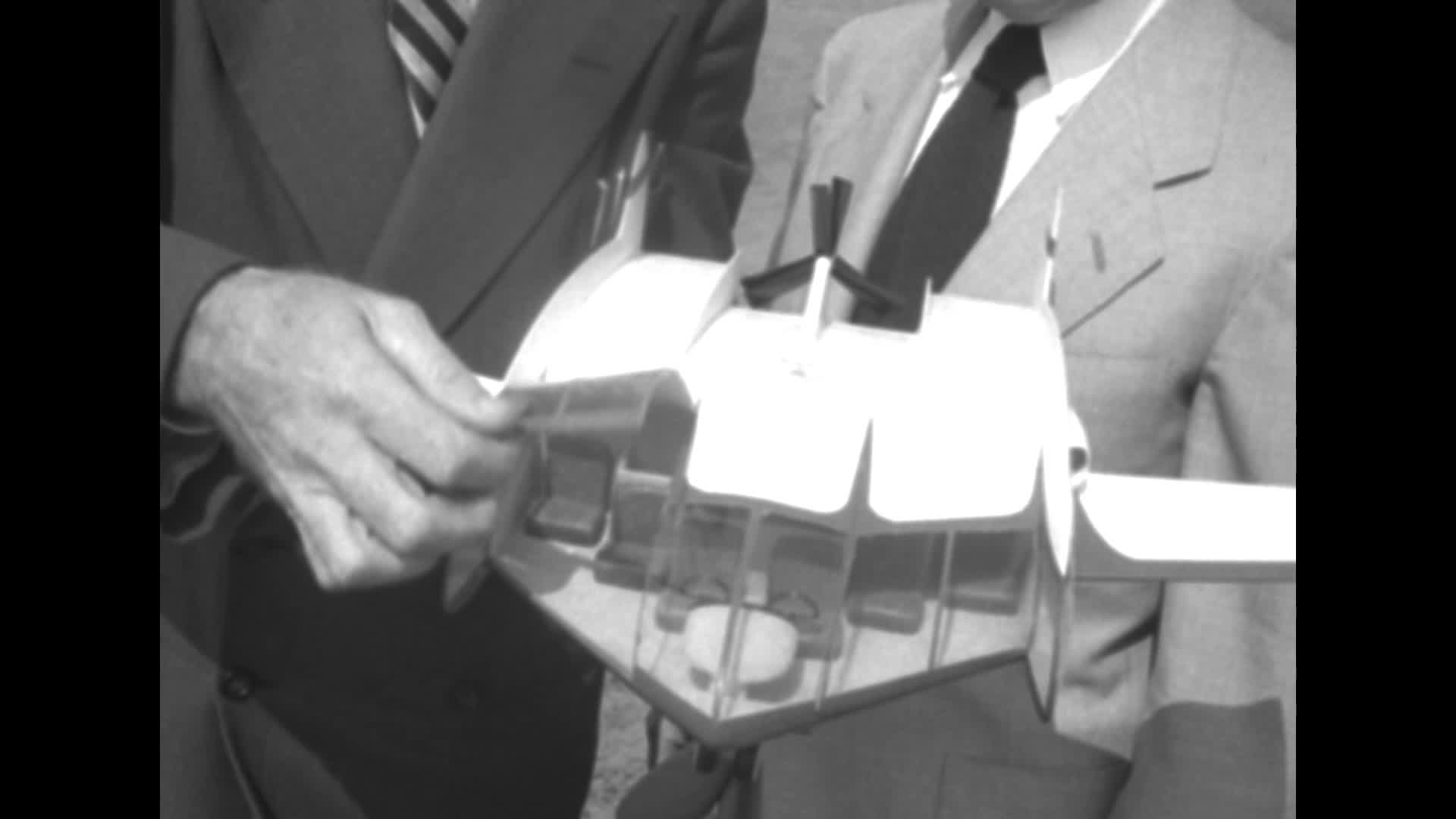
According to the digest, Horton Aircraft dates from 1952 and existed to make and sell what the Commission calls the "Horton Wingless Airplane". Its only asset was said to be a patent on the wingless plane, issued to Horton, the company's president, and assigned by him to the company. The digest describes a two-part bargain. Horton was to receive 500,000 shares in return for the patent rights, and another 200,000 shares for building a model of the aircraft and selling it to the company. The company's entire personnel was three directors, Horton among them, and it had more than 800 stockholders.
Two registration statements were at issue. The first was filed on April 26, 1955 and covered 500,000 shares in all: 400,000 to be sold by the company itself and 100,000 from Horton's own holding, priced at $1 each, or at the market price where that was higher. The second was filed on October 18, 1956 and covered 100,000 Horton-held shares at $25 apiece.
What the Commission found about the aircraft
As the digest summarises them, the registration statements told investors three things about the machine: that it had no wings, that Horton had built a model in 1954 which had been in continuous flight testing, and that it had performed as well as he expected.
The Commission's findings, as reported, contradict each part of that description:
- Wings. The aircraft had them. They projected roughly 8 feet out from the fuselage and were 5 to 6 feet deep. They could be retracted, but no flight had been made with them retracted.
- Airframe. It was a standard airplane that had been remodelled.
- Comparative performance. Horton had a conventional plane that he used as his own yardstick, and the Commission said his aircraft had generally done worse than it.
- Speed. The top speed was put at about half of what a different aircraft achieved with the same motors.
- Distance. The plane was, by admission, not built for distance flying. Its test flights were short, the longest being about 150 miles.
- Range and load. Neither had ever been tested.
- The crash. In June 1955 the prototype crashed while landing, and no test flight had taken place since. The Commission said the second registration statement ought to have told investors so.
Two points follow for the wider dossier. First, Horton Wingless Plane: The Lifting-Body Claim, the N39C Photographs and US2734701 leaves open whether the aircraft ever achieved sustained controlled flight. The digest reports short test flights, but it does not settle whether the wingless configuration achieved sustained controlled flight. Second, according to the digest, the wings had never been retracted in flight. For general background on what "wingless" can mean, see Wingless Aircraft Configuration.
The promotional claims set against those findings
The Commission also looked at brochures and form letters which, it found, Horton had the company prepare and send out during earlier sales of unregistered stock. The digest lists what they said. Horton's work was placed alongside that of Charles Lindbergh, Billy Mitchell, Sikorsky, Leonardo da Vinci and the Wright brothers. The plane was credited with a payload 100% greater and a range 100% greater than other aircraft, with more speed and easier handling than any of them, and with moving twice the load for half the cost. A proposed Horton Wingless Jumbo Transport was to take 4,000 persons on a non-stop journey of 25,000 miles, flying at 60,000 feet and at more than 400 miles per hour. The Commission called these statements false and misleading, and reasoned that, measured against such promises, telling investors the plane had lived up to Horton's expectations was misleading in its own right.
The patent problem
The decision, as reported, states that Horton "had no patent rights or patent he could validly assign" to the company. The reason given is a court ruling of June 1954, which held valid a previous assignment of Horton's interest in the invention to a different company. On the same ground the Commission considered it doubtful, at the least, that Horton was legally able to sell the model plane to Horton Aircraft. The digest does not name the other company, the court, or the patent number. The patent described in Horton Wingless Plane: The HW-X-26-52, N39C and the Photographic Record and Horton Wingless Plane: The Lifting-Body Claim, the N39C Photographs and US2734701 lists Horton Aircraft Corporation as assignee; the digest's finding means that listing should not be read as settling who owned the rights.
Other findings and the court record
Four further matters in the registration statements were found false and misleading: how they described earlier stock sales made without registration, what the offerings would cost to sell, what the money raised would be used for, and the suggestion that the $25 share price reflected some reasonable valuation.
The digest closes with two court outcomes. In September 1954 the United States District Court in Los Angeles issued a permanent injunction barring both the company and Horton from false and misleading statements when selling the stock. On March 8, 1957 Horton was convicted of fraud in selling Horton Aircraft stock; the sentence was 3 years in prison and then 5 years on probation.
What this record does and does not establish
The digest is a short public summary of a decision in a securities proceeding. It gives the Commission's conclusions but not the testimony, exhibits or flight records behind them, and it does not say who measured the wings or timed the flights. It does not identify the conventional plane used for comparison, the plane with the same motors, the donor airframe, or the circumstances of the June 1955 landing crash. It names no financial backers. The figures are therefore a regulator's findings of fact rather than engineering test data, and they are not accompanied by any aerodynamic analysis of why the aircraft performed as it did.
Within those limits, it is a contemporary official finding that runs directly against the promotional account: the plane had wings that were never retracted in flight, its test flights were short, and its top speed was about half that of another plane with the same motors.
Further reading
A later bibliographer's remark that the aircraft probably did not climb well without its extended wings, together with a list of 1950s magazine articles on it, is covered in The Horton Wingless in Print: Serge Krauss's Citation List and Two-Prototype Summary in a 2011 Tailless-Aircraft Newsletter.
References
- Securities and Exchange Commission, News Digest, October 31, 1957, item headed "Horton Aircraft Stock Offering Suspended": https://www.sec.gov/news/digest/1957/dig103157.pdf
Source notes & attribution
- https://www.sec.gov/news/digest/1957/dig103157.pdf