US 6,698,200 B1, titled Efficiency thermodynamic engine, names Kenneth M. Rauen as inventor and Cool Engines, Inc. of New Hampshire as assignee. The patent uses the label Superclassical Cycle engines and argues that its piston-and-displacer designs can exceed the Carnot efficiency. The engine itself is described on Rauen Superclassical Heat Engine. A patent is a statement of what the inventor claims, not a demonstration that the design performs as claimed.
US patent publication; document page 4. Preserved page.
The document and its history
The patent record gives application number US09/853,307, filed on 2001-05-11 and granted on 2004-03-02, with 36 claims. Rauen's assignment to Cool Engines, Inc. is recorded with an effective date of 2001-05-08. The classifications as listed include hot-gas positive-displacement engine plants of open-cycle type (F02G1/02) and engines characterised by their cycles (F02B75/02). The patent cites five earlier patents, including a 1976 Stirling-type engine from D-Cycle Associates (US3996745) and a 1986 regenerated internal combustion engine (US4630447).
The legal events do not reduce to a single clean end date. They list a year 4 fee payment dated 2007-09-09 and a surcharge for late payment dated 2007-09-10, then an entry dated 2011-10-17 for a maintenance fee reminder being mailed. A lapse for failure to pay maintenance fees is entered at 2012-03-02, a note dated 2012-04-02 records the patent as expired for nonpayment of maintenance fees, and an entry dated 2012-04-24 gives the lapse an effective date of 2012-03-02. The listing separately shows an adjusted expiration of 2022-02-24. It labels the patent as expired for fee-related reasons, with its own note that the stated legal status is an assumption and not a legal conclusion.
The starting point: an ordinary Stirling engine
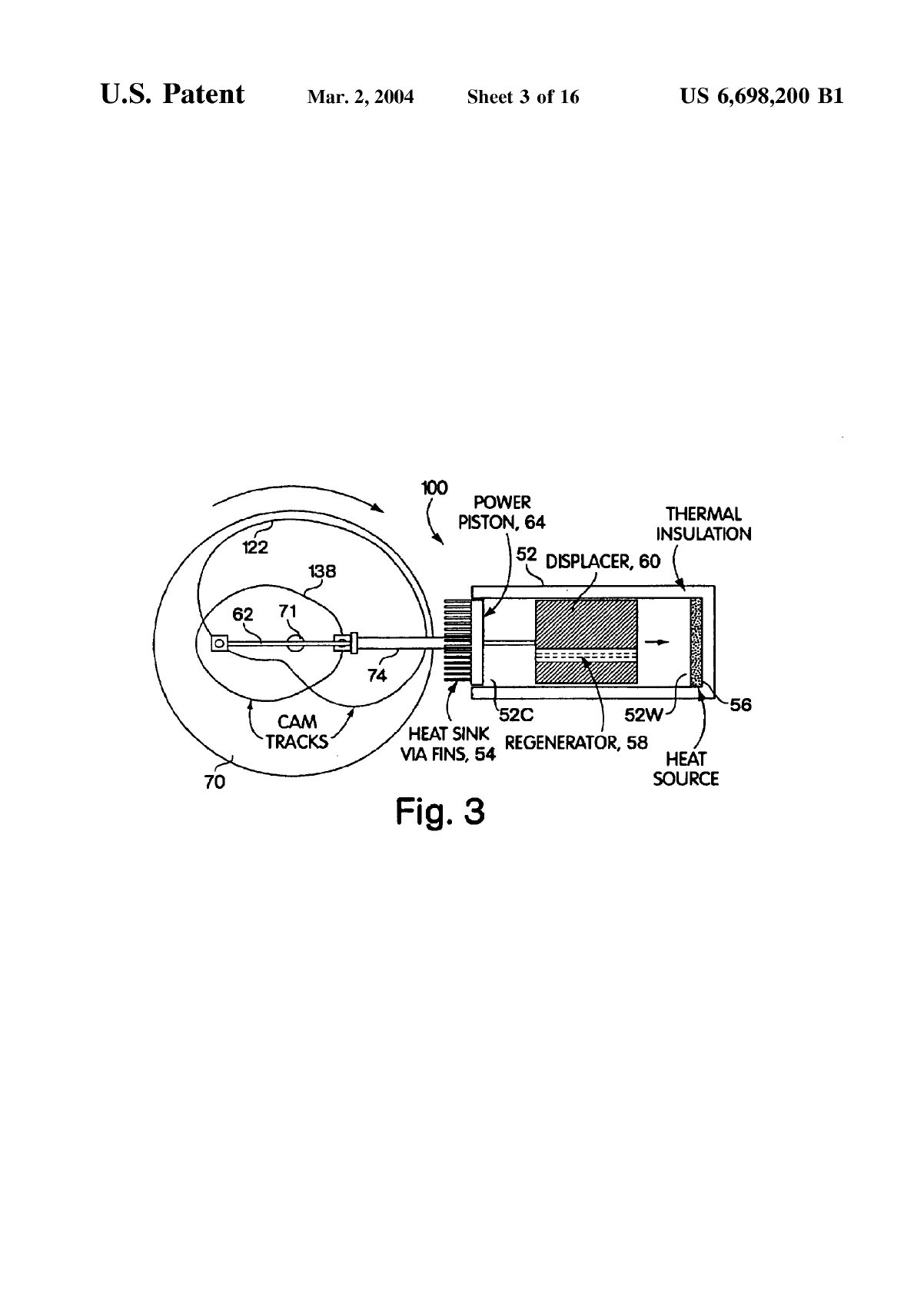
The specification first describes a reference Stirling engine (FIG. 1). A gas such as air sits in an insulated vessel. A displacer divides the vessel into a warm end held at temperature T1 by a heat source and a cold end held at T2 by a heat sink. The gas can pass from one end to the other essentially only through a regenerator carried inside the displacer, which stores heat from gas flowing one way and returns it to gas flowing the other. A separate power piston delivers work to a flywheel through cam tracks.
In that engine the piston and displacer both move sinusoidally, 90° apart, and the cycle consists of constant-volume and constant-temperature steps. The patent remarks that a typical good heat engine turns only about 30% of the heat it receives into mechanical energy.
The Proell Effect and self-refrigeration
The patent's central physical argument is credited to Wayne Proell's 1984 book The Thermodynamic Theory and Engineering Design of Supercarnot Heat Engines (Cloud Hill Press), which it incorporates by reference. The argument runs as follows.
When the displacer pushes gas through the regenerator at constant total volume, the gas inside the regenerator cools and therefore contracts. Because the total volume is fixed, the gas outside the regenerator, in the hot and cold spaces, must expand by the same amount. The patent treats that expansion as adiabatic, so the expanding gas cools further. The asserted result is that gas arriving on the cold side ends up colder than the coldest part of the regenerator. The patent calls this extra cooling "self-refrigeration" and says its size depends on the regenerator's temperature difference and on how far the displacer travels, up to a limit set by the gas's heat capacity ratio, gamma.
On the patent's accounting, the hot and cold spaces share the compensating expansion in proportion to their changing volumes over the stroke, so the cooling credited to the cold side comes to half of the pressure-volume work taken up by the regenerator. According to the patent, the effect goes unnoticed in a Stirling engine because that cycle has two constant-volume steps with opposite flow directions, which cancel it.
The proposed cycles
The patented engines drop that symmetry. They keep one constant-volume cooling stroke through the regenerator and replace the rest of the Stirling cycle with other steps, driven by cam tracks that give the piston and displacer different, non-sinusoidal motions with stationary periods. The drawings cover six embodiments (100, 200, 250, 300, 350 and 400), plus a modified version of the first (150). They are easiest to follow as one basic cycle and a set of variations on it:
- The basic cycle (embodiment 100, FIG. 3): after the cooling stroke, the gas is compressed without any change in entropy and then expands at steady pressure. The patent accepts that this version still throws some heat away as waste.
- A further expansion step (embodiments 200 and 250, FIGS. 7 and 9): the steady-pressure expansion is followed by a second expansion, isentropic in 200 and isothermal in 250.
- A fourth, isothermal step (embodiments 300 and 350, FIGS. 11 and 13): the two differ in the order of their steps. The patent says 300 gives up its waste heat at a higher temperature than embodiment 100, and 350 at a slightly lower one.
- A steady-pressure compression (embodiment 400, FIG. 15): this step is placed directly after the displacer's cooling stroke.
- The strongest claim (modified embodiment 150, FIG. 5): the piston and displacer travel only part of their range, and the warm and cold ends of the vessel swap roles. The patent says the cooling stroke then gives up no heat at all, and its figure list describes this version as having unity efficiency.
Throughout, the specification claims that the regenerator recovers more heat than conventional regeneration does, and it presents that as the route past the Carnot limit. It adds that full-stroke versions lift only half of the extra heat, and that partial-stroke versions give reduced power output.
How the patent handles the Second Law
The specification does not present itself as rejecting thermodynamics. It says the Proell Effect taken alone satisfies the strict entropy statement of the Second Law. It then goes further, arguing that self-refrigeration can create a heat sink inside the engine that is colder than the surroundings, so that heat flows in rather than out, and that embodiment 150 could therefore do useful work from the heat of the atmosphere.
To accommodate this, the patent proposes what it calls refinements to the Second Law, including the statement that "Work and heat may interchange perpetually", on the grounds that work carries no entropy and can be dissipated as heat at any temperature. The patent itself says that its engines get around the usual Second Law requirement that a heat engine lose energy, and it acknowledges that the general understanding of the Second Law stands against the recycling of work back into heat that it describes. Its refinements are therefore a proposal by the inventor, not an accepted statement of the law.
What the patent does and does not establish
The patent establishes that Rauen filed a detailed mechanical and thermodynamic proposal in 2001, that it was granted in 2004, and that the legal events record a lapse in 2012 for failure to pay maintenance fees. The claim discussed on Superclassical Heat Engine Claim rests on the cycle steps and reasoning set out here.
It does not establish that the effect occurs as described. The patent asserts the effect through reasoning and illustrative graphs: its pressure-volume, pressure-enthalpy and displacement-time graphs are presented as typical curves for each design. The granting of a patent is not a finding that an engine exceeds the Carnot limit, and the later documents listed as citing this one are patent documents, not test reports.
Further reading
An earlier patent describes a regenerator end made colder than the engine's cold space by a separately driven displacer, without any claim to exceed the Carnot limit: see US Patent 4,455,826 (1984): Stellan Knoos's Constant-Volume Thermodynamic Machine and Pressure Ratio Intensification by Superheated and Supercooled Regenerator Ends.
Related
- Rauen
- Rauen Superclassical Heat Engine
- Superclassical Heat Engine Claim
- Rauen Claims vs. Evidence: An Archive Dossier Without Test Data
- Rauen Superclassical Heat Engine: The source archive Energy Dossier
Source notes & attribution
- https://patents.google.com/patent/US6698200B1/en