Most of what this dossier records about Arboform comes from vendor copy, an encyclopaedia entry, a review abstract and patents. This 2021 paper is a peer-reviewed laboratory study by a university research group, reporting measurements on injection-moulded specimens of three commercial Tecnaro materials. The authors are Simona-Nicoleta Mazurchevici, Dorin Vaideanu, Doreen Rapp, Cristian-Dragos Varganici, Constantin Cărăușu, Mihai Boca and Dumitru Nedelcu. Their paper appeared in the open-access journal Polymers 13, 2953 (received 21 July 2021, accepted 26 August 2021). The work was funded by a TUIASI publications grant, project GI/P21/2021. The dilatometry was carried out in collaboration with the NETZSCH Applications Laboratory. The authors declare no conflict of interest; the paper gives no further statement about its relationship to the manufacturer.
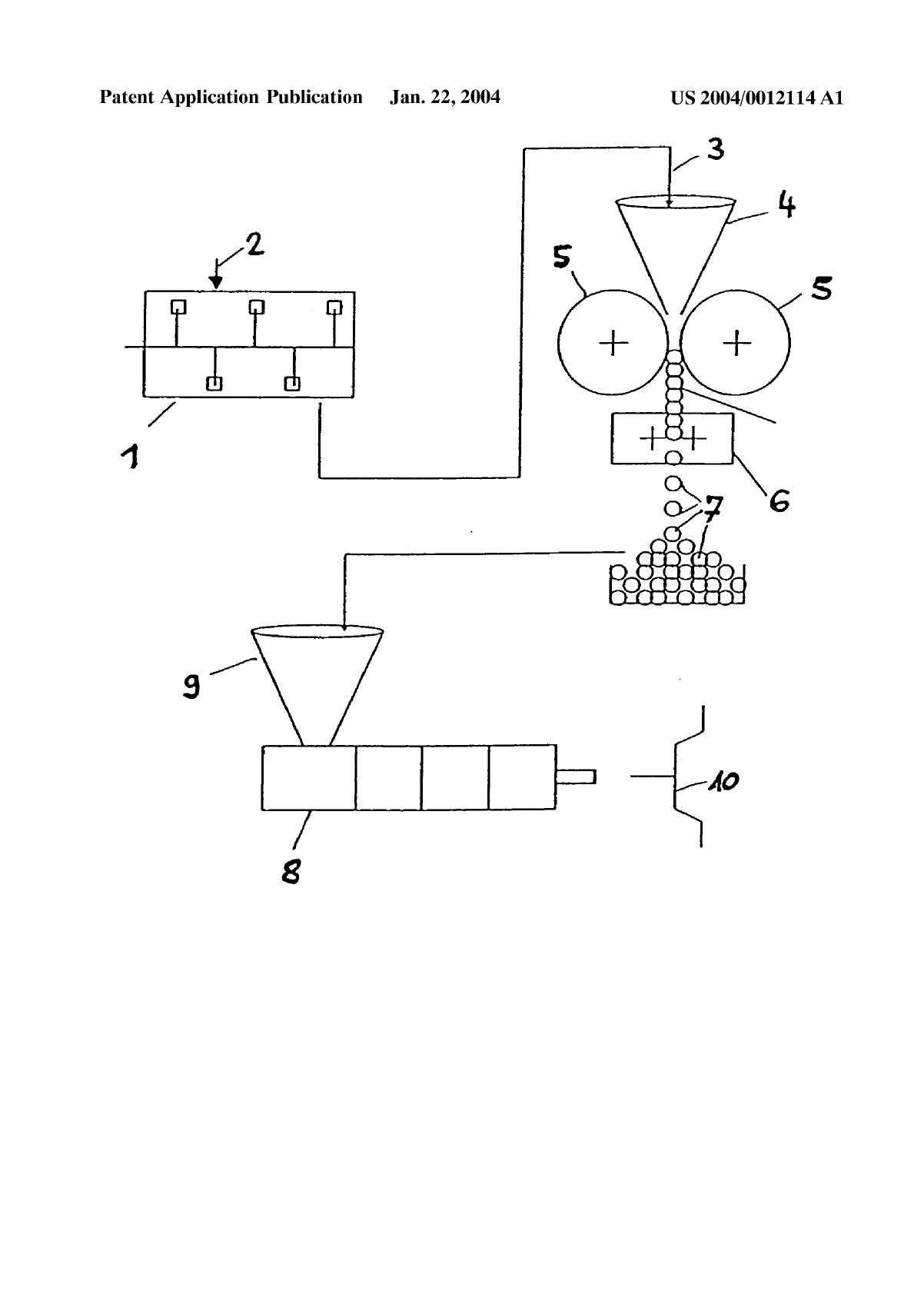
US patent publication; document page 2. Preserved page.
What was tested, and why
Four materials were examined: Arboform LV3 Nature, the lignin-matrix "liquid wood"; Arboblend V2 Nature, a blend of bio-based polymers; Arbofill Fichte, which mixes renewable raw materials (up to 80%) with plastics; and Arboform LV3 Nature with 15% Kevlar-type aramid microfibres added. The authors had a practical motive. Their research group had seen parts made from these materials swell noticeably after long service, and they wanted to know why.
The specimens were injection moulded. Arboform LV3 Nature was injected at 160 °C and 100 MPa, and the aramid-reinforced version at 175 °C. The team then ran four kinds of test:
- Dynamic mechanical analysis (DMA). A bar is flexed repeatedly while it is heated, here at 1 Hz and 2 °C/min. The test gives the stiffness the material stores (E′), the energy it dissipates (E″), and their ratio, the damping factor tanδ.
- Dilatometry. A NETZSCH DIL 402 Expedis Select measured how much each sample lengthened between −150 °C and 120 °C. Each sample was heated twice.
- Thermogravimetric analysis (TGA). Samples were heated in nitrogen from 25 to 700 °C while their mass loss was recorded.
- Microscopy and spectroscopy. SEM and EDX were applied to both plain and aramid-reinforced Arboform LV3 Nature. FT-IR was run only on the reinforced grade.
Key measured results for Arboform LV3 Nature
At what temperature does the material start to change? Two different techniques in the paper point to the same window, roughly 45 to 57 °C. The DMA puts the glass transition of plain Arboform LV3 Nature at 54.5 °C, read from the point where the E′ and tanδ curves cross. The methods section, however, says Tg was taken from the tanδ peak, so the two descriptions do not match. With aramid added, the main damping peak sat slightly higher, at 57 °C. The dilatometer shows the plain material's length departing from normal expansion from 45 °C upward on first heating; the reinforced grade began to deviate a little earlier, at about 37 °C.
What happens there? Rather than simply expanding, the first-heating samples of both Arboform LV3 Nature and Arboblend V2 Nature contracted over a band reaching up to 100 °C. The authors suggest the bonds of the lignin matrix rearrange and shrink, and they tie this to the α-relaxation seen in the DMA. On a second heating, however, the expansion was close to linear, and the reinforced grade then behaved almost like the plain material. This is the authors' answer to their starting question about swollen parts. In their words, a sample "tends to lose its structural stability, by expansion, at temperatures above 55 °C". The DMA also found stored and dissipated energy to be roughly equal, which the authors read as a sign of a heterogeneous material, and a rise in damping near 140 °C that they attribute to the start of melting. In the reinforced grade a second, smaller damping peak appeared at 86.52 °C; the authors tentatively put it down to water evaporating or natural additives breaking down.
When does the material actually come apart? Much later. TGA recorded only a small early mass loss of 2.15% for plain Arboform LV3 Nature. Bulk decomposition began at 262 °C and peaked at 335 °C, taking away 82.77% of the mass and leaving 11.31% at the end. For the aramid grade the paper's table puts the start of that main stage at 280 °C but its peak at 334 °C, essentially unchanged. The text nonetheless says reinforcement raised this temperature by up to 9 °C, which its own table does not show. In the authors' comparison, Arbofill Fichte pyrolysed at a temperature roughly 120 °C higher than the other three materials.
So the practical picture for this grade is a material that loses little mass until bulk decomposition starts at about 260 °C, but that begins to change shape and stiffness at around 50 °C.
Comparisons with the figures already in the dossier
The paper includes a table of baseline properties. These are cited to Tecnaro's website and datasheets, not measured by the authors. For Arboform LV3 Nature, the table gives:
- heat deflection temperature: 49.8 °C
- density: 1.29 g/cm³
- tensile strength: 37 MPa
- strain at break: 0.6%
- impact strength: 11 kJ/m²
These are grade-specific datasheet values. They do not match the generic Wikipedia-derived figures recorded in Arboform: Lignin-Based Bioplastic, Reported Properties and the Verification Gap: thermal stability up to 95 °C, a moulded density of about 1.4 g/cm³, and tensile strength of 9.5–14.5 N/mm². The documents do not say whether the gap reflects different formulations, different test methods or both. The measured glass transition and the expansion anomalies from 45 °C upward do agree with the lower datasheet heat-deflection figure. Neither the measured values nor the datasheet heat-deflection figure supports a working limit near 95 °C for this grade.
The FT-IR spectrum of the reinforced grade adds a further complication. The authors assign bands at 867 and 757 cm⁻¹ to the amorphous and crystalline phases of polylactic acid, but do not comment on what this implies for the material's make-up. A polylactide component fits the Tecnaro patents that claim polylactide–lignin blends, described in Arboform: Lignin-Based Bioplastic, Reported Properties and the Patent Set. It sits less easily with the paper's own description of Arboform as a lignin matrix holding natural fibres and natural additives.
What the paper does not establish
Biodegradability was not tested. The paper describes Arboform as fully biodegradable, but it attributes the statement to Tecnaro. No degradation experiment was carried out. The authors' conclusion that the high carbon and oxygen content found by EDX supports the biodegradability claim is an inference, not a measurement. The paper reports roughly 44% carbon and 56% oxygen by mass for plain Arboform LV3 Nature. A bare elemental composition is not a degradation test. At one point the text also misnames the EDX measurement as a diffraction analysis.
The statements about thermal stability conflict. The abstract says the materials are stable to at least 250 °C. The conclusions say there is no mass loss up to about 200 °C, but also that most of the materials "become thermally unstable at temperatures above 200 °C". The TGA table itself records small mass losses well below 200 °C. The reliable reading is the table: small early losses, then bulk decomposition starting at about 260 °C for Arboform LV3 Nature. Note that the measured dimensional and mechanical changes begin about 200 degrees lower, near 50 °C.
The proposed plastic substitutes rest on one number. The paper lists polypropylene and several polyethylenes as plastics these materials could replace. The basis is a comparison of tanδ values alone, drawn from other studies run under different conditions. Damping by itself does not show that one plastic can stand in for another. The abstract's tanδ range of 0.37–0.54 also leaves out Arbofill, whose value was about 0.07.
Replication is not reported. The paper reports no replicate specimens or statistical spread. Its data are available on request rather than published.
Where this fits
The dossier's other sources on Arboform do not report instrument measurements on a named grade; this paper supplies DMA, dilatometry and TGA data for Arboform LV3 Nature. It narrows the verification gap without closing it. It leaves the environmental claims discussed under Liquid Wood Claim exactly where they were. The patent background is covered in Tecnaro Patent DE 101 51 386: Water as the Processing Aid for Lignin and Natural-Fibre Compounds.
References
- Mazurchevici S.-N., Vaideanu D., Rapp D., Varganici C.-D., Cărăușu C., Boca M., Nedelcu D. "Dynamic Mechanical Analysis and Thermal Expansion of Lignin-Based Biopolymers." Polymers 2021, 13, 2953. https://pmc.ncbi.nlm.nih.gov/articles/PMC8434355/
Source notes & attribution
- https://pmc.ncbi.nlm.nih.gov/articles/PMC8434355/