The source dossier is an aggregation digest rather than a single study. It bundles three loosely related clusters under one heading: the physics of chirality-induced spin selectivity (CISS), a very large list of chirality and metamaterial patents (overwhelmingly Chinese utility models and invention filings), and a "MagnetoOptics / Gyrotropics" section of abstracts on gyrotropic media, the gyrotropic magnetic effect, nonreciprocity and superconducting nonreciprocal transport. The page contains no original experimental data and no methods sections of its own; nearly all substantive content is quoted or paraphrased from external sources, and the compiler adds no synthesis. It should be read as a pointer collection, not as evidence for any of the claims it reproduces.
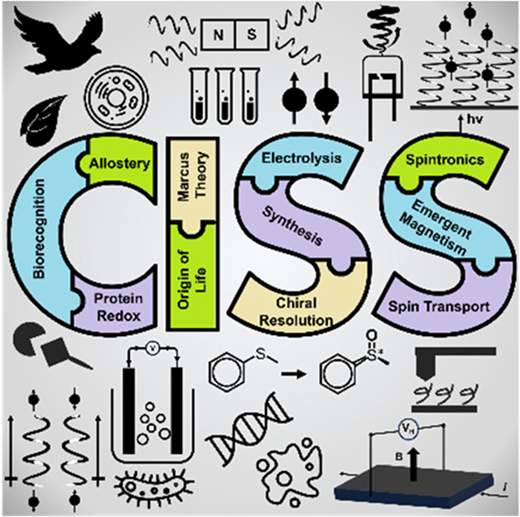
What CISS is
The page opens with a Wikipedia-derived definition: chirality-induced spin selectivity refers to multiple phenomena in which the chirality of a chemical compound influences the spin of transmitted or emitted electrons. The effect is attributed to Ron Naaman and co-workers, with the landmark study being Ray, Ananthavel, Waldeck and Naaman, "Asymmetric scattering of polarized electrons by organized organic films of chiral molecules," Science 283 (5403): 814–816, February 1999 (doi:10.1126/science.283.5403.814).
Four demonstrated manifestations are listed:
- polarization of electrons scattered from chiral molecules;
- spin-dependent transmission probabilities through layers of chiral molecules;
- spin-selectivity of electron transport in a chiral medium;
- enantio-selectivity in chemical reactions induced by spin-polarized electrons.
The single most important caveat on the page is the theoretical status. Models based on spin-orbit coupling (SOC) explain the effect qualitatively, but quantitatively the predicted effect "was always orders of magnitude smaller than what was measured in experiments." The mechanism underlying CISS is explicitly stated as "not completely understood." A hybrid method — a film of pure gold with chiral molecules on it — is reported to have produced results "on par with the magnetic method," i.e. a non-magnetic route to spin polarization comparable to conventional magnetic spin injection.
The 2025 MoS₂ result
The page reports that in 2025 Huang et al. demonstrated voltage-controlled interfacial chirality on an otherwise achiral molybdenum disulfide (MoS₂ (Molybdenum Disulfide)) surface, using an electric double-layer transistor with enantiopure ionic liquids. The induced state was detected through CISS and the electrical magnetochiral effect. The citation given is Huang, Po-Jung; Ando, Yoshio; Tanaka, Miuko; Nishio, Yukito; Ideue, Toshiya; Taniguchi, Kouji, "Proximity-induced chirality at the achiral conductive interface by electrical control of enantiopure ion adsorption," Science Advances 11 (47) eadx2281, 21 November 2025 (doi:10.1126/sciadv.adx2281). The page also links a popular write-up titled "The Quantum Twist: Scientists Unlock a New Way to Control Electrons" (31 January 2025).
Reviews and community resources
- Bloom et al., Chem. Rev. 124, 1950 — "Chiral Induced Spin Selectivity." The abstract frames CISS as "the innate ability of chiral materials to act as spin filters for electron transport," and notes that more recent experiments show displacement currents arising from charge polarization of chiral molecules can lead to spin polarization without the need for net charge flow. The review covers measurement methods, molecules and materials exhibiting CISS, structure–property relations, leading theoretical models, implications in physics, chemistry and biology, and closes with a critical assessment of the field. A PDF and a visual abstract image are hosted on the source server.
- Gao, Meng & Lu, Communications Materials — "Chiral-induced spin selectivity in chiral solid-state materials for biomedical engineering." The page reproduces only the same Wikipedia-derived framing text under this heading, with no specific biomedical results; the abstract-level framing is all that is available here.
- Weizmann CISS community site — https://www.weizmann.ac.il/sites/CISS/ and its publications page, hosted by the Weizmann Institute of Science.
- James Tour video — "Chiral-induced Spin Selectivity // A Course on Abiogenesis by Dr. James Tour." Tour argues that no prebiotically relevant route has been shown to synthesize, separate or polymerize homochiral amino acids, discusses racemic molecules in cells, and presents CISS as enabling cellular efficiency. This is a position/argument, not experimental evidence, and is attributed as such on the page.
The patent list
The bulk of the page is a title list of chirality and metamaterial patents, with no abstracts. It is dominated by Chinese (CN) filings, with a smaller number of KR, TW, JP, WO and US entries. Recurring themes include:
- Mechanical metamaterials with negative Poisson's ratio (auxetic behavior), compression–torsion coupling, tension–torsion coupling, variable stiffness, and impact/vibration absorption. Examples: CN121897689 (different-chirality spliced variable-stiffness negative Poisson's ratio structure), CN121854550 (rigidity-variable compression-torsion chiral metamaterial cell based on integrated molding), CN115750643 (chiral mechanical metamaterial with compression torsion coupling and swelling torsion coupling), CN112045990 (chiral auxetic metamaterial with tension-torsion coupling), TWI793952 (mechanical metamaterial with improving compressive responses).
- Acoustic metamaterials for sound insulation and vibration suppression: CN122245538 (self-similar 2D chiral metamaterial with sound insulation and shock absorption), CN114724536 (underwater sound insulation metamaterial based on chiral structure), CN113808562 (3D chiral acoustic metamaterial with high bearing capacity and low broadband vibration suppression), CN119479600 (pressure-contact chiral-negative Poisson's ratio acoustic metamaterial).
- Optical and terahertz metamaterials: polarization converters, circular polarizers, absorbers, chiral resolution of vortex beams. Examples: CN121784870 (3D spiral metamaterial optical device for chiral resolution of vortex beam), CN115020988/CN115020989 (tunable multi-polarization and linear-circular polarization conversion units and arrays), CN111490355 (terahertz chiral metamaterial wave absorber with flexible substrate), CN119944313 (flexible chiral metasurface with tunable circular dichroism and polarization conversion).
- Vanadium dioxide (VO₂) and phase-change materials: CN121584271 (VO₂-based terahertz broadband chiral absorber, actively regulated), CN120142235 (chiral metamaterial sensor based on vanadium dioxide), CN113285232 (convertible external chiral terahertz metamaterial unit based on vanadium dioxide), CN111965849 (controllable chiral structure based on GST phase-change material temperature control).
- Sensing and detection: CN120779504 (chiral metamaterial absorber for multifunctional sensing), CN114034659 (chiral serine identification via S-shaped mirror-image terahertz metamaterial), CN110186872 (refractive index sensor), US2021373009 (plasmonic meta-surface molecular sensors).
- Flexoelectric metamaterials: CN121922271 (tetra-chiral structure-based flexoelectric metamaterial), CN120145772 (anti-tri-chiral structure-based flexoelectric metamaterial).
- Non-CN entries: WO2026100850 (single-photon generator with chiral metal nanoparticles and a 2D transition-metal dichalcogenide layer), US202528376 (photodetector pixel, photodetector and methods of forming the same), US2014017480 (doped chiral polymer metamaterials), US2011141541 (active chiral photonic metamaterial), US2010141358 (chiral metamaterials), US2022290570 (discrete macroscopic metamaterial systems), JP2021193437 (nonmagnetic waveguide-type isolator), KR20240160417 (manufacturing method of a metamaterial using deformation of a nucleic acid origami structure), KR20180085314 (quasi-planar chiral metamaterial), KR20160113339 (meshed chiral metamaterial), KR101494326 (circular dichroism using negative-index metamaterials), WO2017020791/WO2017020792 (right-/left-handed circular polarisation conversion metamaterial thin films), WO2013010071 (gyrotropic metamaterial structure).
The list is a title inventory only. No claims of performance, no measured results and no legal status are given, and the page does not distinguish granted patents from applications.
Magneto-optics and gyrotropics
The third cluster begins with Wikipedia's magneto-optic effect entry: an electromagnetic wave propagating through a medium altered by a quasistatic magnetic field, in which left- and right-rotating elliptical polarizations travel at different speeds. Transmission through such a medium gives the Faraday effect (Faraday rotator); reflection gives the magneto-optic Kerr effect. Magneto-optic effects break time-reversal symmetry locally and break Lorentz reciprocity, which is the necessary condition for devices such as optical isolators. Two gyrotropic materials with reversed rotation directions of the two principal polarizations, corresponding to complex-conjugate ε tensors for lossless media, are called optical isomers.
The abstracts collected under this heading are summarized below, each attributed to its own authors and venue.
Gyrotropic Magnetic Effect in Metallic Chiral Magnets
Nisarga Paul, Takamori Park, Jung Hoon Han and Leon Balents, Phys. Rev. Lett. 135, 246704, published 12 December 2025 (doi:10.1103/vxtm-kgrx). The paper studies the Gyrotropic Magnetic Effect (GME) (GME), the low-frequency limit of optical gyrotropy, in metals and semimetals coupled to chiral spin textures. Chiral spin textures lacking inversion symmetry imprint on the electronic structure through Hund's coupling, producing low-frequency optical activity. Using perturbation theory and numerical diagonalization of relativistic and nonrelativistic models, the authors analyze single-q and multi-q textures and derive rotatory power in terms of universal scaling functions. Estimates with realistic material parameters give an experimentally viable range. The GME arises from orbital and spin magnetic moments of conduction electrons; the orbital part is closely tied to Berry curvature and matters in relativistic metals but not in nonrelativistic metals without inherent Berry curvature, while the spin contribution can be significant in nonrelativistic metals with large Fermi energy. The authors propose the GME as a sensitive probe of magnetic chirality and symmetry breaking in metallic chiral magnets.
Intrinsic Gyrotropic Magnetic Current of Orbital Origin
Koushik Ghorai, Sankar Sarkar and Amit Agarwal, arXiv:2601.04787. In gyrotropic crystals an oscillating magnetic field induces a charge response known as the gyrotropic magnetic current. Its conventional origin is attributed to magnetic-field-modified band energy and a shift in the Fermi surface; a recent study identified an additional spin-driven magnetic displacement contribution. This work identifies the orbital counterpart of the magnetic displacement current using a density-matrix formulation incorporating minimal coupling and spin-Zeeman interactions, uncovering an orbital contribution to wavepacket velocity arising from the time variation of the magnetic-field-induced charge polarization. In the low-frequency transport regime the mechanism becomes purely intrinsic. It is illustrated in the PT-symmetric antiferromagnet CuMnAs, where the intrinsic gyrotropic magnetic current reverses sign upon Néel vector reversal, establishing it as a direct probe of antiferromagnetic order in CuMnAs and other PT-symmetric antiferromagnets.
Giant enhancement of nonreciprocity in gyrotropic heterostructures
Ioannis Katsantonis, Anna C. Tasolamprou, Thomas Koschny, Eleftherios N. Economou, Maria Kafesaki and Constantinos Valagiannopoulos, Scientific Reports 13, 21986 (2023). Nonreciprocity is desirable in photonic media, but conventional gyrotropic materials have very weak time-reversal-symmetry-breaking effects, requiring large, bulky setups and strong magnetic bias. The authors introduce artificial heterostructures that enhance effective nonreciprocal behavior by reducing the contribution of the diagonal susceptibilities in the collective response, making the off-diagonal (nonreciprocal) terms appear larger. Alternating gyrotropic and metallic or plasmonic films form an Epsilon-Near-Zero (ENZ) Effective Medium by averaging diagonal permittivities of opposite sign; homogenization leaves the nonzero off-diagonal permittivities of the original gyrotropic substance unaltered, so they become dominant and ignite a strong nonreciprocal response. Realistic mid-infrared material examples are provided, and the robustness of the enhancement under actual media losses and bandwidth limitations from frequency dispersion is discussed. Applications cited include signal isolation, wave circulation, unidirectional propagation and asymmetric power amplification.
Spontaneous gyrotropic electronic order in 1T-TiSe₂
Su-Yang Xu et al., Nature 578, 545–549, 2020 (doi:10.1038/s41586-020-2011-8, Epub 26 February 2020), with a companion CHESS write-up by Elke Arenholz. Chirality is ubiquitous in nature and populations of opposite chiralities are asymmetric at fundamental levels, from parity violation in the subatomic weak force to homochirality in biomolecules. In condensed matter, a crystalline electronic system is geometrically chiral when it lacks mirror planes, space-inversion centres or rotoinversion axes; typically this chirality is predefined by the lattice and fixed on crystal formation. In materials with gyrotropic order, by contrast, electrons spontaneously organize to exhibit macroscopic chirality in an originally achiral lattice — proposed as the quantum analogue of cholesteric liquid crystals. The paper reports optical chiral induction and observation of a gyrotropically ordered phase in the transition-metal dichalcogenide semimetal 1T-TiSe₂: shining mid-infrared circularly polarized light on 1T-TiSe₂ while cooling below the critical temperature leads to preferential formation of one chiral domain. The chirality is confirmed by an out-of-plane Circular Photogalvanic Effect current whose direction depends on the optical induction. The role of domain walls is flagged as requiring further investigation with local probes. The CHESS summary attributes the work to a team led by Nuh Gedik's group at mit and describes the circular photogalvanic effect as a change in photocurrent when light helicity is flipped, which can only occur if the electrons in the material are chiral.
Magnet-less gyrotropy using time-periodic modulation of permittivity
Somayeh Boshgazi, Khashayar Mehrany and Mohammad Memarian, Optics Express 33, 24370. Time-varying (TV) media have unlocked non-reciprocity, frequency conversion and parametric amplification. The authors propose a time-modulation of the permittivity tensor in a static achiral, non-gyrotropic crystal to emulate gyrotropy without magnetic materials or external magnetic bias. The emulated gyrotropy arises from temporal rotation of the principal axes of the permittivity tensor, which sustains only circularly or elliptically polarized eigenmodes. A possible realization using modulated electro-optic effects in a nonlinear crystal is proposed.
Topological edge states in tunable bulk gyrotropic media
Jesse Rodriguez, Luc Houriez, Hossein Mehrpour-Bernety and Mark Cappelli, APS Division of Plasma Physics 2022 (abstract PO7.003). Gyrotropic media exhibit topologically protected edge states allowing one-way, back-scattering-immune propagation of interfacial electromagnetic waves, but such media are hard to engineer because ferromagnetic materials limit operating frequencies and a homogeneous bulk magnetized plasma is difficult to produce. The authors construct a tunable bulk gyrotropic medium from magnetized low-temperature plasma discharge tubes in a two-dimensional photonic crystal configuration, with experiments at microwave frequencies of 2–10 GHz. Band structures for magnetized and unmagnetized cases are compared and confirmed via transmission measurements and numerical simulations; evidence for topologically protected edge states comes from local field measurements.
Gyrotropic crystals for helical polychromatic singular beams
Yuriy Egorov and Alexander Rubass, Photonics 10, 01044. The authors study optical singular beams passing through gyrotropic crystals and show experimentally that singular beams with a helical intensity distribution form when passing through a system of two gyrotropic crystals with opposite values of the gyration coefficient. The system can generate optical vortices with a double topological charge in one of the circular polarization components.
Nonreciprocal superconducting transport and the spin Hall effect in gyrotropic structures
Tim Kokkeler, Ilya Tokatl and F. Sebastian Bergeret, SciPost Phys. 16, 055. The search for superconducting systems with nonreciprocal transport and the Superconducting Diode Effect has proliferated, covering planar hybrid structures, asymmetric SQUIDs and certain noncentrosymmetric superconductors. A common feature is gyrotropic symmetry, characterized by a polar vector; alongside time-reversal symmetry breaking, the polar axis allows magnetoelectric effects which, combined with proximity-induced superconductivity, produce spontaneous non-dissipative currents underpinning the diode effect. The authors present a theoretical study of transport in a lateral Josephson junction composed of a normal metal supporting the spin Hall effect, attached to a ferromagnetic insulator. Because of the latter, magnetoelectric effects arise without external magnetic fields. The theory determines the dependence of anomalous currents on the spin relaxation length and on spintronics transport parameters characterizing the metal/ferromagnetic-insulator interface, unifying nonreciprocal superconducting transport with the spin Hall effect, spin galvanic effect and spin Hall magnetoresistance. The authors propose an experiment measuring magnetoresistance in the normal state and nonreciprocal transport in the superconducting state, which would determine model parameters and test theories of magnetoelectric effects in normal systems.
The acoustic gyrotropic tensor in crystals
K. Kumaraswamy and N. Krishnamurthy, Acta Cryst. A36, 760–762 (1980), doi:10.1107/S0567739480001532. The acoustic gyrotropic tensor is a fifth-rank tensor characterized by d_ij,l = −d_ji,l, with i, j = 11, 22, 33, (23, 32), (31, 13), (12, 21) and l = 1, 2, 3, controlling acoustical activity in crystals. Using group-theoretical methods, the authors work out the number of independent coefficients and the character of the tensor under proper and improper rotations, and give a classification of the acoustically active classes.
Distinctive feature of 1D anisotropic and gyrotropic photonic crystals
Alexey P. Vinogradov et al., doi:10.1142/9789812709547_0024. The magneto-optical properties of 1D photonic crystals are considered, with focus on 1D because devices based on 1D PCs are more robust against losses than 2D or 3D PCs. Using anisotropic and gyrotropic materials, such PCs exhibit new phenomena including formation of Yeh band gaps, magneto-optical and birefringence effects. Because anisotropy and gyrotropy are easily induced by external electric and magnetic fields, the properties are tunable. Switchable filters, magnetic superlenses and other devices are considered.
Gyrotropic oscillations of magnetic vortices in two interacting ferromagnetic disks
E. V. Skorokhodov, D. A. Tatarskiy, R. V. Gorev, V. L. Mironov and A. A. Fraerman. The gyrotropic motion of vortex magnetization distributions in two coupled ferromagnetic disks is studied experimentally and numerically. The dependence of the resonant frequency of the collective gyrotropic oscillation mode on the distance between disk centers is measured by magnetic resonance force spectroscopy, and the interaction energy of magnetic vortices as a function of separation is estimated from this dependence using solutions of the Thiele equation.
Gyrotropic media simulation in Meep
The page links the Meep FDTD documentation tutorial on gyrotropic media, which describes how gyrotropy is supported in the Materials module of the open-source electromagnetic simulation package.
Limitations and unresolved questions
- The page is a digest. It provides no independent verification, no experimental data of its own, and no critical assessment beyond what the quoted abstracts and the Wikipedia text contain.
- The central scientific tension is preserved explicitly: SOC-based theory predicts CISS effects orders of magnitude smaller than measured, and the mechanism is "not completely understood."
- The patent list gives titles only. It cannot support any claim about device performance, manufacturability or legal status, and the page does not separate granted patents from applications.
- The James Tour material is an argument about abiogenesis and homochirality, not experimental evidence about CISS itself.
- The gyrotropics abstracts span very different systems (metals, superconductors, plasmas, photonic crystals, magnetic vortices, crystallography) and should not be merged into a single claim about "gyrotropy."
Related work in this wiki
The only clear overlap with existing Bench content is mit, which appears here through the Gedik group's 1T-TiSe₂ work and elsewhere through the Ghasemi/Chen solar steam research. No other ingested source (Bendall, Shchepinov, Clark, Blomgren, Whisson, Ghasemi, Liu Binjiang, Ellsworth) touches chirality, spin selectivity or gyrotropy, so this source is topically isolated from the current corpus.
Source notes & attribution
- Ray, K; Ananthavel, SP; Waldeck, DH; Naaman, R (February 1999). "Asymmetric scattering of polarized electrons by organized organic films of chiral molecules." Science 283 (5403): 814–816. doi:10.1126/science.283.5403.814.
- Evers, Ferdinand; Aharony, Amnon; Bar-Gill, Nir; Entin-Wohlman, Ora; Hedegård, Per; Hod, Oded; Jelinek, Pavel; Kamieniarz, Grzegorz; Lemeshko, Mikhail; Michaeli, Karen; Mujica, Vladimiro; Naaman, Ron; Paltiel, Yossi; Refaely-Abramson, Sivan; Tal, Oren (April 2022). "Theory of Chirality Induced Spin Selectivity: Progress and Challenges." Advanced Materials 34 (13) 2106629. arXiv:2108.09998. doi:10.1002/adma.202106629.
- Bloom, Brian P. et al. "Chiral Induced Spin Selectivity." Chem. Rev. 124, 1950.
- Gao, Rui; Meng, Dan; Lu, Xiongbin. "Chiral-induced spin selectivity in chiral solid-state materials for biomedical engineering." Communications Materials .
- Huang, Po-Jung; Ando, Yoshio; Tanaka, Miuko; Nishio, Yukito; Ideue, Toshiya; Taniguchi, Kouji (21 November 2025). "Proximity-induced chirality at the achiral conductive interface by electrical control of enantiopure ion adsorption." Science Advances 11 (47) eadx2281. doi:10.1126/sciadv.adx2281.
- Paul, Nisarga; Park, Takamori; Han, Jung Hoon; Balents, Leon (12 December 2025). "Gyrotropic Magnetic Effect in Metallic Chiral Magnets." Phys. Rev. Lett. 135, 246704. doi:10.1103/vxtm-kgrx.
- Ghorai, Koushik; Sarkar, Sankar; Agarwal, Amit. "Intrinsic Gyrotropic Magnetic Current of Orbital Origin." arXiv:2601.04787.
- Katsantonis, Ioannis; Tasolamprou, Anna C.; Koschny, Thomas; Economou, Eleftherios N.; Kafesaki, Maria; Valagiannopoulos, Constantinos (2023). "Giant enhancement of nonreciprocity in gyrotropic heterostructures." Scientific Reports 13, 21986.
- Xu, Su-Yang et al. (2020). "Spontaneous gyrotropic electronic order in a transition-metal dichalcogenide." Nature 578, 545–549. doi:10.1038/s41586-020-2011-8.
- Boshgazi, Somayeh; Mehrany, Khashayar; Memarian, Mohammad. "Magnet-less gyrotropy using time-periodic modulation of permittivity." Optics Express 33, 24370.
- Rodriguez, Jesse; Houriez, Luc; Mehrpour-Bernety, Hossein; Cappelli, Mark (2022). "Topological Edge States in Tunable Bulk Gyrotropic Media Composed of Magnetized Low-Temperature Plasma Discharges." APS DPP abstract PO7.003.
- Egorov, Yuriy; Rubass, Alexander. "Gyrotropic Crystals as a Basis for Creation of Helical Polychromatic Singular Beams." Photonics 10, 01044.
- Kokkeler, Tim; Tokatl, Ilya; Bergeret, F. Sebastian. "Nonreciprocal superconducting transport and the spin Hall effect in gyrotropic structures." SciPost Phys. 16, 055.
- Kumaraswamy, K.; Krishnamurthy, N. (1980). "The acoustic gyrotropic tensor in crystals." Acta Cryst. A36, 760–762. doi:10.1107/S0567739480001532.
- Vinogradov, Alexey P. et al. "Distinctive feature of 1D anisotropic and gyrotropic photonic crystals." doi:10.1142/9789812709547_0024.
- Skorokhodov, E. V.; Tatarskiy, D. A.; Gorev, R. V.; Mironov, V. L.; Fraerman, A. A. "Gyrotropic Oscillations of Magnetic Vortices in Two Interacting Ferromagnetic Disks."
- Source page: https://rexresearch.com/CISSMetamaterial/CISSMetamaterial.html
- https://rexresearch.com/CISSMetamaterial/CISSMetamaterial.html