What this source is
This is a source dossier aggregating material about a single research result: a metallic (aluminum) tube whose interior surface is etched into a superhydrophobic texture so that it traps a stable air bubble and floats, even when forced underwater, tilted, impacted, or perforated. The dossier is not a primary report. It collects, in order:
- The abstract of a peer-reviewed paper, Geometry-Enabled Recoverable Floating Superhydrophobic Metallic Tubes, by Tianshu Xu, et al., published in Advanced Functional Materials (Wiley), DOI
10.1002/adfm.202526033. - A ScienceDaily press item, "A breakthrough that could make ships nearly unsinkable."
- A YouTube commentary video by the channel "German Science Guy," titled "New Study: How to Make Ships Unsinkable!"
- A University of Rochester news item, "Scientists engineer unsinkable metal tubes," and the university's own YouTube video, "Creating Unsinkable Metal."
- Abstracts of three patents: US2019319152A1 and US2015136226A1 (super-hydrophobic surfaces and methods for producing them) and US10876193B2 (methods for making a material superwicking and/or superwetting).
The dossier's own header contains a minor provenance inconsistency: the URL path spells the name "GouSuperhydrophobicMetal" while the title reads "GUO." The source URL is [source note 9].
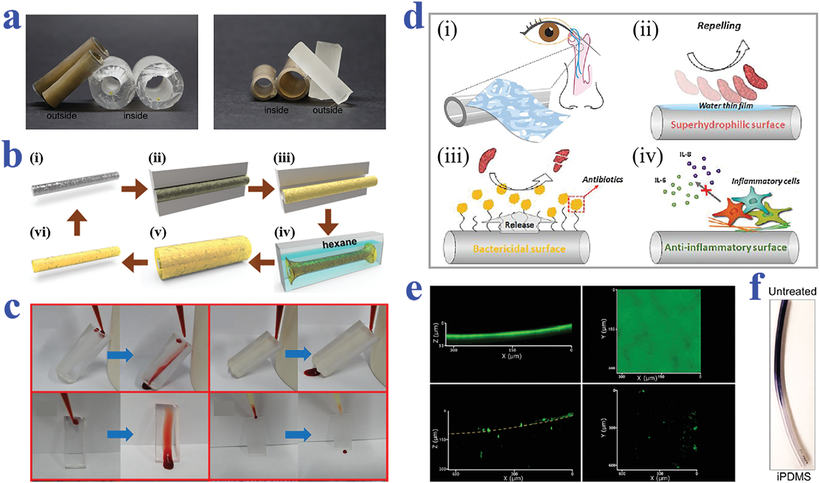
The single image in the dossier is a photograph of the tubes:
The core claim
The paper abstract, attributed to Xu et al., states the following. Biomimetic water-repellent superhydrophobic (SH) self-floating devices have promised a wide range of applications, but current SH floaters are usually limited to small-sized devices because they lack mechanical strength and resistance to environmental stress, making them prone to damage. In this work the authors demonstrate a metallic SH tube with reliable underwater buoyancy, high adaptability to violent environments, and strong resistance to mechanical abrasion and structural damage. The floating ability is attributed to stable air trapped inside the tube. The tube reportedly floats back to the surface even after being fully forced into water, and maintains buoyancy under severe tilting, water impact, and even severe structural damage. The authors propose that SH tube assemblies can be used to construct large vessels, watercrafts, floating platforms, and buoys for marine applications, and they demonstrate a floating SH electrical energy generator to harvest ocean tidal energy.
How it is claimed to work
The mechanism has three parts, as described across the dossier's items:
- Hierarchical micro/nanoscale surface texture. The interior of the aluminum tube is etched to create microscopic and nanoscale pits. This two-scale roughness, combined with the low surface energy of the treated metal, makes the surface superhydrophobic — it strongly repels water and stays dry.
- Trapped air (plastron-like bubble). When the treated tube enters water, the superhydrophobic surface traps a stable bubble of air inside the tube and prevents the tube from becoming waterlogged and sinking. The University of Rochester item compares this to the way diving bell spiders trap an air bubble to stay buoyant underwater, and to fire ants forming floating rafts with their hydrophobic bodies.
- Geometry: a mid-tube divider. Guo is quoted: "Importantly, we added a divider to the middle of the tube so that even if you push it vertically into the water, the bubble of air remains trapped inside and the tube retains its floating ability." The paper's title calls this "geometry-enabled recoverable floating" — the geometry, not the surface chemistry alone, is what keeps the air pocket in place under adverse orientations.
Reported observations and press claims
The University of Rochester news item and the ScienceDaily item report the following, attributed to the lab:
- The tubes "float indefinitely, even when submerged for long periods or punched full of holes."
- The method modifies the inside surface of aluminum tubes by etching micro- and nanoscale pits.
- Guo and his lab "first demonstrated superhydrophobic floating devices in 2019," using two superhydrophobic disks sealed together to create buoyancy. The tube design is presented as an improvement because the disks could lose flotation at extreme angles, whereas the tubes are described as resilient against turbulent conditions.
- Guo: "We tested them in some really rough environments for weeks at a time and found no degradation to their buoyancy." And: "You can poke big holes in them, and we showed that even if you severely damage the tubes with as many holes as you can punch, they still float."
- Lab experiments used tubes of varying lengths, up to almost half a meter. Guo says the technology "could be easily scaled to the larger sizes needed for load-bearing floating devices."
- Multiple tubes can be linked into rafts that could form the basis for ships, buoys, and floating platforms. Rafts of superhydrophobic tubes were shown to harvest water waves to generate electricity.
The ScienceDaily and "German Science Guy" items supply the "unsinkable ships" framing — "A breakthrough that could make ships nearly unsinkable," "could completely revolutionize shipping, coastal protection, and offshore energy supply." This framing is press and video language; it is not a finding of the paper abstract.
Patent claims in the dossier
The dossier reproduces three patent abstracts. These describe surface properties and fabrication methods, not flotation performance.
US2019319152A1 / US2015136226A1 — "Super-hydrophobic surfaces and methods for producing super-hydrophobic surfaces." A metal or metal alloy including a region with hierarchical micro-scale and nano-scale structure shapes, where the surface region is super-hydrophobic and has a spectral reflectance of less than 30% for at least some wavelengths of electromagnetic radiation in the range of 0.1 μm to 10 μm. Methods for forming the hierarchical micro-scale and nano-scale structure shapes on the metal or metal alloy are also described.
US10876193B2 — "Methods for making a material superwicking and/or superwetting (superhydrophilic)." Methods involving creating one or more indentations in the surface of the material that have a micro-rough surface of protrusions, cavities, spheres, rods, or other irregularly shaped features having heights and/or widths on the order of 0.5 to 100 microns, and the micro-rough surface having a nano-rough surface of protrusions, cavities, spheres, rods, and other irregularly shaped features having heights and/or widths on the order of 1 to 500 nanometers. Superwicking and/or superwetting materials having micro-rough and nano-rough surface indentations are claimed, including metals, glass, enamel, polymers, semiconductors, and others.
Note the direction of the third patent: it claims the inverse wetting behavior (superwicking/superwetting, i.e. superhydrophilic) from the same laboratory's surface-structuring toolkit. The dossier juxtaposes the superhydrophobic and superhydrophilic patents without stating whether the tube work is covered by any of them.
Evidence available in this dossier
| Claim class | What the dossier supplies | What it does not supply |
|---|---|---|
| Paper findings | Abstract only | Methods section, quantitative buoyancy data, load figures, contact-angle measurements, durability test protocols |
| Durability | Attributed quotes ("weeks at a time," "no degradation") | Test conditions, water chemistry, temperature, biofouling exposure |
| Scale | Tubes "up to almost half a meter" tested | Demonstration at load-bearing scale; scalability is asserted |
| Patents | Three abstracts describing surface structure and reflectance | Any link between the patents and the tube flotation result |
| Independent verification | None reported | No third-party replication of flotation or the generator |
The primary evidence is a peer-reviewed paper, but only its abstract appears here. The "weeks at a time" and "no degradation" statements are attributed quotes from Guo, not reproduced data. The patent abstracts describe surface properties, not flotation performance. No independent replication is reported in the source.
Limitations, contradictions and unresolved questions
- Press framing vs. paper scope. "Unsinkable ships" and "revolutionize shipping" are press and video language. The paper abstract claims a demonstrated tube and a generator example, not a ship. The dossier does not reconcile the two.
- Scale gap. The paper reports tubes up to almost half a meter; the press says the technology "could be easily scaled" to load-bearing sizes. Scalability is asserted, not demonstrated in the supplied material.
- Durability claim vs. evidence. "No degradation to their buoyancy" over weeks is a quoted assertion. No test conditions, water chemistry, biofouling, or temperature data are given. Marine biofouling and long-term plastron stability are unaddressed open questions.
- Patent scope vs. article scope. The patents cover superhydrophobic surfaces and superwicking methods generally; the article is about tubes and flotation. The dossier does not state whether the tube work is covered by these patents.
- Provenance inconsistency. The dossier header misspells the name ("GouSuperhydrophobicMetal" in the URL, "GUO" in the title).
Related work and context
The 2019 predecessor work — two sealed superhydrophobic disks — is described only through the press item, not through a cited paper in this dossier. The biomimetic analogues (diving bell spider, fire ant) are press-release framing rather than experimental controls. The wave/tidal energy harvesting demonstration connects this source to the wiki's energy topic area, and the buoyancy and structural-damage-tolerance claims connect it to mechanics.
The dossier is a further instance of a recurring pattern in this corpus: a source page that mixes a paper abstract, press framing, video commentary, and patent abstracts, with the patent abstracts doing substantial evidentiary work. See Patent as Evidence and comparisons/source-types.
Source notes & attribution
- Tianshu Xu, et al., "Geometry-Enabled Recoverable Floating Superhydrophobic Metallic Tubes," Advanced Functional Materials , DOI 10.1002/adfm.202526033 (abstract as reproduced in the dossier).
- University of Rochester news item, "Scientists engineer unsinkable metal tubes," https://www.rochester.edu/newscenter/unsinkable-metal-tubes-superhydrophobic-surfaces-691642/ .
- ScienceDaily, "A breakthrough that could make ships nearly unsinkable," https://www.sciencedaily.com/releases/2026/01/260130041105.htm .
- "German Science Guy," "New Study: How to Make Ships Unsinkable!" https://www.youtube.com/watch?v=lGpOkQ_6iT8 .
- University of Rochester, "Creating Unsinkable Metal," https://www.youtube.com/watch?v=kPGiJY-xJw4 .
- US2019319152A1 and US2015136226A1, "Super-hydrophobic surfaces and methods for producing super-hydrophobic surfaces."
- US10876193B2, "Methods for making a material superwicking and/or superwetting (superhydrophilic)."
- Rex Research dossier: https://rexresearch.com/GouSuperhydrophobicMetal/GuoSuperhydrophobicMetallicTubes.html .
- https://rexresearch.com/GouSuperhydrophobicMetal/GuoSuperhydrophobicMetallicTubes.html