This the source archive dossier collects three press articles about a Chinese bone adhesive called "Bone-02" (also written "Bone 02"), one peer-reviewed paper on oyster cement, and abstracts for eighteen patent documents. The dossier's title frames the whole collection as "Bone Glue," but its contents are two loosely related bodies of material: a press-reported product announcement, and a patent portfolio on bone-repair scaffolds, osteoporosis RNA therapeutics and tumor-metastasis nanomaterials. The two are juxtaposed because they share an inventor context, not because the source establishes that they describe the same technology.
US patent publication; document page 2. Preserved page.
The dossier contains no primary research article on Bone-02 itself. Every performance figure attributed to Bone-02 comes from press coverage, and every technical mechanism in the patent section comes from patent abstracts. This distinction governs how the page should be read.
What Bone-02 is claimed to be
According to the press items reproduced in the dossier, Bone-02 is an injectable medical adhesive designed to fix broken bones without metal plates, screws or large incisions. The reported claims are:
- It can be injected directly into a fracture site.
- It bonds bone fragments together in 2–3 minutes, including in blood-rich environments where most adhesives fail.
- It is intended to replace traditional metal implants and to avoid a second surgery for implant removal.
- It is said to be naturally absorbed by the body as the bone heals.
The team leader is named as Lin Xianfeng, described as an associate chief orthopedic surgeon at Sir Run Run Shaw Hospital, affiliated with Zhejiang University in Zhejiang Province, China. The origin story attributed to him is that in 2016, while still a resident physician, he observed experienced surgeons spending hours in the operating room fixing shattered bone fragments with results that were "often far from ideal." He is said to have found inspiration after watching oysters cling firmly to a bridge underwater, prompting the idea of a glue that works in the body's moist environment.
Reported quantitative properties
The dossier's press material attributes the following laboratory figures to Bone-02:
| Property | Reported value |
|---|---|
| Maximum bonding force | over 400 pounds |
| Shear strength | about 0.5 MPa |
| Compressive strength | around 10 MPa |
| Fixation time | 2–3 minutes |
| Trial cases | one case, procedure completed in under three minutes |
These numbers are reported secondhand. The dossier gives no study design, sample size, control group, animal model, mechanical-testing standard, or clinical trial registration for any of them. The "one trial case" is a single anecdote. The claim that the material is naturally absorbed is asserted without composition or degradation data.
The oyster-cement antecedent
The one primary scientific citation in the dossier is a 2010 paper in the Journal of the American Chemical Society:
Jeremy R. Burkett, Lauren M. Hight, Paul Kenny, Jonathan J. Wilker, "Oysters Produce an Organic−Inorganic Adhesive for Intertidal Reef Construction," JACS (2010), doi:10.1021/ja104996y.
The abstract states that oyster cement is an organic–inorganic hybrid and differs from the surrounding shells by displaying an alternate CaCO₃ crystal form, a cross-linked organic matrix, and an elevated protein content. It notes that the presence of cross-linked proteins provides an analogy to mussel and barnacle adhesives, whereas the high inorganic content is exclusive to oysters. The paper's stated purpose is to gain strategies for developing synthetic composite materials and to better understand the components needed for healthy coastal environments.
This is a genuine peer-reviewed finding about oyster cement. It is not a study of Bone-02, and the dossier does not present data linking the oyster-cement characterization to the performance of the adhesive. The connection is an inspiration narrative, not an experimental result.
The patent portfolio
The bulk of the dossier is a set of patent abstracts retrieved via Espacenet and hosted as PDFs on the source archive. They fall into several distinct technical families. The source provides abstracts only — no grant status, prosecution outcome, or experimental validation is included.
Decellularized extracellular matrix (ECM) scaffolds
The largest family. These patents describe removing immunogenic cells from natural tissue while preserving ECM structure, using protease inhibitors, Triton X-100, SDS/SLES, DNase I, freeze–thaw cycles and ultrasonic treatment.
- CN113577391 — Preparation method of natural tissue-derived epiphyseal cartilage combined bone acellular material. Uses distal femur epiphyseal cartilage combined bone of young large white pigs, treated with PBS containing TritonX-100, SLES, HTHOPS, DNaseI and normal saline.
- CN110237303 — Preparation method for decellularized periosteal matrix gel material sourced from natural tissue. Freeze-drying preserves bioactive molecules; the matrix is ground to controlled particle size to promote digestion; EDC crosslinking growth factors.
- CN105879120 — Preparation method of tendon conjunction bone decellularization material of natural tissue source. Treats heel tendon conjunction bone tissue with protease-inhibitor saline, protease-inhibitor PBS, Triton X PBS, SDS PBS and DNase PBS.
- CN105664255 — Method for preparing synchondrosis bone acellular materials from natural tissue origins. Uses protease-inhibitor saline buffer, organic solvent, Triton X PBS, SDS PBS and DNase PBS.
- CN105435307 — Natural-tissue-derived decellularized and decalcified bone material. Uses protease-inhibitor saline buffer, organic solvent, Triton X PBS, SDS PBS, pancreatin PBS, DNase PBS, EDTA isotonic solution and ultrasonic waves.
- CN104511052 — Culture method for composition of periosteal biological scaffold and allogenic seed cells. Seed periosteal cells at 1×10⁶ per milliliter dripped onto a gamma-ray-disinfected scaffold; in-vitro composite culture for one week.
- CN104307045 — Decellularized periosteum material sourced from natural tissues. Specific protocol: rinse three times in aseptic PBS; oscillate 1 hour in 5% PBS with 10 KIU/ml protease inhibitor at 200 rpm; 48 hours in 5% PBS with TritonX-100 at 250 rpm; 48 hours in 10% PBS with SDS at 250 rpm; 12 hours in 1.5 mg/ml PBS with DNAase at 250 rpm.
- CN104307044 — Natural tissue-derived total disc acellular material. Intervertebral disc of a vertebrate; 4 hours at 150 rpm in 10% PBS with 10 KIU/ml; 48 hours in 4% PBS with TritonX-100; 48 hours in 5% PBS with SDS; 12 hours in 0.5 mg/ml PBS with DNA enzyme; final PBS flush for 1 hour.
- WO2023040853 — Periosteum-bone complex for reconstructing soft tissue-bone immune repair. Cutting and proofing, repeated deionized-water rinsing, liquid-nitrogen freeze–thaw, ultrasonic decalcification, then PBS with protease inhibitor, PBS with Triton X-100, PBS with SLES, PBS with DNase I and Tris-HCl buffer.
Mineralization and demineralization control
- CN116328039 — Specific-mineralization-degree natural bone repair material capable of regulating inflammation metabolism. The material is a mineralized extracellular matrix formed after bone tissue ultrasonic decellularization and demineralization, with a calcium mass content of 10–20%. The method: cutting natural bones into slices, cleaning, processing to specifications, cleaning, disinfection, degreasing, decellularization, specific demineralization to 10–20% calcium, final cleaning, residue detection, freeze-drying, packaging and sterilizing.
- US11684696 — Preparation method of gradient mineralized cancellous bone matrix material. Decellularization followed by gradient demineralization; expands porosity and surface collagen exposure, releases growth factors, improves cell adhesion, and up-regulates regeneration-related genes and proteins.
- CN112618797 — Preparation method of antibiotic-crosslinked specific demineralized extracellular matrix scaffold. Uses a specific demineralized and decellularized cancellous bone extracellular matrix scaffold (SDECM) as substrate, with antibiotics loaded by both electrostatic adsorption and chemical crosslinking; releases antibiotics by pH-responsive and degradation-accompanying modes.
- CN118662693 — Bionic bone substance with controllable coagulation time. Comprises calcium phosphate, a phosphate-based organic matter and a bionic spongy reaction agent; the liquid phase includes water, sodium citrate and citric acid; the solid phase includes sodium bicarbonate. Curing time and cancellous degree are controlled by proportion.
Osteoclast targeting and osteoporosis
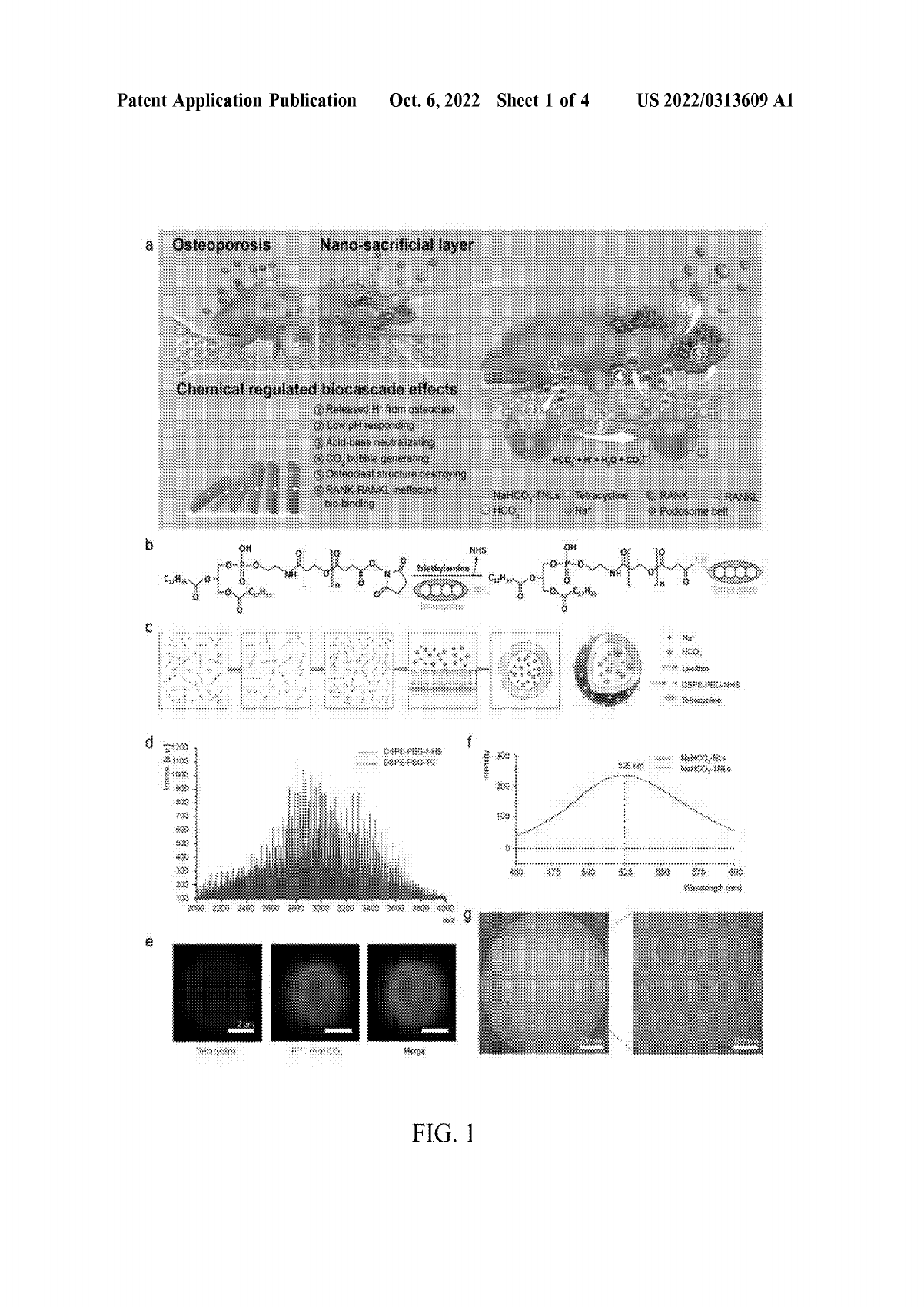
- US2022313609 — Nano composite material aiming at an acidic sealing zone in osteoclasts. Comprises a nanomaterial, bone-targeting molecules, and a compound able to react with the osteoclast acidic sealing zone; after bone-targeting modification the nanomaterial is loaded with the reactive compound.
- CN111481678 — Nano material for osteoclast acidic closed region. Same architecture: nanomaterial plus bone-targeting molecules plus a compound that reacts in the osteoclast acidic closed region.
- CN116019779 — Osteoporosis treatment delivery system based on osteoclast precursor cell targeting circBBS9 knock-down. circRNA is inhibited by siRNA in osteoclast precursor cells, weakening osteoclast polynucleation and bone resorption while preserving other precursor-cell functions; delivery uses cell-membrane microvesicles homologous to osteoclast precursor cells.
- CN116024210 — Osteoporosis marker circRNA and application thereof. Reports that circBBS9 and its human homologues are elevated in osteoporosis; that miR-423-3p is a downstream target of circBBS9; that inhibiting circBBS9 does not affect differentiation of osteoclast mononuclear precursors but weakens polynucleation and bone resorption; and that bone density in osteoporosis mice increases. The siRNA is proposed as a preventive and therapeutic medicine.
Tumor bone metastasis
- WO2025146088 — Nanomaterial for preventing tumor bone metastasis. Claims a spatiotemporal coupling interaction between tumor cells and osteoclasts, and designs a "physical killing" nanomaterial targeting tumor–osteoclast conjugates: a bone-targeting-group-modified nanovesicle encapsulating a carbonate compound and a phosphate compound. When tumor cells are activated, acid secretion by tumor-related osteoclasts triggers the carbonate compound to generate carbon dioxide gas and promotes release of the phosphate compound, which forms calcium phosphate crystals with calcium ions to kill nearby tumor cells.
Duplicated entries
The dossier lists WO2025146088, US11684696 and US2022313609 twice each. These are source artifacts, not distinct documents. A reader counting entries would overstate the number of distinct technologies in the portfolio.
Evidence assessment
The dossier mixes three evidentiary tiers, and they should not be blended:
- Peer-reviewed primary science — the 2010 JACS oyster-cement paper. Solid, but about oysters, not about Bone-02.
- Press-reported product claims — the Bone-02 performance figures. Secondhand, unsourced to any study in the dossier, with no design or controls described.
- Patent abstracts — eighteen documents describing claimed inventions. A patent is a legal claim, not proof of effectiveness; the dossier provides no grant, prosecution or experimental outcome.
The dossier does not state that Bone-02 is covered by any specific listed patent, nor that the patents' data support Bone-02's performance figures. The 400 lb / 0.5 MPa / 10 MPa numbers belong to Bone-02 as reported by press; the decellularization, mineralization, osteoclast-targeting and metastasis mechanisms belong to the patents. Neither set of claims should be transferred to the other.
The "world first" framing appears in the Sixth Tone headline reproduced in the dossier. The dossier offers no independent verification or priority analysis.
Scope drift as a source-quality caveat
The dossier is titled "Bone Glue," but most of its patent entries concern decellularized scaffolds, osteoporosis RNA therapeutics and tumor metastasis — adjacent bone-biology subjects rather than adhesives. This is a tension between the dossier's framing and its contents, and it is worth noting when using the page as a reference.
Related work in the archive
The dossier is another instance of the archive's recurring pattern of presenting patents as a body of work. See Patent as Evidence for the general framing, and Bone Glue Claims vs. Evidence: Press Numbers, Patent Abstracts and the Absence of Primary Data for the specific press-versus-evidence comparison. The topical parent is health.
Source notes & attribution
- rexresearch.com dossier: https://rexresearch.com/XianfengBoneGlue/XianfengBoneGlue.html
- Interesting Engineering: https://interestingengineering.com/science/chinas-oyster-inspired-bone-glue
- Global Times: https://www.globaltimes.cn/page/202509/1343380.shtml
- Sixth Tone: https://www.sixthtone.com/news/1017606
- Burkett, Hight, Kenny, Wilker, JACS (2010): https://pubs.acs.org/doi/abs/10.1021/ja104996y
- Espacenet: https://worldwide.espacenet.com
- https://rexresearch.com/XianfengBoneGlue/XianfengBoneGlue.html