Rochen
A disc-shaped aircraft design in its documentary context.
Start here / 6 minute read
Heinrich Focke and the Focke Rochen: A WWII VTOL Project
The source dossier page "Heinrich FOCKE — Helicopter Glider" is a short archive pointer rather than an original research document. Its substantive prose is a reproduction of the Wikipedia article on the Focke Rochen (English: Focke Stingray), also called the Focke-Wulf Schnellflugzeug or Focke-Wulf VTOL, a German vertical take-off and landing (VTOL) aircraft project designed by Heinrich Focke of the Focke-Wulf company toward the end of World War II. Around that text the page assembles two YouTube links, an Alchetron image page, five patent PDFs, and five images.
Unlike most dossiers in this archive — the free-energy, radiesthesia and contactee material catalogued elsewhere in this wiki — the Rochen is a conventional (if unconventional-looking) aerospace project. It is not an over-unity or paranormal claim, and it should not be read through the "claims vs. evidence" template used for Moray's Radiant Energy Receiver: Reported Figures, the Germanium Valve and the Twenty-Point Duplication Test or Hendershot's Fuelless Motor: Claims, Witnesses and the Hochstetter Counter-Demonstration. The relevant limitation here is different: no full-size flying aircraft is established by this source, the documentation is thin, and the archive page supplies no test data, dimensions or performance figures.
What the Rochen was
According to the page's Wikipedia-derived text, the Rochen was a German VTOL aircraft project that "remained unbuilt before the surrender of Nazi Germany, but saw some development in the postwar years." The page states plainly that "the information about this project is limited," and that the aircraft "was named after the ray owing to its unusual shape." The defining geometry is an airfoil-section body with two large propellers in the center.
The name is given in three forms on the page: Focke Rochen, Focke Stingray (the English rendering), and Focke-Wulf Schnellflugzeug / Focke-Wulf VTOL. These are treated as aliases of the same project.
Design and claimed mechanisms
The page describes the design in a compact block of technical detail. The following mechanisms are attributed to the project:
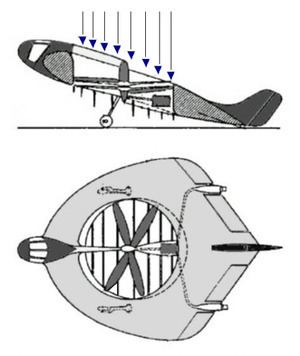
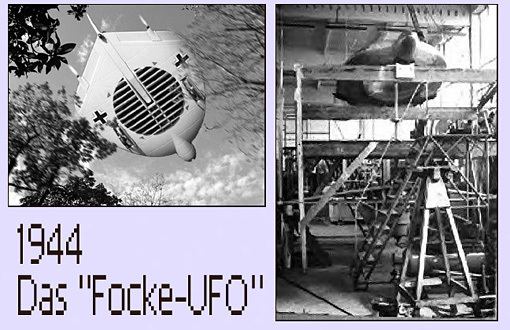
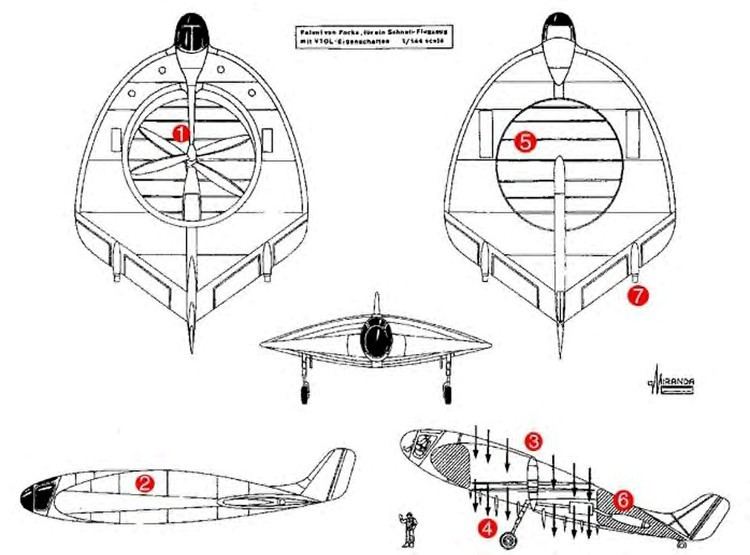
- Circular wing with an open center. The aircraft is described as "a circular aircraft with a large airfoil section and an open center that acted as a huge propeller duct for twin contra-rotating propellers." This is the Circular-Wing Annular-Duct Configuration that gives the design its ray-like planform.
- Contra-rotating propellers. Two propellers in the central duct turn in opposite directions, per Contra-Rotating Propellers.
- Projected turbojet drive. The propellers were to be "driven by a projected Focke-Wulf designed turbojet engine via an axle and gearbox." The engine is described as projected — that is, not an existing, qualified powerplant.
- Downwash vectoring through louvers. Forward flight "would have [been] achieved by vectoring the downwash from the propellers rearward through a series of louvers below them." The louvers "could also be completely closed for gliding flight in the event of engine failure." See Downwash Vectoring Louvers.
- Auxiliary combustion chambers as primitive afterburners. The turbojet's exhaust nozzle "forked in two at the end of the turbojet engine and ended in two auxiliary combustion chambers located on the trailing edges of the circular wing. When fuel was added, the auxiliary combustion chambers acted as primitive afterburners, providing horizontal flight." See Auxiliary Combustion Chambers (Rochen).
- Low-speed control by asymmetric chamber power. "Control at low speed was achieved by varying the power to each auxiliary chamber through two small nozzles."
- Landing gear and layout. "The landing gear was very simple, consisting of the two main gear legs on either side of the central propellers and a small tailwheel. A single fin and rudder would be provided to help with lateral stability at higher speeds. The pilot would sit in a cockpit nacelle that protruded from the front of the circular airfoil-section fuselage."
The conditional mood throughout ("would have achieved," "would be provided") is the page's own; it reflects a design study rather than a flown aircraft.
Development timeline as stated
The page gives two dates that are not reconciled with one another:
- 1939 — "he patented the idea of a circular aircraft with a large airfoil section and an open center that acted as a huge propeller duct for twin contra-rotating propellers." The page also says Focke "started design work on the Rochen … as soon as he had the relevant data for the new German jet engines," placing the design effort in "the last years of the Third Reich."
- 1957 — "Heinrich Focke filed for a patent of the aircraft in 1957, but it was never built."
Whether these refer to the same concept protected at two stages, or to two distinct filings, is not stated. The page also asserts postwar development without describing it: "a wooden 1/10 scale model of the Rochen was built in Bremen and subjected to wind tunnel tests." No results of those tests are given.
The patents
The page's only primary-source artifacts are five patent documents, linked as PDFs. The page header advertises "4 patents," but five identifiers are listed — an internal inconsistency in the source itself.
| Patent | Title as given on the page |
|---|---|
| DE953938 | Kombiniertes Hubschrauber-Drachenflugzeug mit in ihrer Steigung verstellbaren Luftschraubenblaettern |
| US2978037 | Stabilizing means for helicopter aircraft |
| CA587730 | FLYING MACHINES FOR VERTICAL AND HORIZONTAL FLIGHT |
| GB768190 | Improvements in flying machines for vertical and horizontal flight |
| DE950169 | Hubschrauber mit Schraubenblaettern… |
The page does not map any patent to a design stage, does not give filing or grant dates, and does not reproduce claims or drawings. The CA587730 and GB768190 titles are near-identical, suggesting a family of filings covering the same vertical-and-horizontal-flight subject matter; the two German titles point at a combined helicopter/glider with pitch-adjustable propeller blades and at a helicopter with propeller blades respectively. Individual pages exist for each: DE953938 — Kombiniertes Hubschrauber-Drachenflugzeug, US2978037 — Stabilizing Means for Helicopter Aircraft, CA587730 — Flying Machines for Vertical and Horizontal Flight, GB768190 — Improvements in Flying Machines for Vertical and Horizontal Flight, DE950169 — Hubschrauber mit Schraubenblaettern.
Images
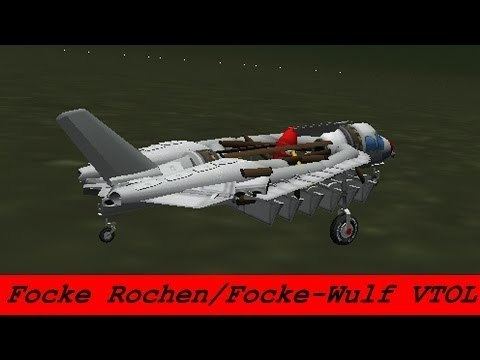
The archive page mirrors five images of the project. The source supplies no captions, so the captions below are descriptive only.
Evidence quality and limitations
- Secondary throughout. The substantive text is a Wikipedia article, with footnotes [1][2][3] referenced but not reproduced in the captured page. The archive adds no independent verification.
- No test data. The Bremen wind-tunnel claim is asserted without results, model dimensions, test conditions or dates.
- No performance figures. No speed, payload, thrust, weight or altitude figures appear anywhere on the page.
- Unbuilt status. A wooden scale model and wind-tunnel work are reported; a full-size flying aircraft is not established. The flight descriptions are design intentions.
- Internal inconsistency. The header says four patents; five are listed.
- Unreconciled dates. The 1939 patent statement and the 1957 filing statement are not explained relative to one another.
- Peripheral links. The two YouTube videos ("Hinter den Wolken" and "Firespitter Carcharoth") and the Alchetron image page are non-authoritative and are not relied on here.
The page is best treated as an archive pointer: a secondary encyclopedia summary plus links to five primary patent documents. The patents, not the prose, are the material worth following up.
Related work in this wiki
- aviation — the topic guide this dossier extends with a German WWII-era VTOL project.
- VTOL Aircraft — the general concept the Rochen exemplifies.
- Circular-Wing Annular-Duct Configuration — the Rochen's defining geometry.
- Downwash Vectoring Louvers and Auxiliary Combustion Chambers (Rochen) — the two forward-flight mechanisms described.
- main-archive — the source archive collection this dossier belongs to.
Model versus aircraft
The archived account explicitly describes a wooden one-tenth-scale model and postwar wind-tunnel testing. “Unbuilt” refers to the full-size aircraft, not the absence of any physical model. The source also includes a KSP simulation link; a simulation still is not a photograph of a flying prototype. Patent drawings document an arrangement or proposed control method, not a flight demonstration.
Source notes & attribution
- Rex Research, "Heinrich FOCKE: Helicopter Glider ~ Articles, videos & 4 patents," https://rexresearch.com/FockeRochen/FockeRochen.html (retrieved 2026-09-17).
- Wikipedia, "Focke Rochen," https://en.wikipedia.org/wiki/Focke_Rochen (as reproduced on the archive page).
- Patent PDFs linked from the archive page: DE953938, US2978037, CA587730, GB768190, DE950169.
- https://rexresearch.com/FockeRochen/FockeRochen.html
Go deeper.
13 further articles2 min
Focke Rochen
The Focke Rochen (English: Focke Stingray ), also known as the Focke-Wulf Schnellflugzeug or Focke-Wulf VTOL , was a German VTOL aircraft project designed by Heinrich Focke of the Focke-Wulf company toward the end of World War II. The source dossier page that is the source for this article reproduces a Wikipedia summary of the p
1 min
Heinrich Focke
Heinrich Focke was a German aircraft engineer associated with the Focke-Wulf company. In the source dossier that is the source for this page, he appears solely as the designer of the Focke Rochen (Focke Stingray), a German VTOL aircraft project of the late World War II period.
1 min
Circular-Wing Annular-Duct Configuration
The circular-wing annular-duct configuration is the defining geometry of the Focke Rochen as described in the source dossier. The source states that in 1939 Heinrich Focke "patented the idea of a circular aircraft with a large airfoil section and an open center that acted as a huge propeller duct for twin contra-rotating propell
1 min
VTOL Aircraft
VTOL (vertical take-off and landing) denotes aircraft able to take off and land vertically while also achieving forward flight. The concept is seeded in this wiki by the source dossier on the Focke Rochen , which the source describes as "a German VTOL aircraft project" and which the archive page also calls the Focke-Wulf VTOL .
1 min
DE953938 — Kombiniertes Hubschrauber-Drachenflugzeug
DE953938 is one of five patent documents linked from the source dossier on Heinrich Focke and the Focke Rochen . The title is given on the archive page as:
1 min
CA587730 — Flying Machines for Vertical and Horizontal Flight
CA587730 is one of five patent documents linked from the source dossier on Heinrich Focke and the Focke Rochen . The title is given on the archive page as:
1 min
Auxiliary Combustion Chambers (Rochen)
The auxiliary combustion chambers are a thrust-augmentation feature the source dossier attributes to the Focke Rochen . The source states that "the exhaust nozzle forked in two at the end of the turbojet engine and ended in two auxiliary combustion chambers located on the trailing edges of the circular wing."
1 min
Downwash Vectoring Louvers
Downwash vectoring louvers are the mechanism the source dossier attributes to the Focke Rochen for achieving forward flight from a vertical-lift configuration. The source states that "the Fw-Rochen would have achieved forward flight by vectoring the downwash from the propellers rearward through a series of louvers below them."
1 min
US2978037 — Stabilizing Means for Helicopter Aircraft
US2978037 is one of five patent documents linked from the source dossier on Heinrich Focke and the Focke Rochen . The title is given on the archive page as:
1 min
DE950169 — Hubschrauber mit Schraubenblaettern
DE950169 is one of five patent documents linked from the source dossier on Heinrich Focke and the Focke Rochen . The title is given on the archive page, truncated, as:
1 min
GB768190 — Improvements in Flying Machines for Vertical and Horizontal Flight
GB768190 is one of four patent documents linked from the source dossier on Heinrich Focke and the Focke Rochen . The title is given on the archive page as:
1 min
Contra-Rotating Propellers
Contra-rotating propellers are two propeller assemblies mounted on the same axis and turning in opposite directions. In the source dossier that seeds this page, they are the lift-producing element of the Focke Rochen : the source states that the aircraft's open center "acted as a huge propeller duct for twin contra-rotating prop
1 min
Focke-Wulf
Focke-Wulf was a German aircraft manufacturer. In the source dossier that is the source for this page, it appears as the company context for the Focke Rochen project: the aircraft is described as "designed by Heinrich Focke of the Focke-Wulf company towards the end of World War II," and the projected powerplant is described as "
The visual record.
5 archived figures · open to inspectThe source room.
Everything readable here stays on StrangewellArchived texts preserve what the source said. They may contain historical, speculative, or promotional claims; inclusion is not verification.
Source text2 min
Heinrich FOCKE : Helicopter Glider ~ Articles, videos & 4 patents
https://www.youtube.com/watch?v=_B5VUr3b_pA&t=6s KSP Focke Rochen VTOL, prototype plane, Firespitter Carcharoth
Supporting documents (5)
“Captured” means saved for research; a full reading guide may still be pending.