The Electrokinetic Lifter
Gravity control by high voltage, or just an ion wind?
Start here / 8 minute read
Force on an Asymmetric Capacitor: The 2003 Army Research Laboratory Lifter Tests and Why Their Ion-Wind Estimate Fell Short (Bahder & Fazi)
"Force on an Asymmetric Capacitor" is a technical report dated March 2003 by Thomas B. Bahder and Chris Fazi of the Sensors and Electron Devices Directorate, U.S. Army Research Laboratory (ARL), Adelphi, Maryland, covering work done from August to December 2002. The authors built several lightweight lifters, confirmed that they rise under roughly 30 kV, and then tried to work out why. Their answer is that they do not know: a simple ion-wind calculation comes out far too small, a rougher ion-drift estimate lands in the right range, and neither amounts to a theory. The report carries the usual disclaimer that its findings are not an official Department of the Army position.
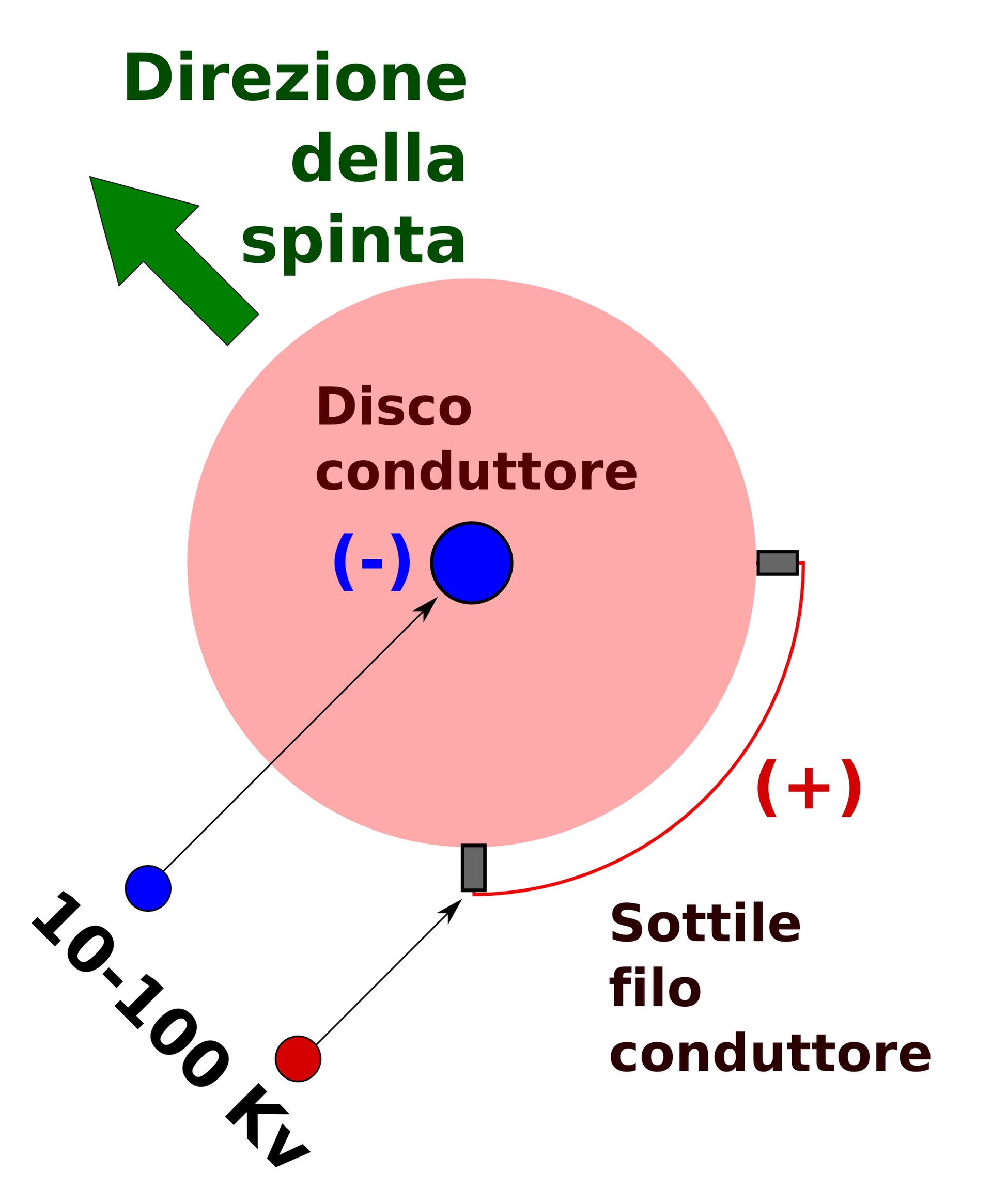
Abassign · CC BY-SA 3.0
Why an Army laboratory looked at lifters
The report says Bahder took up the question at the suggestion of W. C. McCorkle, Director of Aviation and Missile Command. A literature search by the authors turned up no technical description of the Biefeld-Brown effect in the standard journals; they found it documented mainly in patents and on hobbyist web sites, alongside two reports and two theoretical papers. That led them to ask whether the effect was genuine or mere hearsay, and to settle the point by building the devices themselves.
Their historical section traces the idea through Thomas Townsend Brown's patents, from British Patent No. 300,311 (applied for on April 15, 1927, issued November 15, 1928) to the 1960 patent described in US 2,949,550: Thomas Townsend Brown's Electrokinetic Apparatus Patent (Wire-and-Plate Thrusters, Discs and a Torpedo Body). The authors remark that the 1928 patent mixes electromagnetic and gravitational ideas, whereas the 1960 one makes no reference to gravity. They single out Brown's later patent No. 3,187,206 (issued June 1, 1965) because it asserts that the force persists in vacuum. As Patent as Evidence sets out, such assertions record what an inventor claimed, not what was demonstrated.
What was built and what was seen
All the test pieces paired a thin wire with a much larger foil electrode.
- Triangular lifter. Built to a design published by Jean-Louis Naudin: about 20 cm on a side, 38-gauge wire held 3 cm above aluminium foil strips of 20 cm × 4 cm, on a balsa frame trimmed from ~7 g to ~5 g. At ~37 kV and ~1.5 mA it left its resting surface but flew weakly, which the authors put down to its weight and to arcing across the short gap.
- Square lifter. An 18 cm × 20 cm version made from a Styrofoam lunch box and drinking straws, with the gap widened to 6 cm. At 30 kV and ~1.5 mA it hovered vigorously.
- Flat wing. A single 20 cm × 4 cm foil with the wire 6.3 cm from its edge, made to test whether a closed loop of electrodes matters. At ~30 kV it flew up strongly; the report prints the current as ~500 mA. The authors conclude the closed shape is not needed.
- A single hanging wire. About 12 in length with a scrap of tape at its end, at ~35 kV and 1 mA. It swung as much as 30° from vertical and oscillated.
Three observations recur. The force pointed toward the small electrode whichever polarity was applied, which differs from the statement the report attributes to Brown that the force is greatest with the small electrode positive. The force kept that direction however the capacitor was turned, from which the authors conclude it has nothing to do with the Earth's gravitational field or atmospheric potential. And arcing killed the lift, so the foil edge nearest the wire had to be rounded. A ground plane under the device was not needed. Every working capacitor hissed, a sound the authors suggest "may be a clue to the mechanism responsible for the net force".
The report describes no thrust measurement. When it speaks of an observed force, it means that a device weighing a few grams lifted off or that a hanging wire swung.
The ion-wind estimate
The report's best-known result is a ceiling on what it calls ionic wind: charges accelerated freely through the full voltage, handing all their momentum to the device as recoil. With 40 kV and 1.0 mA, electrons as the carriers could lift 6.8 × 10^-5 gram, about five orders of magnitude short of a 5 g lifter. Even copper ions stripped from the wire, taken as the heaviest candidates, give only 0.002 gram, three orders short of a 3–5 g device.
It matters what this rules out. The model is ballistic: the charges cross the gap without colliding with anything. The authors themselves note that in air charges are known to drift through collisions instead, and that this picture is the more accurate one for an air-filled gap.
The ion-drift estimate
Treating the current as carriers drifting across the gap gives a scaling relation in which force equals current times gap length divided by carrier mobility. With 1 mA and a 0.04 m gap, the electron mobility the report cites (620 cm²/Volt·sec) yields 6.4 × 10^-4 N, enough for 0.064 gram. Against a device of roughly 5 g that is about two orders of magnitude short, and the authors conclude that drift of electrons cannot explain the force. The mobility the report cites for N2 ions in air (2.5 cm²/Volt·sec) yields 0.16 N, enough for 16 gram, which the authors call within a factor of 3 for a 5 g capacitor. Only the ion figure, then, reaches the right order of magnitude.
The 0.04 m gap is simply the value entered in this calculation. It should not be read as the gap of the square lifter, which the report gives as 6 cm.
The physical picture offered is of slow positive ions lingering as a cloud around the thin wire and attracting the oppositely charged foil, with the supply renewing the cloud as the device moves. The authors find this compelling but stress it is a scaling argument, not a microscopic model, and that it remains to be shown whether it has merit.
The thermodynamic treatment
A third section models partially ionized air as a nonlinear dielectric fluid and derives a general four-term expression for the force on the electrodes. Three of the terms depend on the square of the electric field, which fits the observed indifference to polarity. The authors cannot say how large any term is, since that requires the high-field dielectric properties of air, which they had not measured. For an ordinary linear dielectric the leading term points the wrong way, toward the larger electrode. For a vacuum the expression gives zero force.
What the report does and does not establish
It establishes that the lifter demonstrations circulating on the Internet could be reproduced with simple materials in a government laboratory, and that the force does not track gravity or polarity. It does not establish a mechanism, and it does not support an antigravity reading. The authors name no single surviving explanation. They call the drift picture plausible but only a scaling estimate, one that matches the observed force in order of magnitude and no more closely, and they set beside it the thermodynamic treatment of air as a nonlinear dielectric, whose terms they cannot yet evaluate. Neither is established.
The experiments described in the report were all run in air, and what it says about vacuum is second-hand. The authors mention one piece of earlier preliminary work, a second report they cite, which tested the effect in vacuum and claimed a small force, smaller than the one seen in air. They also say it seems Brown may have tested in vacuum without reporting the results. Their basis for that is a letter reproduced by way of Naudin, whose signature by Brown the report does not vouch for. The letter describes vacuum tests in Paris in 1955-56, at the Bahnson Laboratories in 1957-58 and at a General Electric facility in 1959, with laboratory notes that were never published and that, the letter says, its writer could no longer consult. Of the Paris tests it asserts that small saucer-type airfoils were run at 70 kV to 220 kV in a vacuum exceeding 10^-6 mm Hg, that thrust continued even when no vacuum spark was occurring, and that the remaining thrust was several orders of magnitude larger than leftover ionization could account for. The report verifies none of this, and its own thermodynamic expression gives zero force in vacuum.
The authors therefore treat the question as open and call it the most pressing one, recommending measurements in vacuum and across gas pressure, gas species and voltage, together with a microscopic model of ionization and charge transport.
Further reading
A 2004 paper by Martin Tajmar approaches the same question from the other side: it encloses a corona discharge in a grounded box hung as a pendulum, reports no steady thrust above 10 µN, and estimates the corona wind with a mobility-based relation of the same form as the drift estimate above. See The Biefeld-Brown Effect as a Misread Corona Wind: Martin Tajmar's Sealed-Box Pendulum Test and Its 10 µN Limit.
A May 2004 NASA survey of breakthrough-propulsion research reaches a firmer conclusion than this report does, attributing the thrust of lifters and asymmetrical capacitors to ion wind on the strength of other studies; it does not cite the Army work. See Prospects for Breakthrough Propulsion From Physics: Marc Millis's 2004 NASA Survey and Its Verdict on Biefeld-Brown Devices, Lifters and Asymmetrical Capacitors.
A December 2009 NASA Glenn memorandum uses the same current-times-gap-over-mobility relation, weighs a Naudin-type lifter on a balance with and without a wind shield, and reports that the measured thrust equals the ion wind's momentum: An Investigation of Ionic Wind Propulsion: NASA Glenn's 2009 Balance Tests Showing Lifter Thrust Equals the Ion Wind, and Why It Stays Too Weak for Aircraft (Wilson, Perkins & Thompson).
Go deeper.
4 further articles6 min
The Biefeld-Brown Effect as a Misread Corona Wind: Martin Tajmar's Sealed-Box Pendulum Test and Its 10 µN Limit
"The Biefeld-Brown Effect: Misinterpretation of Corona Wind Phenomena" is a paper by Martin Tajmar, then at ARC Seibersdorf research in Austria and a lecturer at the Vienna University of Technology, published in the AIAA Journal in 2004. It does two things. It reviews what Thomas Townsend Brown and others claimed about thrust fr
6 min
An Investigation of Ionic Wind Propulsion: NASA Glenn's 2009 Balance Tests Showing Lifter Thrust Equals the Ion Wind, and Why It Stays Too Weak for Aircraft (Wilson, Perkins & Thompson)
"An Investigation of Ionic Wind Propulsion" is NASA Technical Memorandum NASA/TM—2009-215822, dated December 2009, by Jack Wilson of ASRC Aerospace Corporation and Hugh D. Perkins and William K. Thompson of NASA Glenn Research Center in Cleveland, Ohio. It was sponsored by Glenn's Fundamental Aeronautics Program. Where the other
6 min
US 2,949,550: Thomas Townsend Brown's Electrokinetic Apparatus Patent (Wire-and-Plate Thrusters, Discs and a Torpedo Body)
US 2,949,550, "Electrokinetic apparatus", is the patent in which Thomas Townsend Brown set out a wire-and-plate electrode arrangement for producing thrust from high voltage. It was filed on 3 July 1957 as application US669830A, granted on 16 August 1960 and assigned to Whitehall Rand Inc; the patent record lists it as expired. W
5 min
Prospects for Breakthrough Propulsion From Physics: Marc Millis's 2004 NASA Survey and Its Verdict on Biefeld-Brown Devices, Lifters and Asymmetrical Capacitors
"Prospects for Breakthrough Propulsion From Physics" is NASA Technical Memorandum NASA/TM—2004-213082, written by Marc G. Millis of Glenn Research Center, Cleveland, Ohio, dated May 2004 and prepared for the 2004 Conference on Evolvable Hardware in Seattle (June 24–26, 2004). It is a survey, not an experiment: it sums up what NA