A 2026 open-access paper by Manca Lunder, Sebastian Dahle, Borut Poljšak and Rok Fink (the corresponding author; accepted 9 February 2026) makes a methodological argument that, on the authors' account, bears on the antibacterial figures in the 18 studies of Plasma-Activated Water (PAW) it surveyed. The authors argue that long-lived oxidants in treated water can go on acting on bacteria after the plasma is switched off, so that a laboratory which counts survivors without first stopping that chemistry risks overstating the kill. Their own results set a limit on the argument: they read the complete loss of bacteria after 24 h of storage mainly as the delayed death of cells already injured, and fresh bacteria added to day-old treated water fell by only 0.41 log (E. coli) and 0.32 log (S. aureus). The authors' title calls neutralization "the critical step".
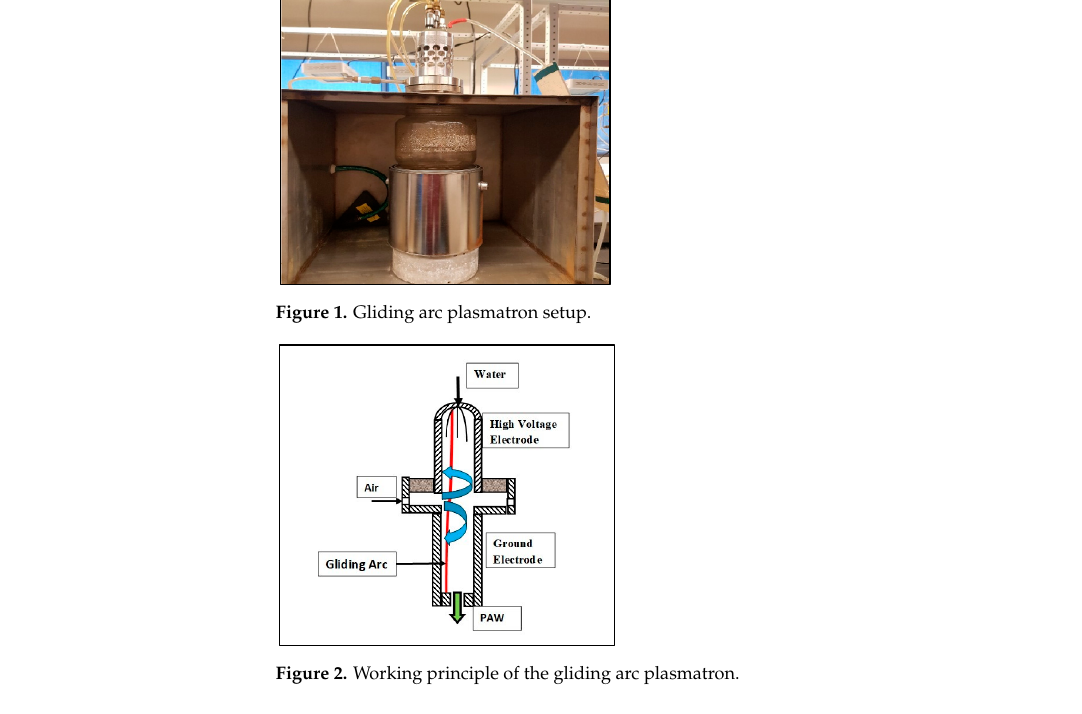
Mobish Shaji et al., Physical Properties of Plasma-Activated Water, Plasma 6 (2023). CC BY 4.0. Figure region cropped from document page 3.
What is the complaint?
Standard disinfectant tests assume that the agent is chemically quenched at the moment of sampling. The paper cites EN 1276, ASTM E1054 and United States Pharmacopeia guidance, which name neutralizer recipes for chlorine, hydrogen peroxide, alcohols and similar agents. The authors' comparison is with chlorine and ultraviolet light: chlorinated water samples are routinely collected into bottles containing sodium thiosulphate because free chlorine keeps working, whereas ultraviolet treatment leaves nothing behind and stops acting when the lamp does. Plasma-activated water, they argue, belongs with chlorine.
The reason lies in the two lifetimes of Reactive Oxygen and Nitrogen Species (RONS). The paper says short-lived species such as hydroxyl radicals vanish almost at once (it quotes a residence time of about 150 ps at the gas–water interface), while ozone and hydrogen peroxide persist for minutes and, on the literature it cites, may remain in the liquid for weeks or months. It is these long-lived oxidants that would keep acting on a culture plate.
The authors then tabulate 18 earlier studies of plasma-treated water. By their account most used no neutralizer at all, several only diluted the sample in phosphate-buffered saline or peptone solutions, one removed the reactive species by centrifugation, and one (Hummert et al., 2023) used a validated chemical neutralizer adapted from a disinfectant standard. They state that no systematic evaluation of neutralizers for this purpose had been published and that no standard protocol exists.
What did the authors do themselves?
The water was treated in a flow-through dielectric barrier discharge reactor (one of the discharge types listed on Non-Thermal Plasma (Cold Atmospheric Plasma)): 500 mL of laboratory-prepared hard water, pH 8.3 and conductivity 1,794 μS/cm, was pumped at roughly 2 L/min as a jet through a quartz tube wrapped in a copper mesh electrode, the grounded jet itself serving as the second electrode. The paper reports a power input of 825 W and a specific energy input of 0.083 kWh/kg for a 3 min treatment. Its pulse settings are given inconsistently, with a repetition rate of 30 kHz in the device description and 15 kHz in the treatment procedure.
Reference strains of Escherichia coli and Staphylococcus aureus were present in the water during treatment. The team then counted survivors with and without neutralization, measured hydrogen peroxide, ozone, nitrite and nitrate with a photometer immediately and after 24 h at 4°C, and compared six liquid neutralizers and several agar media. The neutralizers, chosen from EN 1276, were phosphate-buffered saline, sodium thiosulphate, lecithin, polysorbate 80, sodium chloride with tryptone, and a combination of all five that the paper calls "Mix".
What was measured?
Kill without neutralization. Three minutes of treatment gave reported log reductions of 1.09 for E. coli and 3.27 for S. aureus. After a day of cold storage neither strain could be recovered; the paper gives a further 4.42 log fall for E. coli (5.51 in total) and a further 2.16 for S. aureus.
Chemistry over 24 h. Ozone fell by 56% in treated water without bacteria and by 69% with bacteria. Hydrogen peroxide fell by 28% (given as 29% elsewhere in the paper) and 66% respectively. Nitrite barely moved (0.62 to 0.58 mg/L without bacteria; 0.15 to 0.20 mg/L with), and nitrate went from 31.40 to 30.49 mg/L and from 33.30 to 27.70 mg/L. The authors read the faster loss in the presence of bacteria as the oxidants being consumed, and say their results suggest that reactive oxygen species were primarily responsible for the antibacterial effect within the first 24 h. They add that nitrogen species likely act together with the oxygen species over longer storage. This is an inference from how the concentrations changed; the study did not measure which species killed the bacteria.
Effect of neutralizing. Every neutralizer raised the recovered count relative to the un-neutralized sample, which the paper reports as highly significant (p < 0.0001). Mix did best: 2.67 log more S. aureus and 0.96 log more E. coli.
Culture media. Non-selective agars (tryptic soy and the neutralizing Dey-Engley agar) recovered more colonies than selective ones, which the authors attribute to selective media suppressing injured cells. Their recommendation is Mix combined with overlay media they label NEA for E. coli and NMSA for S. aureus.
How far does the evidence go?
The paper supports its central caution better than its specific prescription.
- The differences between the six neutralizers were not statistically significant for either strain. Mix is the best performer numerically, not demonstrably.
- The authors themselves qualify the storage result. Because bacteria were in the water during treatment, total loss after 24 h reflects, in their words, "delayed loss of viability" from injury already done, not proof of a day-long active agent. When fresh bacteria were added to day-old treated water, the reductions were only 0.41 log (E. coli) and 0.32 log (S. aureus).
- Neutralization targets the long-lived species only; the paper concedes that short-lived species in freshly made water may still contribute.
- One reactor, one water recipe, two strains and a single 3 min exposure were tested. The authors stress that chemistry varies with device, volume and water, so a neutralizer validated here is not thereby validated elsewhere. The validation of Mix against EN 1276 is reported in a supplementary appendix, not in the main text.
- The write-up has internal slips beyond the pulse rate: the discussion cites a 4 mg/L nitrite decrease that does not match the reported 0.62 to 0.58 mg/L, the combined-media rankings appear to list the two species' agars under the wrong organism, and in the agar-only test NMSA performed worse than plain selective agar for S. aureus yet is still recommended.
- The paper does not re-test any earlier study. It shows that an inflating bias is plausible and sizeable in its own system, not how large it was in anyone else's.
Why it matters for this dossier
The paper's own experiments concern bacteria suspended in laboratory-prepared hard water; it does not address agricultural or surface uses of plasma-treated water. Still, any such claim (see Plasma Agriculture) that depends on plate counts of treated water would raise the same question about when the residual oxidants were quenched. On this paper's argument, a log-reduction number is hard to interpret unless the study says how, and how quickly, the residual hydrogen peroxide and ozone were neutralized before counting. The paper also sharpens a point of chemistry: the reactive species in treated water are not uniformly fleeting, and on the authors' reading the slow ones are behind both any lasting effect and the measurement problem, although the paper's own test with fresh bacteria found that lasting effect to be modest after a day of storage.
Source notes & attribution
- https://pmc.ncbi.nlm.nih.gov/articles/PMC12962882/