Robert A. Nelson's short article "The Next Bigly Thing: Power from the Air" is an advocate's overview of attempts to draw usable electricity from the atmosphere. It sets Jules Guillot's antenna collector, the subject of Guillot and Eclator, beside earlier American patents and the balloon collectors of Hermann Plauson, and ends with a small modern experiment. The article reports no tests of its own. Everything in it is a patent number, a book title or a quotation from older print, so its value here is as a map of who claimed what, and in which units.
What does the article argue?
Nelson's thesis is that industrial-scale power from the sky was already achieved in the early 1900s, and that work on it lapsed after the First World War and has not revived. He presents atmospheric electricity as simple, robust, cheaper than wind or solar power, and available everywhere at all times. None of these comparisons is supported by cost figures or measurements in the article.
The physical basis he offers is brief. The Earth is described as an electrostatic generator, with a positively charged atmosphere over a negative ground, and the article puts the resulting current at approximately 3 x 10^-16 amperes per square centimetre, or 1500 amperes for the whole planet.
Who is on Nelson's list?
- Andor Palenscar: US patent US674427, granted in 1901, for a collecting apparatus that the article says included a novel motor to use the electrostatic energy.
- Walter Pennock: an aerial energy collector, US patents US911260 (1909) and US1014719 (1912).
- Jules Guillot: the "Atmospheric Electric Siphon" of the 1920s.
- Hermann Plauson: balloon and aerial collectors, described in his 1920 book "Gewinnung und Verwertung der Atmosphärischen Elektrizität" and in patents US1540998, BP157262 and BP157263.
- Meridian International Research: experiments said to have been under way since 1997, building on Plauson, Oleg Jefimenko and others.
For Palenscar and Pennock the article gives only patent numbers and dates; no output is claimed for either.
What does it say about Guillot?
The figures match those in the dossier's main page, Guillot: The 'Eclator' and Atmospheric Power — A source Dossier Page: about 2.5-3 kilowatts with an antenna roughly 20 meters high, and about 300 watts from a tabletop apparatus with a 2 meter collector. Nelson states that output depends on total collector surface and on the height of the vertical antenna, but gives no surface areas, load, duration or instrument for either figure.
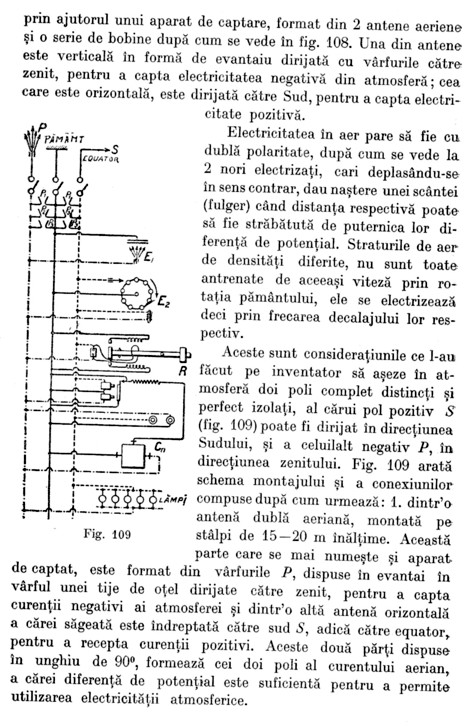
The description of the apparatus comes from a quoted passage that Nelson attributes to The Invention Encyclopedia of 1930, edited by the engineer George Constantinescu. That passage has Guillot "pumping" electricity out of the air with two collectors kept electrically isolated from each other. One stands upright and ends in a spray of rods aimed straight overhead; the passage assigns it the negative electricity. The other lies level and faces south, toward the Equator, and is assigned the positive. A transformer adapts the output for industrial motors. Nelson adds that the siphons produce a magnetic field and that a Ruhmkorff induction coil starts the system. The same passage mentions, without detail, aerial cables on Mont Blanc in France and cables carried by captive balloons in Germany.
One bibliographic point needs care. The article says Guillot received three French patents but lists "FR551882, FR565395, and FR551882", which is two distinct numbers with the first repeated. The article's list therefore contains only two distinct numbers, presumably the two French patents described on Guillot: The 'Eclator' and Atmospheric Power — A source Dossier Page.
What is claimed for Plauson's balloons?
Nelson describes Plauson as an Estonian who directed the Fischer-Tropsch Laboratories in Hamburg in the 1910s and 20s. The numbers come from Science & Invention magazine (March 1922 and June 1928). The article credits the presentation to "Hugo Gernsbach", a misspelling of Hugo Gernsback.
What was built. The magazine passages Nelson quotes describe an experimental balloon of aluminum leaf, tethered by copper-plated steel wire. Its collecting points were needles of amalgamated zinc, and a radium preparation was added to ionize the surrounding air. Nelson also states, in his own words and with an illustration but no figures, that Plauson constructed an industrial-scale prototype between two peaks in the Alps.
What was reported. All the measured values concern one balloon or a pair. A single balloon is credited with a steady 1.8 amperes at an average of 400 volts, while its collector, insulated from the ground, stood at 42,000 volts. With a second balloon flown 100 meters from the first, the current is said to have passed 3 amperes; once a large condenser was connected, the figure given is 6.8 amperes at about 500 volts.
The two magazine passages express the resulting power differently. One gives nearly three-quarters of a kilowatt for a single balloon and 3.4 kilowatts for the pair, which is what the stated volts and amperes multiply to. The other reports "17-1/4 kilowatts" and "81-1/2 kilowatts" in 24 hours; those are the same outputs summed over a day, that is, kilowatt-hours of energy, and they should not be read as a larger power. The passages also disagree on altitude: 300 yards in one, 300 meters in the other.
What is only projected or proposed. Everything larger is an estimate, a patent claim or a plan. Nelson puts the yield of an array of one hundred balloons, set 100 yards apart, at a minimum of 200 horsepower, rising as high as 400 in winter, without showing how the figure was reached. The 1000-foot insulated towers mentioned in the magazine are something Plauson proposed, not something reported as built. The figure of 225,000 volts at a height of one mile is what German patents claim, according to the magazine, and a patent claim is not a measurement.
What does the survey not establish?
Nelson concludes that Guillot and Plauson "proved" industrial levels of power can be generated this way. The article's own contents are narrower than that. Its sources for output are an encyclopedia entry, two magazine features and patents, and none of them is accompanied by a test protocol, an independent witness or a replication.
The only recent result cited is modest. It comes from the Meridian International Research website, which Nelson notes had not been updated since 2005, and amounts to lighting several white LEDs from a plain zinc antenna standing 5 m tall. Between that and several kilowatts lies the gap the article describes as a commercial opportunity; it could equally be read as the distance between what has been shown and what has been asserted.
Further reading
- Guillot and Eclator for the inventor and the apparatus.
- Guillot: The 'Eclator' and Atmospheric Power — A source Dossier Page for the 1930 encyclopedia article and the two French patents.
- Walter I. Pennock's 1909 US Patent 911,260: A Balloon-Borne Collector for Atmospheric Electricity for Pennock's 1909 balloon-collector patent itself, which, like Nelson's entry for it, gives no output figures.
- Kelvin's 1859 Atmospheric Electricity Measurements: The Potential Gradient and the Water Dropper Equaliser (Aplin & Harrison) for how fair-weather atmospheric potential was measured with calibrated instruments.
Source notes & attribution
- http://rexresearch.com/atmosphelx/atmosphelxpower.html