What this source is
This is the source archive dossier page on David Hamel, a French-Canadian inventor who spent roughly thirty years building a claimed magnetically driven flying saucer. The page is a compilation rather than a single document. It stitches together three distinct evidentiary registers:
- Journalistic and essayistic retellings of Hamel's life and 1975 abduction account — Matthew Hayes's NICHE essay "Stuff Stories: A Flying Saucer" (2022), Eric Shinn's Maisonneuve article "Welcome to the Future," and a podcast episode description for "David Hamel's Granite Saucer."
- A technical description and photo gallery hosted on Jean-Louis Naudin's site (jnaudin.free.fr), presenting the "Gravitomagnetic Drive" as 3D designs derived from Dan LaRochelle's original 2D diagrams, plus construction photographs and commentary by builder Tracy Jones.
- Builder test reports posted to a mailing list in September 1999 by Tracy Jones, which are the only quasi-experimental record on the page.
The page also links out to a Scribd document on a separate "scalar generator" device and to a "hyperdimensional physics" construction document, and embeds a large number of construction photographs.
The dossier is unusual among archive pages in that it contains, side by side, the inventor's success claim and substantial counter-evidence supplied by his own supporters — including an explicit statement that dozens of attempted replications failed.
The biographical and contactee narrative
According to the accounts reproduced here, Hamel was born in Montreal, the firstborn of fifteen children, and joined the Canadian army in 1939 at age fifteen. He landed at Dieppe, was shot in the spine, and was eventually captured and held at Dresden in 1944. He describes surviving the February 1945 firebombing of Dresden by fleeing his prison and rigging a hammock beneath a train; he claims to have signalled the Russians to a Nazi oil-well zone and to have been awarded the Order of the White Eagle. He also claims that during the escape he saw aircraft join in formation with a flying saucer at the apex — an early sighting that the narrative uses to frame his later work.
The central account is dated 1975, when Hamel lived in Maple Ridge, British Columbia. Watching television with his wife Nora, he says the screen went fuzzy and two beings emerged and took him aboard their craft. In Eric Shinn's telling, the beings introduced themselves as "A" and Arkan from the planet Kladen, with an androgynous android companion named "On." Hamel describes the experience as out-of-body ("They sent me through the roof!") and says the beings appeared as a humanoid male-female couple only because his brain constructed that visualization during telepathic contact.
The propulsion explanation attributed to "On" is the core technical claim of the dossier: the ship floated in an anti-gravity bubble powered by electrically charged vortical airflow between magnetic rings. The motor needed no fuel except the inherent magnetic forces that attracted and repelled its components; by varying the relative position of the magnetic rings, a vortex of charged air could be created intense enough to escape gravity and radar. Hamel was reportedly given a fifteen-minute demonstration ride at hypersonic speed, and was instructed to develop the technology on Earth to save humanity from "the Grid" (described as the world's asphalt-electrical network) and to build a survival ship like Noah's Ark.
The narrative also includes a claimed second encounter three months later, in which the beings returned in a black car with red diplomatic plates and communicated for three hours with Nora Hamel rather than with David. Nora, born in 1944 with cerebral palsy, is said to have been visited by the beings six years earlier, in 1969, during recovery from one of fourteen operations, with angelica leaves reportedly left on her hospital bed, in her hair and on the floor. The couple later reported finding matching angelica leaf patterns beneath wallpaper in their Gilmour, Ontario home, and a yoke in the attic matching one carried by a man Hamel said he saw from the saucer.
Hamel is described as supporting his wife on a military disability pension, working in a self-built backyard shed, and attracting devotees for whom a visit was "a spiritual pilgrimage, a conspiracy confirmation and an environmentally friendly energy workshop all rolled into one." He died in 2012. Until his death he claimed he had succeeded, but that the saucer had flown off into the sky of its own accord.
The three-stage design
The technical section, attributed to Naudin's site with diagrams courtesy of Dan LaRochelle, describes the complete ship as built in three stages, constructed from the top down:
- First stage ("the motor") — analogous to the ionosphere, described as the stage in which ions are produced. This is the part most of the page details, and the part Hamel's original craft is said to have been equivalent to.
- Second stage — analogous to the stratosphere, where the air is thin and hard to breathe.
- Third stage — analogous to sea level, where passengers would live.
The motor consists of a fixed top, a fixed base, and two semi-free floating wings between them. The wings float on ceramic magnets and are restricted in their travel by balls and pinions. Three granite balls are spaced 120° apart between the two wings. Six granite pinions are spaced 120° apart: three between the top and the top wing, and three between the base and the bottom wing.
Other described features:
- Air intakes — three horizontal slits in the circumference of the base rim.
- Central return hole — a central hole in the base through which air returns; Dan LaRochelle calls this the "1st Stage Vortex Return." A crescent-shaped hole is visible inside the central opening, which the page's author speculates channels air into a central column but declines to interpret further.
- Alignment holes — matching holes in the base and bottom wing through which a bolt is inserted to hold the wings lined up during assembly.
- A rod and cross — a rod at the top of the motor sits in a cross at the bottom of the bottom wing's cone and moves within it.
- Second-stage pinions — larger than first-stage pinions, following what Hamel calls "the rules of the dimensions" or what others call the "master pyramid matrix."
The page notes that all magnets are ceramic magnets.
Rejection magnets and the assembly constraint
The dossier gives unusual attention to the magnet arrangement, which is the mechanical heart of the claim. In the "rejection magnets" section, Hamel is shown holding a ceramic magnet and rod at the top of the motor; there are two magnets, one attached to the rod and one to be lowered down to repel it.
Tracy Jones's construction commentary describes the arrangement in detail:
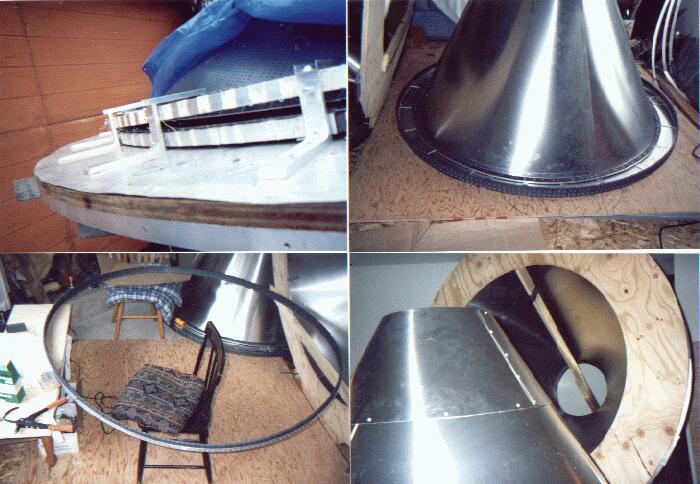
- 2 × 4 × 6 inch magnets were installed at Hamel's direction to give the wings more lift — 18 on one side of the wing and 18 on the underside, each in rejection to the other, held by brackets. Hamel marked them all with a large "N" to prevent mixing them up.
- Stainless steel channel holds the magnets in place; all are standard rectangle magnets from AZ Industries, with the indentations facing the opposing magnets face to face.
- On the wing not visible in the photograph is another row of magnets directly underneath the visible row, also indented side facing indented side in rejection.
- A welded pipe holds a long spike that keeps the wings lined up during assembly. Jones stresses this must be done exactly, "or else the wings magnets will not be in rejection when the top wing is resting above the bottom wing. If the wings go to far from one side to the other the magnets will come into attraction and lock up." The length of this movement is restricted by the pinions.
- There are no perimeter magnets at the very bottom or very top; the two wings between them carry the perimeter magnets.
- All magnets are pop-riveted with stainless steel pop rivets, with a warning to measure three or four times before riveting because the rivets are hard to grind off.
This is the clearest statement in the source of the design's central mechanical idea: the wings are held in a metastable state of magnetic repulsion, and the pinions and balls bound their travel so they cannot slip into attraction and lock.
Tracy Jones's construction work and test reports
Tracy Jones is the most substantive technical voice in the dossier. He built multiple models, including a plexiglass version, and posted dated test reports to a mailing list in September 1999.
Construction notes
Jones describes his own wing construction: the cone is one piece, the horizontal wing surface is one piece, and the top skin required two pieces attached to 3/4-inch plywood because he ran out of material. The bottom has 3/4-inch plywood with a three-inch center hole and air holes around the bottom. Ribs on the horizontal wing are two 1/2-inch aluminum strips joined with a brass screw and glued with 3M glue, acting as stiffeners. The cone stiffener is a round piece of 1/2-inch plywood halfway down the cone with 1/2-inch aluminum strips from there to the horizontal portion. He reports the construction weighed only 34 pounds without magnets.
For the plexiglass models, Jones paid a plastic shop $215 each for four domes with horizontal wings, and $30 each for inner cones. He reports the only advantage was solving "droopy wings" and being able to see inside — "which was pretty much nada." He describes trying to get cigarette smoke to flow downward into the inner cones after forcing it up to the top, to visualize how the air was supposed to flow between the wings. A Canadian machine shop charged $465 (US) for all nine pinions; he used cue balls for the shoulder pinions. He later reports that Dan LaRochelle told him plastic wouldn't work anyway, and that LaRochelle kept the plastic domes while Jones kept some of the magnets for a third HFS.
Jones also describes a drum build: his insert was designed to go inside a 55-gallon drum after cutting 1/2 inch off the top and re-gluing it. Bob Thomas's drum had peek holes cut in the side so he could watch it oscillate; Jones did the same at the top.
The September 1999 test reports
Jones attached a Buick windshield wiper motor with a 1/2-inch aluminum arm to the bottom wing and drove it from a battery charger. His reported observations, in sequence:
Report 1 (start of test): - The bottom wing oscillates about 1/4 inch; the top wing slightly less. - The center floating magnet oscillates about 1/8 to 1/4 inch and does not spin. - A portable phone was disconnected 6 times, the furthest at about 5 feet, lying in a line toward a pole transformer. A power transformer was located approximately 60 feet from the device and estimated 20–25 feet above ground; phone lines ran from the pole to the house, closest distance to the HFS approximately 30 feet. Most interference was toward those lines and pole. - The loudest noise interference occurred along that line of sight and closer to the HFS, increasing until the phone disconnected. - Other interference was noted below the device toward the edge between the phone lines and the HFS, above the edge of the wing where the magnets are. - A TV was hooked up alongside the HFS, level just above the wings, about 4 feet away. Considerable picture interference was noted, but not sound. - The strongest buildup before a phone disconnect occurred when he oscillated the top wing by hand while the bottom wing was motor-driven. - When the motor was turned off, all phone interference ceased. - The strongest detected interference was when the phone was within 2 inches of the skin, and this was constant all the way around the HFS, independent of the location of overhead phone wires or the pole transformer. - The windshield motor had run 75 minutes at the time of writing.
Report 2 (95 minutes): The TV began resonating with the wing movement, with both sound and picture turning off and on.
Report 3 (215 minutes): The motor was still running. Every time the arm touched or moved within the connected joints it sparked, sometimes heavily; this also happened when aluminum touched aluminum, not only steel. The TV showed only large flashes on each spark, with no program. A phone call disconnected when the phone was placed close to the wings. Two more flash photographs were taken.
Report 4 (325 minutes): The tests began at 4:50 PM and it was then 10:15 PM — 5 hours 25 minutes, or 325 minutes. Jones writes that the device "just keeps running and running, but no lift off." He tested whether grounding was responsible by detaching the motor from the structure while still running; sparking continued when the aluminum arm touched the frame or moved while loosely attached to the bottom wing. He rebolted it and ran an alligator clip from the bottom wing and struck the top wing — no spark. Striking the clip to the frame from the top wing — still no spark. Attaching the clip to the frame on the opposite side and striking the bottom wing produced lots of spark, but none from the top wing. Each spark caused intense TV flashing, described as like looking down into the tube itself.
These reports are single-operator, uncontrolled, uninstrumented observations. No force, power, field strength or lift was measured. The reported phenomena — sparking at loose aluminum joints, TV picture interference, phone disconnection near a running electric motor — are consistent with ordinary electrical noise from a brushed DC motor and arcing contacts, though the source does not make that assessment.
The "Tracy's wheels" modification and parts list
Jones later designed a modification he called "Tracy's wheels," intended to provide more surface area for what he considered the cones to be — a capacitor — without making the device bigger, and to be easier to assemble. He replaced the outer rings with a method of centering the rings (wheels) so the magnets remain in balance while moving across one another, insulated the outer skin from the machine, replaced the center floating magnet with two fixed magnets in the hub in rejection to each other, and used soda pop cans filled with concrete as cups and miniature snooker balls (1½-inch hard plastic) as pinions.
The dossier reproduces his materials and cost list, purchased largely at the Boeing Surplus facility in Kent, Washington, with purchasing rules noted (what you see is what you get, no refunds; sharing a purchase with another customer allowed; payment by check or cash; material is new leftover or obsolete; most sold by the pound). The list is a build-cost inventory, not a specification:
| Item | Description | Use | Cost |
|---|---|---|---|
| 1 | 2 × 4 × 12 ft .010 aluminum sheets | Capacitors and inner cones | 22.00 |
| 2 | 1 × 5 × 12 ft .032 aluminum sheet | Capacitors and skin | 56.00 |
| 3 | 80 ft × 3 ft wide thin rubber | Possible insulator | 20.00 |
| 4 | 2' × 8' × 1" acrylic plastic | Framing and spacers | 50.00 |
| 5 | 3 × 2" × 2" × 8' solid nylon | Possible framing alternative | 13.00 |
| 6 | 2 × ¼" × 24" × 16" aluminum plate | Hub rings | 44.80 |
| 7 | 12' × ¼" rubber mat | Possible insulator | 30.00 |
| 8 | 28" × 28" × 1/8" copper plate and remnants | General use | 16.50 |
| 9 | 2 large pieces plywood w/ 1/16" alum coating | Possible structure | 10.00 |
| 10 | 4 × 20' × ½" rubber belt | Insulator for skin | 4.00 |
| 11 | 4' × 8' × 1" honeycomb aluminum sheet | Possible capacitor | 16.50 |
Additional small items: 1" shrink tubing at $0.10/ft, 500 plastic ties ($7.10), 10 drill bits ($0.40 total), two small wire cutters ($1.00). From Tacoma Screw Products: 500 aluminum 1/8 × ½ rivets ($12.30), 500 aluminum 1/8 × 3/8 rivets ($11.48), 400 aluminum 1/8 × ¼ rivets ($7.10), 10 1/8 extra-hard drill bits ($14.00), 100 6-32 brass machine nuts ($3.15), 100 1" 18-8 #8 Phillips head screws ($11.49). From American Games: 12 miniature snooker balls, 1 × ½ inch ($24.00).
Reported failures and the counter-evidence in the source
The dossier contains, in the words of Hamel's own supporters, the strongest evidence against the claim:
- Dan LaRochelle, a core member of the Hameltech Yahoo group who reproduced the schematics, "knows as many as forty people who have tried to build a forty-five-gallon oil drum device based on Hamel's design — all unsuccessfully." He describes a friend who spent $10,000, stayed a month with Hamel, spent his life savings, and whose wife divorced him.
- Steve Hiscock, a magnet enthusiast from Belleville, Ontario, spent between $4,000 and $5,000 over twelve years of active collaboration with Hamel on an eight-inch model that remains incomplete. He estimates he would need another $5,000–$7,000 to build a model two feet wide, which he says is the minimum size at which the motor can function. He frames the decade-long process as spiritually enriching rather than technically successful, and says: "What has to happen is that we need a mathematical model based on a working device, so people can understand and reproduce the idea."
- Tracy Jones reports "pretty much nada" from the plexiglass models and "no lift off" after 325 minutes of running the motor.
- Hamel's own account is that his original first-stage craft flew off unexpectedly and was never seen again — meaning the one claimed success left no recoverable artifact.
- No patent is cited for the device. The source notes that Hamel claims a magnet-related patent application was "misfiled" or lost, and that he caused a scene at the Canadian Patent Office in Gatineau, Quebec, when he found his file missing. No documentation of the application is provided.
The page presents these facts without resolving the contradiction between Hamel's claim of success and the absence of any working device.
Related claims mentioned in the source
Two further claims appear in the dossier but belong to different inventors and must not be attributed to Hamel:
- Perendev Power / Mike Brady. Hiscock notes that inventor Mike Brady of Johannesburg claimed to have developed the first fully functional fuel-less magnetic motor after three decades of research, and that Brady's company Perendev Power licensed a twenty-kilowatt generator model to German and Australian distributors, with a four-megawatt model existing in blueprint form. The source itself notes that without peer-reviewed publication the technology remains on the fringe "even if the products are commercially viable." This is a separate claim by a separate inventor.
- The David Hamel scalar generator. A linked Scribd document describes a device with nested spinning rings said to generate "scalar currents and effects," using unbalanced magnetic fields and spinning discs to generate energy and alter gravity. The document's stated evidence is that photographs of the device appeared fogged. This is a different device from the HFS and rests on a different, equally weak evidentiary basis.
The dossier also mentions Dan Dial, who built an eight-foot "Modified Tesla Coil" and an "Enhancer" device; Jones reports pointing a neon tube toward the coil and watching it light up as it approached, and leaving machines with Dial to study.
Publication history and community
The dossier documents a small literature and support network around Hamel:
- The Granite Man and the Butterfly by Jeanne Manning and Pierre Sinclaire — described as the definitive text, an engaging retelling of the abduction, philosophy and inventions, and the basis for Sinclaire's blueprints.
- Granite Starship by Paul Coulbeck — which Hamel says copied his book, with characters renamed and no credit given.
- The Word Made Manifest Through Sacred Geometry: The Work of David Hamel by Bob Thomas with Hamel — a planned co-authored book following Thomas's two-month stay.
- The Eyewitness series — four VHS titles capturing Hamel ranting, with line drawings explaining the aliens' technology.
- The Hameltech Yahoo Internet group — established 2000, over six hundred members, described as ground zero for the worldwide support network.
- Dan LaRochelle's booklet "The Gods Have Returned" — distributed at the Tesla Conference in Colorado Springs and the Exotic Research Conference in Phoenix; LaRochelle admits to getting a lot of facts wrong in it.
- The Granite Man of Gilmour (2019) — a 15-minute documentary by Matthew Hayes.
LaRochelle first read about Hamel on the KeelyNet alternative-energy website in 1997, which is the direct link between this dossier and the existing wiki page for KeelyNet.
Limitations and unresolved questions
- The source merges two evidentiary registers — Naudin's technical page and press essays — without distinguishing them. The "Gravitomagnetic Drive" framing and 3D designs come from Naudin's site; the abduction narrative comes from journalists.
- No measurement of force, power, field strength, airflow velocity or lift appears anywhere in the source.
- The reported electrical effects (phone disconnection, TV interference, sparking) are not instrumented and are not separated from ordinary motor and arcing noise.
- The claimed mechanism — charged vortical airflow between magnetic rings producing an anti-gravity bubble — is asserted, not derived or tested.
- The one claimed successful flight left no artifact and no witness record beyond Hamel's account.
- The patent claim is undocumented.
- The source's own supporters report forty failed replications and no working device.
Related work in this wiki
- David Hamel — the inventor.
- Hamel Flying Saucer (HFS) — the HFS / Gravitomagnetic Drive device.
- Tracy Jones — the principal builder and test reporter.
- Gravitomagnetic Drive Claim — the claimed mechanism.
- Rejection Magnets — the face-to-face repulsion arrangement.
- Hamel Claims vs. Evidence: The Gravitomagnetic Drive, Forty Failed Replications and the Absence of Measurement — the claim-by-claim assessment.
- KeelyNet BBS — where LaRochelle first encountered Hamel.
- Fuelless Motor Claim — the broader claim class, of which Hamel's is one instance.
Source notes & attribution
- rexresearch.com, "David HAMEL: GravitoMagnetic Drive," https://rexresearch.com/HamelGravitomagneticDrive/HamelGravitomagneticDrive.html (retrieved 2026-09-17).
- Matthew Hayes, "Stuff Stories: A Flying Saucer," NICHE, 2022-07-25, https://niche-canada.org/2022/07/25/stuff-stories-a-flying-saucer/
- Eric Shinn, "Welcome to the Future," Maisonneuve , https://maisonneuve.org/article/welcome-future
- Jean-Louis Naudin, "The Hamel Flying Saucer," http://jnaudin.free.fr/html/dhfsv1.htm and http://jnaudin.free.fr/html/dhpicts.htm
- Tracy Jones, HFS test reports, September 1999 (reproduced in the dossier).
- "The David Hamel Scalar Generator," Scribd, https://www.scribd.com/document/230843435/The-David-Hamel-Scalar-Generator
- "Hyperdimensional Physics: The David Hamel Flying Saucer (HFS) Anti-Gravity Zero Point Field Disc Construction," Scribd, https://www.scribd.com/document/5504468/
- https://rexresearch.com/HamelGravitomagneticDrive/HamelGravitomagneticDrive.html