This source dossier collects material on time crystals — quantum and classical systems whose lowest-energy or steady state involves repetitive motion in time, by analogy with the periodic arrangement of atoms in an ordinary crystal. The page is a curated compilation rather than a single argument: it reproduces the abstract of Frank Wilczek's 2012 Physical Review Letters paper, a long Wikipedia-derived account of the concept and its experimental history, a Max Planck press release and the abstract of the corresponding PRL paper on a magnon space–time crystal, excerpts from two recent PCT patent applications on liquid-crystal space–time crystal devices, and material on hopfions and hopfion crystals.
The dossier performs no verification of its own. Its contents range from peer-reviewed theoretical and experimental physics to encyclopedia summaries, institutional press releases and patent assertions, and the reader should keep those categories distinct. The two patent applications describe classical (soft-matter) space–time crystals, a different regime from the quantum time crystals of Wilczek's original proposal; the dossier does not adjudicate whether the two are the same phenomenon.
What a time crystal is claimed to be
The Wikipedia-derived section defines a time crystal as "a quantum system of particles whose lowest-energy state is one in which the particles are in repetitive motion." Because the system is already in its quantum ground state, it cannot lose energy to the environment and come to rest. The concept is presented as the temporal analogue of ordinary crystallization: atoms in a normal crystal are arranged periodically in space, while in a time crystal the arrangement is periodic in both space and time.
The mechanism invoked is spontaneous symmetry breaking. In an ordinary crystal, continuous spatial translation symmetry is broken and replaced by the lower discrete symmetry of the periodic lattice. Because the laws of physics are also symmetric under continuous translations in time, the 2012 question was whether that temporal symmetry could likewise be broken. The dossier's Wikipedia-derived section attributes the original proposal to Alfred Shapere and Frank Wilczek in 2012, but the same dossier elsewhere cites Wilczek's sole-authored Physical Review Letters paper "Quantum Time Crystals" (2012) and a Max Planck release naming Wilczek as the discoverer; the source does not reconcile these attributions.
The source stresses that a time crystal is not simply any oscillator. A pendulum in a clock is periodic in time, but a time crystal "spontaneously" self-organizes into robust periodic motion, breaking a temporal symmetry rather than being driven into it.
Time-translation symmetry and Noether's theorem
The dossier links the concept to Noether's theorem: symmetries in nature lead directly to conservation laws. Time-translation symmetry — the statement that the laws of nature applying today applied in the past and will apply in the future — implies conservation of energy. This is the reason the thermodynamics discussion below matters: if time-translation symmetry were broken in a way that produced work from nothing, energy conservation would be violated.
The source draws an analogy with broken spatial symmetry in normal crystals, where particle momentum can change through interaction with the lattice (for example in Umklapp processes) while quasimomentum is conserved in a perfect crystal. It lists three characteristics of the analogous broken symmetry: the system has lower symmetry than the underlying arrangement; it exhibits spatial and temporal long-range order; and the order results from interactions among the constituents, which align relative to each other.
Discrete versus continuous time crystals
The dossier's most important technical distinction is between two regimes.
Discrete time crystals (DTCs), also called Floquet time crystals, arise in periodically driven systems. The initial discrete time-translation symmetry t → t + nT with n = 1 is spontaneously broken to a lower discrete symmetry with n > 1, where T is the driving period. The signature is a subharmonic response: the system oscillates at an integer fraction of the drive frequency. The dossier quotes Philip Ball's formulation that DTCs are so named because "their periodicity is a discrete, integer multiple of the driving period."
The source is careful to distinguish DTCs from many other systems that show spontaneous time-translation symmetry breaking but are not time crystals: convection cells, oscillating chemical reactions, aerodynamic flutter, subharmonic response such as the Faraday instability, NMR spin echoes, parametric down-conversion, and period-doubled nonlinear dynamical systems. DTCs are said to be unique in satisfying a strict definition:
- Broken symmetry — the system oscillates with a period longer than the driving force.
- Crypto-equilibrium — the oscillations generate no entropy, and a time-dependent frame exists in which the system is stroboscopically indistinguishable from equilibrium. The dossier notes this is not the case for convection cells, oscillating chemical reactions or aerodynamic flutter.
- Long-range order — the oscillations are in phase (synchronized) over arbitrarily long distances and times.
Additionally, the broken symmetry is said to result from many-body interactions — a collective process, as in spatial crystals — which the dossier says is not the case for NMR spin echoes. These properties are presented as making DTCs a novel type or phase of nonequilibrium matter.
Continuous time crystals (CTCs) arise under continuous driving. Instead of a subharmonic response, the system shows an oscillation with an intrinsic frequency and a time phase taking random values between 0 and 2π, as expected for spontaneous breaking of continuous time-translation symmetry.
Thermodynamics
The dossier states explicitly that time crystals do not violate the laws of thermodynamics: energy in the overall system is conserved, such a crystal does not spontaneously convert thermal energy into mechanical work, and it cannot serve as a perpetual store of work. It may, however, "change perpetually in a fixed pattern in time for as long as the system can be maintained."
The source uses the phrase "motion without energy" — the apparent motion does not represent conventional kinetic energy. It also states that a time crystal's entropy stays constant over time, which "barely satisfies the second law of thermodynamics by not decreasing." This phrasing is potentially misleading and should be read alongside the explicit statement that no work is extracted and no thermal energy is converted.
The no-go debate
The dossier records a genuine theoretical controversy. In response to Wilczek and to Xiang Zhang's 2013 rotating-ring proposal, Patrick Bruno (European Synchrotron Radiation Facility) and Masaki Oshikawa (University of Tokyo) published articles stating that space–time crystals were impossible. Subsequent work developed more precise definitions of time-translation symmetry breaking, leading to the Watanabe–Oshikawa no-go statement that quantum space–time crystals in equilibrium are not possible.
The source then notes that later work restricted rather than overturned this result: strictly speaking, Watanabe and Oshikawa showed that long-range order in both space and time is not possible in equilibrium, but breaking of time-translation symmetry alone is still possible. This distinction — a restriction of scope rather than a refutation — is important and is preserved here.
A theoretical exception is attributed to Valerii Kozin and Oleksandr Kyriienko (2019), who showed that a permanent quantum time crystal can exist as an isolated system if the system contains unusual long-range multiparticle interactions. The original no-go argument holds only for typical short-range fields decaying as r^−α for some α > 0. Kozin and Kyriienko analyzed a spin-1/2 many-body Hamiltonian with long-range multispin interactions and showed it broke continuous time-translational symmetry, with certain spin correlations oscillating in time despite the system being closed and in a ground energy state. The dossier itself flags that demonstrating such a system in practice "might be prohibitively difficult," and that concerns about the physicality of the long-range nature of the model have been raised.
Experimental timeline as reported
The dossier assembles a chronology from the Wikipedia-derived account and the experiments section. Dates in the two accounts do not always agree; the source does not reconcile them.
| Year | Group / platform | Reported result |
|---|---|---|
| 2012 | Shapere and Wilczek | Theoretical proposal of the quantized time crystal |
| 2013 | Xiang Zhang, UC Berkeley | Proposal: constantly rotating ring of charged ions |
| 2014 | Krzysztof Sacha, Jagiellonian University, Kraków | Predicted discrete time crystals in a periodically driven ultracold atomic cloud "bouncing on an oscillating mirror" |
| 2016 | Princeton and Santa Barbara groups; Norman Yao, Berkeley | Independent suggestions that periodically driven quantum spin systems could show DTC behaviour |
| 2016–2017 | Christopher Monroe (University of Maryland); Mikhail Lukin (Harvard) | Two independent DTC realizations, both published in the same issue of Nature in March 2017 |
| 2018 | Aalto University | Time quasicrystal and its phase transition to a continuous time crystal in superfluid helium-3 at 0.0001 K |
| 2019 | Tilman Esslinger, ETH Zurich | Limit-cycle dynamics observed; robustness against perturbations and the spontaneous character of the symmetry breaking were not addressed |
| 2020 | Aalto University (Nature Materials, 17 August 2020) | Observation of interactions and flow of constituent particles between two time crystals |
| 2021 (February) | Max Planck Institute for Intelligent Systems | Magnon space–time crystal at room temperature, imaged by STXM |
| 2021 (July) | Andreas Hemmerich, University of Hamburg | First dissipative time crystal in an open system (ultracold atoms in an optical cavity) |
| 2021 (November) | Google + universities, Sycamore processor | Discrete time crystal on a 20-qubit chip using many-body localization |
| 2021 (June, November) | University of Maryland; QuTech (TU Delft / TNO) | "Virtual" Floquet time crystals on quantum simulators |
| 2022 (February) | UC Riverside | All-optical dissipative time crystal at room temperature, using injection locking in a microresonator |
| 2022 (March) | University of Melbourne | Time crystals on IBM Manhattan and Brooklyn processors, 57 qubits total |
| 2022 (June) | Hans Keßler and Andreas Hemmerich, University of Hamburg | First experimental observation of a continuous time crystal |
| 2024 (February) | TU Dortmund University | Indium gallium arsenide time crystal lasting 40 minutes |
| 2024 (May) | Alejandro Fainstein (Instituto Balseiro / Centro Atómico Bariloche) and Paulo Santos (Paul Drude Institute) | Solid-state continuous time crystal in a driven-dissipative exciton–polariton condensate |
| 2025 (March) | TU Dortmund University | Nonlinear behaviour, Farey tree sequence and devil's staircase in a semiconductor time crystal |
The dossier notes a discrepancy: the Wikipedia-derived account says discrete time crystals were observed "as early as 2016," while the experiments section dates the Monroe and Lukin reports to 2016–2017 with publication in March 2017. The source does not resolve this.
The Monroe trapped-ion experiment
The dossier describes Monroe's team trapping a chain of ¹⁷¹Yb⁺ ions in a Paul trap confined by radio-frequency electromagnetic fields. One of two spin states was selected by a pair of laser beams, pulsed with a shape controlled by an acousto-optic modulator using a Tukey window "to avoid too much energy at the wrong optical frequency." The hyperfine electron states |F = 0, m_F = 0⟩ and |F = 1, m_F = 0⟩ are separated by 12.642831 GHz. Ten Doppler-cooled ions were placed in a line 0.025 mm long and coupled together.
The researchers observed a subharmonic oscillation of the drive. The experiment showed "rigidity" of the time crystal: the oscillation frequency remained unchanged even when the crystal was perturbed, and it gained a frequency of its own rather than only following the drive. Once the perturbation or vibration frequency grew too strong, the time crystal "melted" and lost the subharmonic oscillation, returning to moving only with the induced frequency.
The Lukin nitrogen-vacancy experiment
Lukin's group used a diamond crystal doped with a high concentration of nitrogen-vacancy centers, which have strong dipole–dipole coupling and relatively long-lived spin coherence. The strongly interacting dipolar spin system was driven with microwave fields, and the ensemble spin state was read out with an optical (laser) field. The spin polarization was observed to evolve at half the frequency of the microwave drive, with oscillations persisting for over 100 cycles. This subharmonic response is described as a signature of time-crystalline order.
The Hamburg continuous time crystal
In the June 2022 experiment, the drive (pump laser) was operated continuously, thus respecting continuous time-translation symmetry. The system consisted of a Bose–Einstein condensate in an optical cavity, pumped with an optical standing wave oriented perpendicularly to the cavity axis, in a superradiant phase localizing at two bistable ground states between which it oscillated. The observed limit-cycle oscillations were shown to be robust against perturbations of technical or fundamental character, including quantum noise and dissipation-associated fluctuations.
The Fainstein–Santos exciton–polariton platform
The platform was a (Ga,Al)As semiconductor microcavity with GaAs quantum wells in the spacer, pumped by a non-resonant continuous-wave laser that created an incoherent particle bath relaxing into a Bose–Einstein condensate of lower polaritons. For increasing power of a non-circularly polarized excitation, the condensate pseudo-spin spontaneously underwent Larmor-like precession without an external magnetic field or pulsed drive — a signature of a continuous time crystal. The precession frequency could be controlled by excitation power and locked to self-sustained coherent breathing vibrations of the microcavity at about 20 GHz. At higher drive powers the system exhibited period doubling relative to the phonon frequency, realizing a discrete time crystal phase under continuous excitation in the same device.
The TU Dortmund long-lived crystal
A team at TU Dortmund University built a time crystal from indium gallium arsenide that lasted 40 minutes — nearly 10 million times longer than the previous record of around 5 milliseconds. The lack of any decay suggested the crystal could have lasted longer, "at least a few hours, perhaps even longer." In March 2025 the same group reported complex nonlinear behaviour in a semiconductor-based time crystal of the same material, uncovering transitions from synchronized oscillations to chaotic motion under periodic laser driving, with structures such as the Farey tree sequence and the devil's staircase.
The magnon space–time crystal (Max Planck, 2021)
The dossier reproduces a Max Planck press release and the abstract of Phys. Rev. Lett. 126, 057201 (published 3 February 2021), "Real-Space Observation of Magnon Interaction with Driven Space-Time Crystals," by Nick Träger and co-authors.
The abstract states that the concept of space–time crystals (STC) — translational symmetry breaking in time and space — was recently proposed and experimentally demonstrated for quantum systems, and that this work transfers the concept to magnons, demonstrating a driven STC at room temperature. The STC is realized by strong homogeneous microwave pumping of a micron-sized permalloy (Py) stripe and is directly imaged by scanning transmission X-ray microscopy (STXM). Micromagnetic simulations were adapted to model the experimental findings. Beyond generating the STC, the authors observed the formation of a magnonic band structure due to back-folding of modes at the STC's Brillouin zone boundaries, and interactions of magnons with the STC appearing as lattice scattering, generating ultrashort spin waves down to 100-nm wavelengths that cannot be described by classical dispersion relations for linear spin-wave excitation.
The press release adds detail. The German–Polish collaboration involved the Max Planck Institute for Intelligent Systems in Stuttgart, Adam Mickiewicz University and the Polish Academy of Sciences in Poznań. The imaging instrument was the scanning transmission X-ray microscope Maxymus at BESSY II at Helmholtz Zentrum Berlin. Doctoral student Nick Träger and Pawel Gruszecki are named as first authors; Gisela Schütz heads the Modern Magnetic Systems Department; Joachim Gräfe is last author.
In the experiment, a strip of magnetic material was placed on a microscopic antenna through which a radio-frequency current was sent. The microwave field triggered an oscillating magnetic field that stimulated magnons in the strip. Magnetic waves migrated into the strip from left and right, spontaneously condensing into a recurring pattern in space and time. The press release states that, unlike trivial standing waves, this pattern formed before the two converging waves could meet and interfere, and that the pattern, which regularly disappears and reappears on its own, "must therefore be a quantum effect."
Schütz is quoted on the X-ray camera's resolution — "20 times better than the best light microscope" — and its ability to operate at up to 40 billion frames per second with high sensitivity to magnetic phenomena. Gruszecki states that the crystal condenses at room temperature and that particles can interact with it, unlike in an isolated system, and that it reached a size that could be used. Gräfe concludes that adding a temporal dimension to crystals adds "another dimension of possible applications," with potential for communication, radar or imaging technology.
The dossier also includes a Physics synopsis link ("Making Space-Time Crystals Using Magnons") and a research-square preprint on confined magnon modes and anisotropic exchange interaction in ultrathin Co films by Ying-Jiun Chen.
Patent WO2026174186 — Discrete space–time crystal device
The dossier reproduces excerpts from WO2026174186, "Discrete Space-Time Crystal Device and Method of Forming Same." The patent claims classical discrete space–time crystals (DSTCs) in a chiral nematic liquid crystal (LC) system. The excerpts are patent assertions, not independent validation.
Key claims and embodiment parameters, preserved as stated:
- By applying a Floquet electrical signal to a chiral nematic LC sandwiched between parallel electrodes, both the spatial and temporal symmetries of the emergent LC structure revealed by optical images can be broken discretely and spontaneously, and the internal temporal periodicity of the system doubles in relation to the external drive.
- Both 1+1-dimensional (1+1D) and 2+1-dimensional (2+1D) discrete space–time crystals are observed, with the discrete time crystallization phases depending on temperature and external driving schemes, illustrated by a phase diagram.
- Rigidity (robustness) of the time crystals against temporal perturbation and spatial defects has been verified, with the DSTC phase maintaining order locally for a remarkably long time. Defects and their dynamics within the DSTCs are also observed.
- A device includes a first substrate with a first electrical contact, a second substrate with a second electrical contact, a doped chiral nematic liquid crystal material between them, and a power supply coupled to one or more of the contacts. The power supply applies a signal having a first period, and in response the period of an optical signal emitted from the device is an integer multiple of the first period.
- The doped chiral nematic liquid crystal material comprises an ionic dopant — a solvable ionic dopant that increases the electrical instability of the nematic liquid crystal material. The dopant can be cetyltrimethylammonium bromide, other cetyl alkyl ammonium compounds, or the like.
- Ionic dopant concentration: greater than 0 and less than 0.2 wt%, or greater than 0.05 wt% and less than 0.2 wt%.
- LC materials: 5CB (4-Cyano-4'-pentylbiphenyl) and/or E7 (a mixture of 4-Cyano-4'-pentylbiphenyl, 4'-Heptyl-4-biphenylcarbonitrile, 4'-Octyloxy-4-biphenylcarbonitrile, and 4-Cyano-4'-Pentylterphenyl).
- The patent attributes the period-doubling effect in 1+1D DSTCs to "topological Majorana-like quasiparticle features," where periodic inter-transformations of co-existing topological solitons and disclinations emerge in response to external stimuli. The different states of these topological objects are described as the particle and anti-particle states of the observed Majorana-like quasiparticles — "a classical analogue of Majorana particles."
- A candidate for a fractional discrete space–time crystal is observed when changing the sample thickness.
- The patent argues that the classical DSTC's rigidity allows maintaining order locally over times much longer than discrete time crystals in quantum systems, because although the classical system cannot benefit from many-body localization, there is no quantum coherence and the relative noise from thermal fluctuations is much smaller for soft matter systems.
- Proposed applications include reconfigurable beam deflectors, steerers, and lasing elements.
The patent describes sample preparation by sandwiching a chiral nematic LC between two electrically conductive transparent substrates, doped with ionic substances. The spatially varying optical phase retardation pattern is produced by the LC's complex director orientation driven by the field, revealed by inserting an additional first-order full-wave retardation plate. Alternating blue and purple spatial regions in the figures indicate spatial variations in the LC's three-dimensional structures represented by the locally averaged molecular orientation direction n (the "director").
Patent WO2026183497 — Continuous space–time crystal device
The dossier reproduces excerpts from WO2026183497, "Continuous Space-Time Crystal Device and Method of Forming and Using Same." Embodiments relate to devices exhibiting continuous space–time crystal behavior.
Key claims and embodiment parameters, preserved as stated:
- A device includes a first substrate, a second substrate, a photo-responsive dye layer, and a nematic liquid crystal material between the substrates. In response to applied light, a continuous space–time crystallization phase forms within the nematic liquid crystal material.
- The nematic liquid crystal material comprises one or more of 5CB (4-Cyano-4'-pentylbiphenyl) or E7 (a mixture of 4-Cyano-4'-pentylbiphenyl, 4'-Heptyl-4-biphenylcarbonitrile, 4'-Octyloxy-4-biphenylcarbonitrile and 4-Cyano-4'-Pentylterphenyl).
- The photo-responsive dye layer is coated onto an inner surface of one or both substrates and can be an azo compound, such as azobenzene or 2-(4-dimethylamino-phenylazo)-N-(3-triethoxysilane-propyl)-benzamide (dMR). The layer is sensitive to certain (e.g., visible) wavelengths and insensitive to others. The applied light can be ambient light, light from a light source, and/or a polarized light source.
- The device can exhibit 0+1D, 1+1D, 2+1D, or 3+1D continuous space–time crystal behavior.
- An output of light from the device depends on the wavelength(s) and polarization of an input light. The nematic liquid crystal material can include anisotropic particles: 4-Cyano-4'-pentylbiphenyl having a first dimension of between about 0.1 and 10 nm (or about 0.5 nm) and a second dimension of between about 0.5 and 5 nm (or about 2 nm), with the second dimension at least about 3 to about 10 times greater than the first.
- The device can form part of a telecommunications device, cryptography device, optical device, photonic time crystal generator, anti-counterfeiting system, or barcode device.
Sample preparation (as stated in the patent)
The glass substrates were coated with the photo-responsive material dMR, which is sensitive to blue and violet light and insensitive to red light. To coat a monolayer of dMR on the glass surfaces, the glass plates were submerged in a 1 wt% solution of dMR in toluene at 45 °C. After a 90-minute submersion, the dMR molecules are bonded to the glass surfaces; excess dMR was washed away by a toluene rinse, followed by blowing with dry nitrogen and curing at 115 °C for 2 hours. The LC cells were constructed using two glass substrates coated with monolayers of dMR, where the cell thickness d = 2–4 µm is defined by glass spheres mixed with a methanol-diluted epoxy. Once the epoxy cured, the cell was filled via capillary forces with nematic 4-cyano-4'-pentylbiphenyl (5CB, EM Chemicals).
Measurement and analysis (as stated in the patent)
To obtain the time order of CSTCs, the patent calculates the correlation function G in the time coordinate. For crystals, the spatial correlation function G(r) is a constant; for smectic liquid crystals, G(r) decays as ~r^(−η) (η < 0.15) along the smectic layers, which is a quasi-long-range order. For CSTCs, the normalized digital signal of each pixel is measured at different times, and the correlation function is calculated with 2200 spatial pixels and 9000 temporal frames, showing a quasi-long-range order in time.
Relative time phases were measured from 100 experimental realizations. In each realization, the driving light is first blocked with a red colour filter (allowing only red light to pass). The red filter is then removed and the CSTC spontaneously emerges. After a time interval Δt = 60 s, light signals from the recorded video are measured and the phase calculated using the Fast Fourier Transform analysis function in MATLAB (MathWorks).
Claimed applications
The patent describes a "time watermark" that can be fabricated at low cost: a 1 cm × 1 cm × 2 µm sample requires only ~2 × 10⁻¹⁴ g of LC and a surface monolayer with <10⁻¹⁴ g of the azobenzene dye, sandwiched between glass or other surfaces. Due to spontaneous temporal symmetry breaking, the time crystals can be exploited in pseudorandom number generators. Combining multiple CSTCs generates unique, fingerprint-like states corresponding to spatiotemporal topological soliton arrays, each time they emerge, maintaining order for a remarkably long time. The phases of CSTCs can be tuned by smoothly switching the driving light intensity, allowing creation of a 2+1D barcode by superimposing multiple CSTCs. The patent states that a 2D barcode can store over 100 times more bits than a 1D barcode, and that the capacity of storing information with proper data coding in higher-dimensional barcodes like 2+1D is effectively unbounded due to the extra temporal coordinate (>100,000 bits per second). The intrinsic robustness of the space–time order is claimed to further enhance error correction capabilities of 2+1D barcodes.
For anti-counterfeiting, the temporal periodicity of CSTCs can be used as keys in cryptographic systems. With two CSTCs having temporal periodicities T₁ and T₂ (assuming T₁ < T₂), an identical spatial pattern only recurs after a time interval of (T₁ × T₂)/(T₂ − T₁), which could be used to check authenticity. CSTCs with different temporal periodicities can be introduced by incorporating pre-programmed light intensity filters. The entire system may display disorder-like spatiotemporal behavior, but within each CSTC the time-crystalline order with a specific temporal periodicity can be maintained for a long time. The entire fingerprint-like CSTC state can be precisely predicted if the information about the pre-programmed light intensity filters (the system's keys) is known.
Related patents listed
The dossier lists six related Chinese patents without excerpts:
- CN122326245 — Cholesteric phase and twisted nematic phase liquid crystal for terahertz wave band and preparation method
- CN121801578 — Tilted spiral cholesteric liquid crystal composition and liquid crystal display device comprising same
- CN121005792 — Left-handed torsion II type cellulose nanocrystal and right-handed chiral photon self-supporting transparent film
- CN121299973 — Method for regulating and controlling beam in-plane deflection through chiral liquid crystal topological solitons with 1/2 topological defects
- CN120295020 — Electronic control skyrmion motion method based on chiral nematic liquid crystal
- CN120172947 — Luminescent chiral agent, preparation method thereof and chiral nematic liquid crystal material
Floquet theory
The dossier includes a Wikipedia-derived explanation of Floquet theory, the mathematical framework for periodically driven systems. Given a system in which the forces are periodic — such as a pendulum under a periodic driving force, or an oscillating circuit driven by alternating current — the overall behavior is not necessarily fully periodic. The example given is a child being pushed on a swing: although the motion is driven by regular, periodic pushes, the swing can gradually reach greater heights while still oscillating to and fro, producing a combination of underlying periodicity and growth.
Floquet theory's essential insight is that the solution can be decomposed into two parts: a periodic component reflecting the repeated motion, and an exponential factor reflecting growth, decay, or neutral stability. This decomposition allows analysis of long-term behavior and stability in time-periodic systems.
The dossier also lists two related Floquet research items: a paper on the chiral anomaly in a (1+1)-dimensional Floquet system under high-frequency expansion using the van Vleck expansion, and a paper by Alexander Stegmaier et al. on topological edge states in the frequency dimension realized with Floquet electrical circuits, which builds Floquet-driven capacitive circuit networks to realize topological states of matter in the frequency domain. A further item, by Qian Ma et al., covers Floquet topological states in time-varying metasurfaces.
Hopfions and hopfion crystals
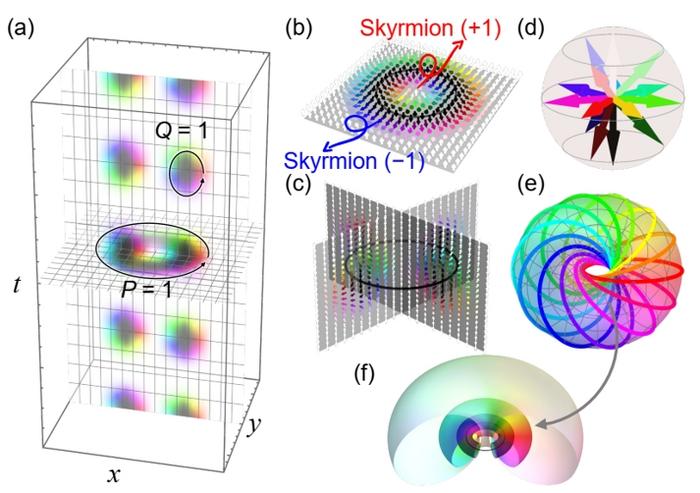
The dossier's final section covers hopfions and hopfion crystals, drawing on a EurekAlert press release and the arXiv paper "Construction of Hopfion Crystals" by Wen-Tao Hou et al. (arXiv 2504.03981).
The Wikipedia-derived definition states that a hopfion is a topological soliton: a stable three-dimensional localized configuration of a three-component field n = (n_x, n_y, n_z) of unit length with a knotted topological structure. They are the three-dimensional counterparts of 2D skyrmions. The soliton is mobile and stable — protected from decay by an energy barrier — and can be deformed but always conserves an integer Hopf topological invariant. It is named after the German mathematician Heinz Hopf.
The EurekAlert account describes an internationally joint research group between Singapore and Japan that unveiled a blueprint for arranging knot-like patterns of light into repeatable crystals extending across both space and time. The work lays out how to build and control hopfion lattices using structured beams at two different colors, pointing to future systems for dense, robust information processing in photonics. Hopfions had previously been produced mainly as isolated objects; the authors show how to assemble them into ordered arrays that repeat periodically, much like atoms in a crystal, but with the pattern repeating in time as well as space.
Starting from a one-dimensional chain, the researchers describe how to sculpt higher-order versions whose topological strength can be dialed up or down. In their scheme, one can tune an integer counting how many times the internal loops wind, and even flip its sign by swapping the two wavelengths. In simulations, the resulting fields show near-ideal topological quality when integrated over a full period.
Beyond time-only repetition, the paper outlines a route to true three-dimensional hopfion crystals: a far-field lattice formed by an array of tiny emitters with tailored phase and polarization, all driven at two close colors. The lattice naturally divides into subcells with opposite local topology while preserving a clean, alternating pattern across the whole structure. The authors sketch practical layouts using dipole arrays, grating couplers, or microwave antennas. Unlike earlier optical hopfions that relied on beam diffraction along the propagation axis, this design works in the joint space–time domain at a fixed plane, with periodic beating doing the heavy lifting. The team also discusses when the structures can "fly" some distance while maintaining their topology, and when diffraction undermines their integrity.
The arXiv abstract states that despite extensive studies of isolated hopfions, a framework for constructing spatially ordered arrays of hopfions — hopfion crystals — had been lacking. The authors present a systematic approach for generating hopfion crystals with cubic symmetry by combining the Hopf map with rational mapping techniques. By superposing helical waves in ℝ⁴, they construct hopfion crystals with tunable Hopf indices and controllable topology. They demonstrate simple cubic, face-centered cubic, and body-centered cubic hopfion crystals, and extend the framework to create crystals of more complex topological structures, including axially symmetric tori, torus links, and torus knots with higher Hopf indices.
Limitations and unresolved questions
- Mixed evidence tiers. The dossier combines peer-reviewed theoretical and experimental physics (PRL, Nature, Nature Materials) with Wikipedia summaries, institutional press releases, and patent excerpts. The physics claims are attributed to named papers and groups; the patent claims are patent assertions, not independent validation. The dossier itself performs no verification.
- Date discrepancy. The Wikipedia-derived account says discrete time crystals were observed "as early as 2016," while the experiments section dates the Monroe and Lukin reports to 2016–2017 with publication in March 2017. The source does not reconcile this.
- Quantum versus classical regime. The two patents claim classical (non-quantum) time crystals in liquid crystals, a different regime from the quantum time crystals of Wilczek's original proposal. The source does not adjudicate whether these are the same phenomenon.
- No-go status. The Watanabe–Oshikawa result is presented as restricted rather than overturned. The Kozin–Kyriienko isolated-system exception is presented as theoretically possible but possibly prohibitively difficult to demonstrate, with concerns raised about the physicality of the long-range model.
- Thermodynamics phrasing. The source asserts time crystals do not violate the second law, but also uses phrases such as "motion without energy" and "perpetual change." These should be read alongside the explicit statements that energy is conserved, no thermal energy is converted to work, and no perpetual store of work exists.
- Definitional boundary. The source distinguishes DTCs from convection cells, oscillating chemical reactions, aerodynamic flutter, NMR spin echoes, parametric down-conversion, and period-doubled nonlinear systems. This distinction is central and should be preserved when citing the dossier.
Related work and cross-references
The dossier connects to the wiki's physics, energy, mechanics, computing and chemistry guides. The thermodynamics discussion is a useful counterpoint to perpetual-motion-adjacent claims elsewhere in the archive. The two WO patents are patent assertions and connect directly to Patent as Evidence. The dossier is another the source archive collection and fits the archive's pattern of mixing peer-reviewed papers, encyclopedia summaries, press releases and patents, as described in comparisons/source-types.
Source notes & attribution
- Frank Wilczek, "Quantum Time Crystals," Phys. Rev. Lett. 109 , 160401, published 15 October 2012. DOI: 10.1103/PhysRevLett.109.160401.
- Wikipedia, "Time crystal." https://en.wikipedia.org/wiki/Time_crystal
- Max-Planck-Gesellschaft, "See World's First Video of a Space-Time Crystal," 24 February 2021. https://scitechdaily.com/see-worlds-first-video-of-a-space-time-crystal/
- Max Planck Society, "World's first video recording of a space-time crystal." https://www.mpg.de/16401528/world-s-first-video-recording-of-a-space-time-crystal
- Nick Träger et al., "Real-Space Observation of Magnon Interaction with Driven Space-Time Crystals," Phys. Rev. Lett. 126 , 057201, published 3 February 2021. https://pubmed.ncbi.nlm.nih.gov/33605763/
- WO2026174186, "Discrete Space-Time Crystal Device and Method of Forming Same."
- WO2026183497, "Continuous Space-Time Crystal Device and Method of Forming and Using Same."
- Wikipedia, "Floquet theory." https://en.wikipedia.org/wiki/Floquet_theory
- EurekAlert, "Scientists discovered hopfion crystals – which are flying in spacetime." https://www.eurekalert.org/news-releases/1096046
- Wikipedia, "Hopfion." https://en.wikipedia.org/wiki/Hopfion
- Wen-Tao Hou et al., "Construction of Hopfion Crystals," arXiv 2504.03981. https://arxiv.org/html/2504.03981v1
- Source dossier: https://rexresearch.com/WilczekTimeCrystals/WILCZEKTimeCrystals.html
- https://rexresearch.com/WilczekTimeCrystals/WILCZEKTimeCrystals.html