What this source is
This is a short source archive page collecting material about Pellegrino Ernetti (16 October 1925 – 8 April 1994), an Italian Catholic Benedictine priest, musicologist and self-described physicist, and about the Chronovisor — a device he claimed could observe and record past events. The page is a compilation rather than a technical report: it reproduces a Wikipedia-derived biographical summary, links a book by Peter Krassa, displays three images, and lists three video links (Discovery UK, The Why Files, and Jimmy Akin's Mysterious World).
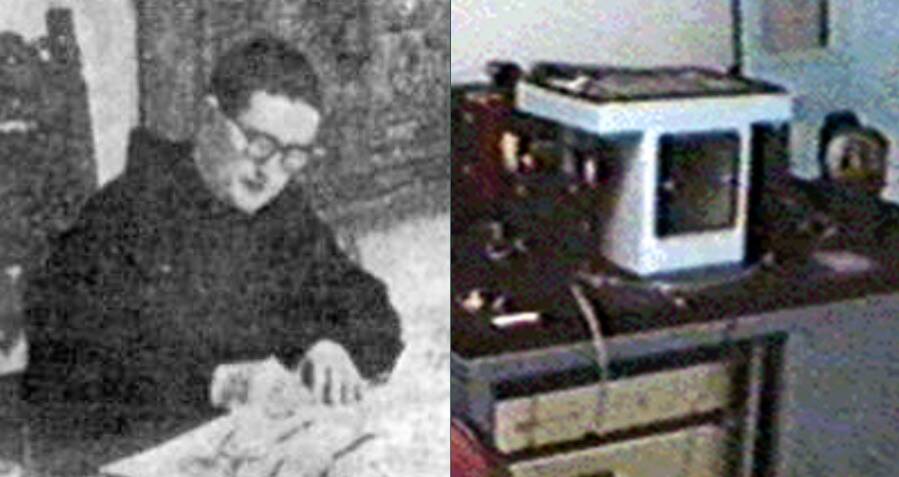
The page contains no schematic, no measurement, no instrument description, and no primary documentation. The mechanism of the claimed device is never explained — only asserted. It is a press-and-narrative account, and the article below treats it as such.
Who Ernetti was
The source describes Ernetti as a Benedictine priest who specialised in Gregorian chant and archaic music, worked as a lecturer, choir director and author, and conducted laboratory research on sound. That musical and acoustic background is the only technical credential the source supplies. It is worth noting that the source's own framing places his notoriety not in musicology but in the claim that he "invented a device that could observe past events including the Crucifixion of Jesus Christ and a speech by Cicero."
The 1972 Chronovisor claim
In 1972, Ernetti claimed to have created a time machine capable of observing and recording past events. According to the source, he said the "Chronovisor" had been developed over several years through the collaboration of twelve scientists, three of whom he identified by name:
- Pellegrino Ernetti himself,
- Agostino Gemelli, and
- Wernher von Braun.
The remaining nine collaborators are unnamed in the source. No documentation of the collaboration, no institutional affiliation, and no working notes are cited.
Specific observations Ernetti claimed
Ernetti asserted that he had used the Chronovisor to:
- observe the Crucifixion of Jesus Christ;
- view a performance of the lost Latin tragedy Thyestes by the Roman poet Quintus Ennius;
- listen to a speech by the Roman politician and orator Cicero.
The physical "evidence" and its identification
Ernetti presented two items as material support for the claim:
- a photograph he said depicted Jesus Christ during the Crucifixion;
- a text he said reproduced the lost play Thyestes.
The source reports that both were subsequently discredited:
- The photograph was identified as an image of a wooden sculpture of Christ by the sculptor Coullaut Valera — that is, a photograph of a statue, not a record of a past event.
- The text is regarded by scholars as a modern composition, likely created by Ernetti himself.
The source states plainly that Ernetti's claims for the Chronovisor are "generally regarded as pseudoscientific."
The 1952 tape-recorder origin anecdote
The source attributes the origin story of the Chronovisor project to Peter Krassa's book, Father Ernetti's Chronovisor: The Creation and Disappearance of the World's First Time Machine. As recounted there:
On 15 September 1952, Ernetti was working with Agostino Gemelli on a tape recorder that frequently broke down. Gemelli had for years silently addressed his deceased father for guidance during difficult moments, though he believed he had never received a conscious reply. Frustrated, Gemelli called out to his father for help. When the recording was replayed after repair, both men heard a voice they identified as Gemelli's father saying:
"Of course I shall help you. I'm always with you."
Gemelli was distressed; Ernetti continued the experiment. On repeating the procedure, the recorder allegedly captured a clearer voice:
"But, Zucchini, it is clear, don't you know it is I?"
The nickname "Zucchini," the story holds, was a childhood name known only to Gemelli and his father. The source characterises this episode as "an early account of anomalous voice phenomena" — that is, it is presented as narrative, not as verified fact.
The Pius XII element
The two men, per the story, brought the matter to Pope Pius XII, who assured them that their discovery was purely scientific and could reinforce people's belief in an afterlife. The source offers no document, date, or witness for this audience.
Evidence status
The source is internally split: it reports the claims and, in the same breath, reports their debunking. It does not resolve the tension — it presents both as the record. The evidentiary position is therefore:
| Claim | Status per the source |
|---|---|
| Chronovisor observes past events | Asserted by Ernetti; no mechanism, no measurement |
| Twelve-scientist collaboration | Asserted; only three named; no documentation |
| Photograph of the Crucifixion | Identified as a photo of a wooden sculpture by Coullaut Valera |
| Text of Ennius's Thyestes | Regarded by scholars as a modern composition, likely by Ernetti |
| 1952 tape-recorder voice | Narrative account of anomalous voice phenomena; unverified |
| Pius XII endorsement | Anecdotal; no supporting document |
| Overall classification | "Generally regarded as pseudoscientific" |
Limitations and unresolved questions
- No technical content. The source never describes what the Chronovisor was supposed to be, how it was supposed to work, or what physical principle it invoked. Nothing in this source can answer that question.
- Unverifiable collaborators. The twelve-scientist claim cannot be checked from this source. The three named collaborators are not documented elsewhere in the corpus. Wernher von Braun was a rocket engineer, not a time-viewing researcher, and no independent documentation of his involvement is offered. Agostino Gemelli died in 1959, which constrains any claimed collaboration timeline; the source does not address this.
- Discredited physical evidence. The only two physical exhibits were identified as non-genuine, which directly undercuts the central claim.
- Asserted linkage. The relationship between the 1952 voice anecdote and the 1972 Chronovisor claim is asserted by Krassa but not independently corroborated.
Related work in this corpus
The Chronovisor belongs to a recurring pattern in this archive: extraordinary device claims presented without measurement, later critiqued. The energy-domain examples include comparison-boyce-hho-claims-vs-evidence, comparison-ammann-claims-vs-evidence, comparison-alperen-claims-vs-evidence and comparison-garrett-carburetor-claims-vs-thermodynamic-critique, all of which share the structure of an inventor's assertion set against an absence of instrumentation. The Chronovisor extends that pattern into a non-energy domain — time-viewing rather than energy generation — and is treated here as a claim category rather than a demonstrated technology. See Chronovisor Claim (Time-Viewing / Retrocognition Devices) and Chronovisor Claims vs. Evidence: The Photograph, the Text and the Pseudoscience Classification.
The wiki's existing coverage of fringe-science historiography and its debunking — for example low-energy-nuclear-reactions and the Krivit/plagiarism material — provides the closest methodological analogue: a claim is recorded, its provenance traced, and its evidentiary status stated without endorsing it.
Source notes & attribution
- Rex Research archive page: Fr. Pellegrino ERNETTI Chronovisor — Books & Videos , https://rexresearch.com/ErnettiChronovisor/ErnettiChronivisor.html (retrieved 2026-09-17).
- Wikipedia, Pellegrino Ernetti , https://en.wikipedia.org/wiki/Pellegrino_Ernetti (as reproduced by the source).
- Peter Krassa, Father Ernetti's Chronovisor: The Creation and Disappearance of the World's First Time Machine (book linked by the source).
- Video links listed by the source (peripheral, not treated as evidence): Discovery UK, The Chronovisor: The Truth Behind this Secret Time Machine ; The Why Files, Chronovisor: The Vatican's Secret Device to See Through Time ; Jimmy Akin's Mysterious World, The Chronovisor (Vatican, Time Travel, Time Viewer) .
- https://rexresearch.com/ErnettiChronovisor/ErnettiChronivisor.html