The Dean drive was a mechanical device built and promoted by the inventor Norman Lorimer Dean (1902–1972), who claimed it was a reactionless drive: a machine able to produce a one-way force in free space, which would contradict Newton's third law of motion. What is known about it comes from magazine reports of the 1960s and 1970s, Dean's two patents and later assessments by physicists and NASA authors. As summarised in secondary accounts, they describe machines shown only in private, never independently analysed, and judged by later analysts to have most likely moved by friction against whatever they sat on.
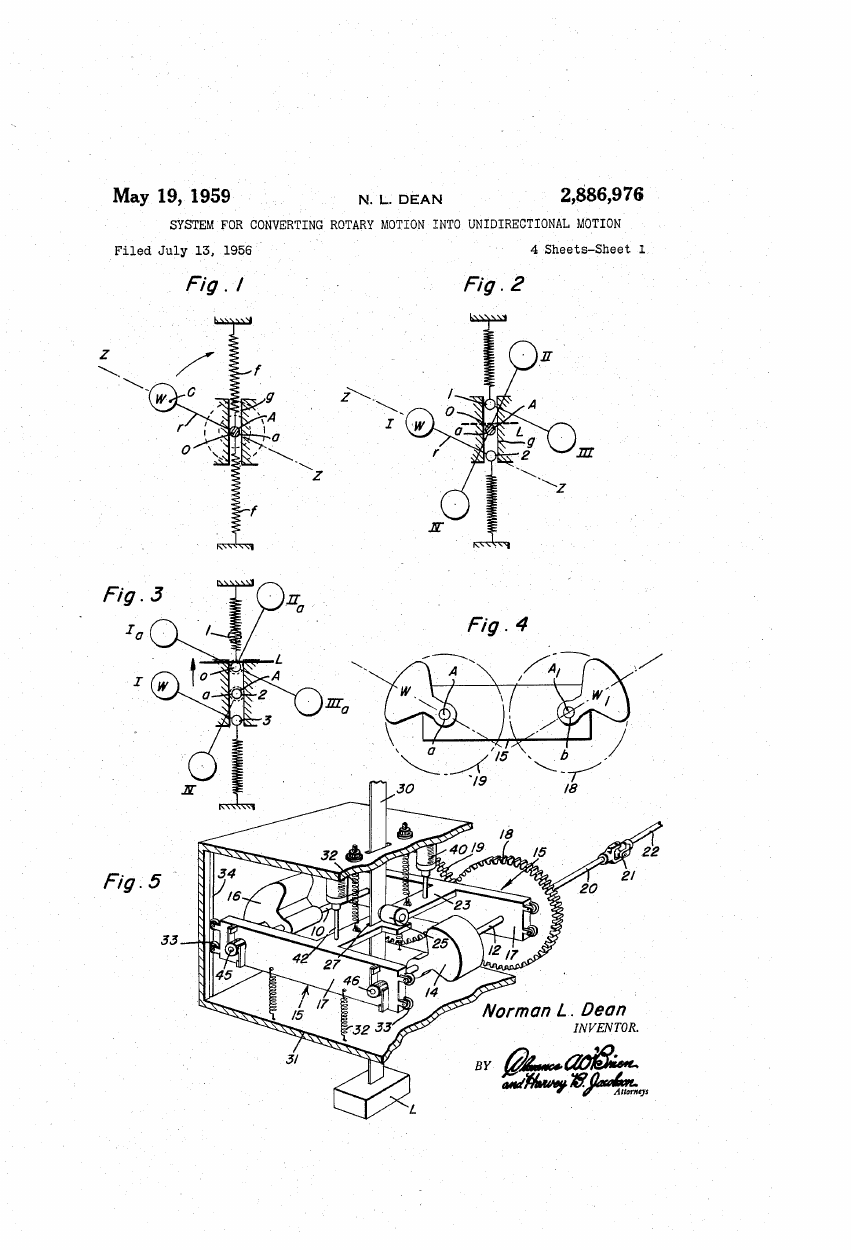
Norman L. Dean, US Patent 2,886,976 (1959) · US government work
What Dean claimed, and how it was supposed to work
Dean maintained that his apparatus generated a unidirectional force without pushing against anything. How the machines he demonstrated were meant to do this is poorly documented. The Wikipedia article on the Dean drive, in a passage it marks as lacking a citation, says that Dean hoped to sell the technology and was guarded about its workings, and passes on a loose description of the insides: weights that spun in an asymmetrical arrangement, and a lot of shaking when the machine ran. The two patents discussed below do disclose designs, but the demonstration machines are described as different from those, and Dean apparently never revealed how they were built.
The theoretical case was thinner still. Dean did not back the claim with a rigorous theory. He and John W. Campbell, the magazine editor who promoted the device, are said to have held that Newtonian mechanics is incomplete and that Dean had hit on an additional, fourth law of motion, described as a nonlinear correction to one of Newton's laws.
The most developed explanation came from a witness, not from Dean. William O. Davis saw a demonstration and found Dean's own account of the mechanism unconvincing; his notebook records a decision to look for a theory in which the drive could exist without contradicting other known facts. The result appeared in Analog in May 1962 as "The Fourth Law of Motion". It proposed that momentum might be conserved invisibly, through what Davis called gravitational-inertial radiation, and that bodies might respond to action and reaction forces out of phase with one another.
What witnesses reported
The demonstrations are described as private and under Dean's control, and none of the reports that follow is a measurement. The Popular Mechanics report and Davis's 1976 article, in particular, are relied on here as later accounts summarise them: they are secondhand summaries of private demonstrations. The reports fall into two kinds of effect, plus the testimony of people who were not shown anything.
A machine that seemed to lose weight. John W. Campbell, the longtime editor of Astounding Science Fiction (renamed Analog under his editorship), said he had watched the device run on a bathroom scale, with the reading appearing to drop when it was switched on. He published photographs of the scale with the drive stopped and running. The June 1960 cover of the magazine showed a United States submarine near Mars, supposedly carried there by a Dean drive.
A machine that seemed to push or pull without recoil. Davis's June 1976 Analog article is reported as describing a version of the machine that pressed against a hand without moving, although the same push from the hand shifted it easily once it was switched off. Davis, who visited Dean with G. Harry Stine after Campbell's first articles, saw that demonstration himself, and wrote that both men concluded "we had witnessed a real anomaly and that the possibility of fraud in the demonstration was slim." A representative of Popular Mechanics was also given a demonstration; the magazine's piece ("Engine With Built-in Wings", September 1961) is summarised as reporting a suspended device that drew a load toward itself without being drawn toward the load in turn.
People who asked and saw nothing. Jerry Pournelle recounts that in the 1950s, while working for an aerospace company, he approached Dean about buying the device. Dean's terms for showing it were money up front and a promised Nobel Prize; the company was unwilling to pay and never saw a model. The claim that representatives of 3M came away with a similar result at about the same time is itself secondhand, reported by way of Pournelle's account. Pournelle came to believe the device had never worked, and remarked that Stine, though well qualified to judge, was more gullible than others.
What was actually tested
Three kinds of checking appear in the record, and none of them was an independent measurement of a machine Dean demonstrated.
Davis and Stine's own apparatus. Davis's hypothesis predicted a lag between action and reaction, so Stine, an engineer, built devices of his own to look for one. The programme was short: it ended in 1965, when the national economy turned down, and Davis's 1976 article "Detesters, Phasers and Dean Drives", which reported the results, was also his case for taking the experiments up again, a case that apparently went unanswered. The outcome that article reports is mixed. With a straight-line arrangement, Stine said, a phase angle of 3 degrees appeared repeatably, something conventional physics would rule out. When the pair moved to a pendulum arrangement, using a ballistic pendulum driven by a rocket, the effect did not show up.
The pendulum test of Dean's machine. As the 1976 article is reported, hanging the original drive from a pendulum would have been the decisive test, and by Davis's account Dean refused to allow it. Campbell reported having seen one; Davis and Stine doubted this, suspecting that Campbell was passing on Dean's word and had not seen the test himself. Davis's position was that nothing could be decided until the test was made.
The patents and similar designs. Dean was granted two United States patents: 2,886,976, a "System for converting rotary motion into unidirectional motion", and 3,182,517, a "Variable oscillator system", granted on May 11, 1965. The patent record summarised in US Patent 2,886,976 (1959): Norman L. Dean's System for Converting Rotary Motion into Unidirectional Motion gives 19 May 1959 as the grant date of the first, while some secondary accounts give 9 May 1959. These are the only designs for which Dean disclosed details, and according to Davis's 1976 article the disclosure is too incomplete to build a Dean drive from. A patent is in any case a record of a claim, not a test of it. Analysis of the kind set out in the 2006 NASA memorandum covered in Responding to Mechanical Antigravity (2006): Millis and Thomas on Why Oscillation Thrusters Like the Dean Drive Only Appear to Produce Thrust concludes that neither Dean's patented designs nor the many similar ones can produce net directional thrust in free space.
The physicist Russell Adams came to a matching view by a different route. For his Analog article "The Bootstrap Effect" (April 1978) he went through reactionless-drive patents held at the US patent office, 50 or more of them, and studied how each was meant to work. His verdict was that all of them depended on rubbing against the surface they rested on, which would leave them useless in space.
How analysts explain what the witnesses saw
Two effects need explaining: a scale reading that fell, and machines that moved or resisted being moved.
For the scale, later analysis by the NASA memorandum's authors and by the physicist John G. Cramer points at the instrument. A vibrating machine can interact with a scale's springs through friction and resonance, and that interaction is named as the likely cause of the lower reading Campbell and others reported. Cramer, in his Analog column "Alternate View" in 1997, called the demonstration to Campbell faulty and the drive bogus.
For the motion, the explanation analysts give is stick-slip friction: the resistance between the device and the surface beneath it is unequal in the two directions, so the vibration carries the device one way. The NASA memorandum, which treated the Dean drive as the best-known oscillation thruster, held that such machines need a frictional connection to the ground, with the ground serving as their reaction mass.
What the record does and does not show
The witnesses' impressions, including Davis and Stine's conclusion that they had seen a real anomaly, are observations made at private demonstrations that Dean controlled, with no independent measurement behind them. The explanations later analysts offer, scale artefacts and stick-slip friction, are in turn inferences from how such machines behave, not measurements of Dean's own machines.
The negative side of the case is also a matter of reports, not of independent documentation. That Dean refused a pendulum test of his own machine is Davis's account, from the 1976 article. That no working model was shown publicly or independently analysed, and that Dean offered no rigorous theory, is how the Wikipedia article on the drive sums the matter up. The finding that the patented designs and many similar devices cannot produce net thrust in free space comes from the 2006 NASA memorandum and the secondary account that relies on it; as Responding to Mechanical Antigravity (2006): Millis and Thomas on Why Oscillation Thrusters Like the Dean Drive Only Appear to Produce Thrust notes, the memorandum reports no measurements on Dean's machines. The demonstration machines are described as clearly different from the patented ones, and Dean apparently never patented or explained them. Pournelle is cited for the report that after Dean's death neither those machines, nor any working device, nor diagrams for them were found, so what Dean actually showed his visitors can no longer be examined.
Afterlife of the name
The device's most durable effect may be on vocabulary. The physicist Amit Goswami wrote in 1984 that "it is now customary in SF circles to refer to a reactionless drive as a Dean drive."
Further reading and a note on the 1976 article
The June 1976 Analog article "Detesters, Phasers and Dean Drives" is described in full in Detesters, Phasers and Dean Drives (1976): G. Harry Stine's Witness Account of the Dean Drive and the Huyck Corporation Tests. Its text names G. Harry Stine as the author, quoting Davis's 1960 laboratory notebook at length, and records that Davis died on May 10, 1974; where this page credits the article to Davis, the statements are Stine's. By Stine's account the 3-degree phase angle was seen on oscillating test rigs he called Phasers, the rocket-driven ballistic pendulum was a separate experiment that found nothing, and Dean died in the late 1960s, which differs from the 1972 given above.
Source notes & attribution
- https://en.wikipedia.org/wiki/Dean_drive