Flux capacitance
Schematics and notes from the time-travel archive.
Start here / 9 minute read
John Bajak: 'Flux Capacitance' Time Travel Circuit — Schematics, the Two-Watch Claim and the Love Theory
What the source is
The source dossier reproduces a small dossier of material attributed to John Bajak of P.O. Box 8324, White Plains, New York: a hand-drawn circuit schematic dated 1990 and titled "Flux Capacitance Time Travel Circuit," a short covering letter dated January 31, 1994, an operating manual for a "Temporal Flux Generator," a first-person narrative titled "The 911 Beginning," a letter to a Navy chaplain dated December 3, 1990, and a short theoretical essay, "Time Travel Theory."
The file itself carries the header of BAJAK1.ASC, dated 02/09/96, distributed through KeelyNet BBS (PO Box 870716, Mesquite, Texas 75187), a self-described "free alternative sciences BBS sponsored by Vanguard Sciences," with Jerry Decker as the listed contact and files mirrored at Bill Beaty's amasci.com. The source page also reproduces a later commentary thread from Paranormalis.com ("What is the Bajak Flux Capacitor?") and a set of photographs of a built unit and its components.
The central claim is that a very simple circuit — a battery, an electrolytic capacitor, a piezoelectric transducer and a few switches and controls — generates a "temporal flux" that can accelerate, decelerate or oscillate a target object between past and future. The source presents this as Bajak's assertion and as the subject of informal, unverified replication attempts. Nothing in the document constitutes independent measurement or peer review.
The device as described
The schematic is reproduced in the source as ASCII art, with the following parts list given verbatim:
B1      27 volt source
C1      1200 uF 50V electrolytic
P1      piezoelectric transducer (value uncritical)
S1      charging switch (SPST)
G1      25-ohm rheostat (future control)
G2,G3   switch (SPST) and 1M-ohm potentiometer for past control
The Paranormalis commentary reproduces a slightly reorganized version of the same list and adds a part number for the transducer:
B1 27 volt source
C1 1200 uF 50V electrolytic
P1 Piezoelectric transducer (273-073) (value uncritical)
S1 Charging switch (SPST)
G1 25-ohm rheostat (future control)
G2 1M-ohm potentiometer for past control
G3 Switch (SPST)
The transcriber of the original ASCII file flags an unresolved ambiguity in the schematic: "I don't know whether G1 and G2 are really supposed to be a rheostat and a potentiometer, or both rheostats, or both pots. He refers to two rheostats elsewhere, and I was just going to call them pots until I remembered that rheostats would have some inductance." This ambiguity is never resolved in the source.
The operating instructions are given verbatim as:
Instructions for Use of Temporal Flux Generator: With batteries installed, Depress switch for 3 to 4 seconds, Release for 3 to 4 seconds; Repeat as necessary.
The manual adds that the transducer output should be pointed "toward the person or thing you want changed," that the target "will begin oscillating between past and future," and that the generator "is more powerful during Nighttime." It warns against pointing the device at oneself "for any appreciable amount of cycles," claiming that "DAMAGE to your time detection circuits may occur, Damaging your overall sanity," and states that "You may in the course of activation, meet yourself. Do not panic; Be reassured that if you know yourself, Only one of you will survive." These are instructions and assertions in the source, not findings.
The claimed mechanism and the "critical energy" analogy
Bajak's 1994 letter frames time travel by analogy with a nuclear weapon: "to time travel is sort of like constructing a nuclear bomb - but instead of needing critical mass, one needs critical energy to 'break the time barrier'. That energy is 1215.9 microfarads. Play around with it..."
The figure is inconsistent across the document. The 1994 letter gives 1215.9 µF; the theory section gives 1214.9 µF as the "capacitance of time resonance"; the parts list specifies a 1200 µF capacitor. The stated "critical energy" value therefore does not match the specified component, and the two stated threshold values differ from each other.
The mechanism Bajak proposes is that quartz "has the property of negative inductance (in which mass moves in response to charge and vice-versa)," and that when charge is pulsed into a "time resonant capacitor," the crystal "surfs" the time landscape "like a surfer in the sea, carrying mass in its wave along with it." Ordinary time, lacking this negative inductance, "continues in appearance of a continuum, like the general theory of relativity." The source presents this as Bajak's own reasoning; it is not derived from or checked against standard electromagnetism or relativity.
The claimed experiment
The only experimental claim in the source is a two-watch comparison, stated in the theory section:
This has been proven in experiment wherein a quartz piezoelectric crystal has been placed in parallel circuit with a capacitance of time resonance (1214.9 uF) and given DC pulses. At a voltage of 9 volts and 1/2 second pulse frequency and ten second duration, the home clock has been pushed forward within the time field one second as compared with an away clock five feet away. This experiment has been duplicated three times at different voltages and distances. Generally, the higher the voltage, the higher the surf.
No protocol, instrument list, raw data, blinding, or independent observer is described. The claim rests entirely on Bajak's first-person assertion. The stated effect — one second of divergence over a ten-second run at 9 V — is presented without uncertainty estimates or controls beyond a second clock five feet away.
Reported replication attempts
The Paranormalis thread reproduced in the source collects several informal reports, which conflict with one another:
- Blake Bowyer (March 12, 1998) claims a successful build: using "the beeping from a smoke alarm to provide an oscillating input," with the machine placed on top of a watch synchronized to a control, run "for exactly seven minutes," he reports the target watch "was exactly two minutes and seventeen seconds faster then the control watch." No controls, protocol or measurement method are described.
- An April 4, 1998 poster reports a schematic error: "the positive and negative terminals on the battery. The smaller end on the battery schematic is negative, but it is written as positive." The same poster is confused about the past/future control sequence, stating that "you have to hold down the past control THEN press the future control to travel forwards in time."
- A July 16, 1998 poster reports three failed builds: twisted connections, substituted parts (a 1000 µF plus a 100 µF capacitor in place of the 1200 µF, and a 1 M-ohm potentiometer in place of the 25-ohm rheostat), a piezo buzzer instead of a piezo transducer, and a soldered build. The poster lists five possible causes (bad connections, bad parts, incorrect parts, incorrect wire type, faulty wire) and notes "I got no audible noise."
- An October 11, 1998 poster reports watches overheating, hands "warped into a perfect french curve shape," a crystal "shattered in an odd repeating spiral pattern," and a second watch that "merely glowed blue and red and then disolved into thin air." The same poster notes the Earth's rotation and orbital motion and concludes that any time displacement would not "remain in an useful earthly postion," describing the problem as "a 27 dimension problem."
- A May 9, 1999 poster reports no effect on first power-up, then a growing headache when the transducer was aimed at the operator from about a foot away, and finally a burned-out rheostat "with quite the little smoke and spark show." The poster offers a mundane hypothesis: "without a driver circuit, maybe the transducer emits some sort of sound freq. that tends to give humans a headache."
- A March 9, 2007 poster ("Philip Galindo") describes an in-car "experience" at 100 mph, reporting a "subliminal and accoustical roller coaster" feeling, faded signs and older-looking cars, with "The year and date are all the same." No measurement is reported.
The thread also distinguishes Bajak's design from a later, differently attributed document: "The Bajak Report File is completely different from Bajak's original design. For one thing I noticed it was created by Steven Gibbs. I think this is the one where I noticed the value of the capacitor was in millifarads... It also gives instructions to build an electronic switch that takes the place of the manual on-off design switch." The source explicitly separates the two designs; the Gibbs-attributed variant is not Bajak's circuit.
The narrative material
"The 911 Beginning" is a first-person account in which Bajak describes building "an electroshock machine made of batteries, a capacitor, and a switch," attaching a piezoelectric crystal, and perceiving "an electrical and subliminally acoustical roller coaster." He reports headaches, clocks appearing to slow or stop, a television that "started talking to me" and then "exploded," repeated 911 calls, and eventual transport to Florida North Psychiatric Hospital. He also connects his narrative to the disappearance of Deborah Poe from a nearby Circle K convenience store.
The December 3, 1990 letter to Chaplain Cooley at the Orlando Navy Base asks the chaplain to confirm events of June 1, 1990, and describes anxiety over a $700 debt to his father (RADM Sigmund Bajak), a truck "spraying the mall at a high rate of speed with a perfumy chemical which ignited," and a television program "carrying a 1995 copyright which appeared on my home TV screen during a time in the morning when the station was supposed to be off-the-air." Bajak writes that "I am now trying to sort out my memories of that day to determine which events really happened" — an explicit statement of uncertainty about his own account.
A transcriber's note summarizes an omitted December 2, 1990 letter, which reportedly claims travel back to September 9, 1981, a letter written October 22 and read the prior June 4, "some time mess in Central America" about May 1990, and an admonition to "always take popcorn with you on time trips as an offering of friendship." The transcriber notes the parallel to the Montauk story's 20-year cycle.
The "Love theory"
Bajak's "Time Travel Theory" proposes that time is "a wave of Love arising from the light plane," with Love defined as mass in time: "one gram in one second = 1 unit of Love, 1 unit of love = 1 hubert." He states axioms ("The universe as we know it is based on physical quantity 'love'"; "Love is indivisible") and propositions (Love limits communication; Love is infinitely accessible; Love is finitely variable; "A point in the universe is an arc in love-explained space/time"), and gives the expression F(P) = ((f(t), Δt, 1/t)). He derives L = mt², wt = Lvc², and "Capacitance = time constant / resonance," and states that "The solution to an individual time wave is C_b = TC_a / RC_b."
These are asserted, not derived from or checked against established physics. The source presents them as Bajak's personal theory. The wiki treats them as an idiosyncratic, unverified framework rather than as physics; see Bajak "Love Theory" of Time.
Evidence assessment
The evidence in this source is very weak by any external standard:
- The only claimed demonstration is a first-person assertion with no protocol, instruments, raw data or independent observers.
- The replication reports are anonymous or pseudonymous forum posts, mutually contradictory, and include both claimed successes and claimed failures, overheating, shattering and burnout.
- The source itself contains a schematic error (battery polarity) and an unresolved component ambiguity (rheostat vs. potentiometer).
- The "critical energy" figure is internally inconsistent (1215.9 µF vs. 1214.9 µF vs. a 1200 µF part).
- The narrative portions are self-reported experiences that Bajak himself frames as requiring sorting out, and include a psychiatric hospitalization.
- The theoretical framework is not consistent with standard electromagnetism or relativity.
The source therefore documents a claim and its informal reception, not a validated effect. See Bajak Claims vs. Evidence: The Two-Watch Experiment, Replication Reports and the Schematic Error for the claim-by-claim contrast.
Images
The source page includes photographs of a built unit and its components, reproduced here as local media where available:
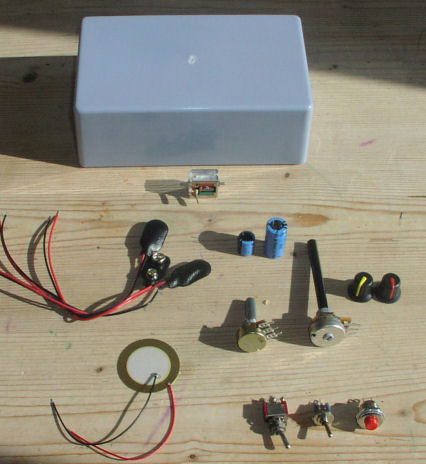
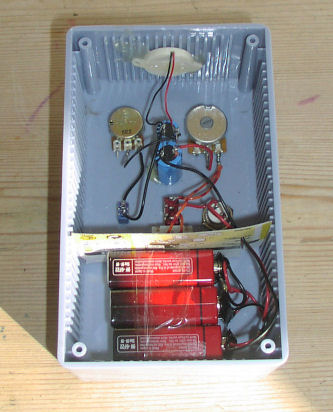
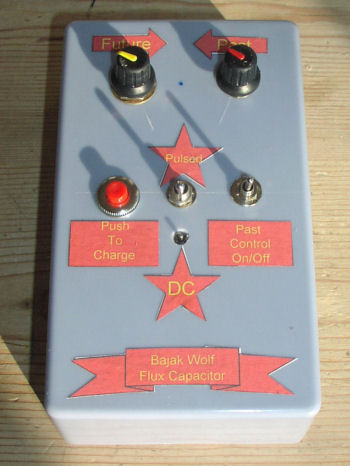
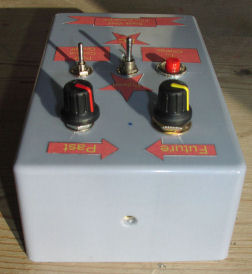
These images document a physical build of the circuit; they do not constitute evidence of the claimed temporal effect.
Related work
The Bajak circuit belongs to a family of archive-sourced time-displacement claims in this corpus, including the Marcum Time Machine and the Chronovisor Claim (Time-Viewing / Retrocognition Devices). It also shares the KeelyNet/alternative-science-BBS lineage with other material in the archive; see KeelyNet BBS. The device itself is described in Flux Capacitance Time Travel (Bajak Circuit).
Source notes & attribution
- Rex Research, "John BAJAK: Flux Capacitor ~ Alleged Time machine; notes & schematics," https://rexresearch.com/BajakTimeTravel/BajakTimeTravel.html (retrieved 2026-09-17).
- BAJAK1.ASC, KeelyNet BBS, dated 02/09/96; mirrored at http://www.amasci.com/freenrg/bajak1.txt.
- Paranormalis.com thread, "John Bajak Flux Capacitor," https://paranormalis.com/threads/john-bajak-flux-capacitor.17924/.
- https://rexresearch.com/BajakTimeTravel/BajakTimeTravel.html
Go deeper.
6 further articles3 min
Flux Capacitance Time Travel (Bajak Circuit)
The "Flux Capacitance Time Travel Circuit" is a small electronic circuit attributed to John Bajak and dated 1990. Bajak asserts that the circuit produces a "temporal flux" that can accelerate, decelerate or oscillate a target object between past and future. The claim is presented in the source as Bajak's own assertion, supported
3 min
Bajak Claims vs. Evidence: The Two-Watch Experiment, Replication Reports and the Schematic Error
This page contrasts the claims made in the Bajak flux-capacitor dossier with the evidence the source actually provides. It follows the pattern used for other archive-sourced extraordinary claims in this wiki, such as Chronovisor Claims vs. Evidence: The Photograph, the Text and the Pseudoscience Classification and comparison-mar
3 min
Time-Displacement Claims
A time-displacement claim is an assertion that an apparatus displaces matter in time. In this wiki the term is used as a descriptive category for the class of claim, not as an endorsement of any instance of it. The category exists so that such claims can be recorded, attributed, and assessed on their evidence rather than absorbe
2 min
Bajak "Love Theory" of Time
The "Love theory" is an idiosyncratic framework proposed by John Bajak in his "Time Travel Theory" essay, reproduced in the source. It is presented here as Bajak's personal theory, not as established physics. The wiki records it because it is the stated theoretical basis for the Flux Capacitance Time Travel (Bajak Circuit) claim
2 min
John Bajak
John Bajak is the claimant and author of the "Flux Capacitance Time Travel Circuit," a small electronic circuit he asserts produces a "temporal flux" capable of altering the rate at which time flows. He is identified in the source by a mailing address at P.O. Box 8324, White Plains, New York 10602-8324, and in a 1990 letter by a
1 min
KeelyNet BBS
KeelyNet was a dial-up bulletin board system that distributed alternative-science and free-energy files in the 1990s. The Bajak flux-capacitor file (BAJAK1.ASC, dated 02/09/96) carries the KeelyNet header, which identifies the system as "A FREE Alternative Sciences BBS sponsored by Vanguard Sciences," located at PO Box 870716, M
The visual record.
9 archived figures · open to inspectThe source room.
Everything readable here stays on StrangewellArchived texts preserve what the source said. They may contain historical, speculative, or promotional claims; inclusion is not verification.
Source text22 min
John BAJAK : Flux Capacitor ~ Alleged Time machine ; notes & schematics
Flux Capacitance Time Travel Circuit \ \ \____________________________________________________________________________
Keep following.
Thematic connections, not evidence of a shared mechanism03 / Time & gravity
The time machine
Trace the story through its diagrams and surviving accounts.
↗12 / Time & gravity
The hyper-dimensional resonator
Explore the device story and its proposed mechanism.
↗13 / Time & gravity
The magnetic portal
A magnet arrangement at the center of a teleportation narrative.
↗